How Mohammed Mossadegh’s Liberal Anti-Imperialism Collapsed
In the 1950s, Iran’s secular government nationalized its oil reserves as part of its anti-imperialist agenda. Its overthrow by the US and UK, enabled by Iranian business and religious elites, paved the way for the reactionary revolution that later replaced it.
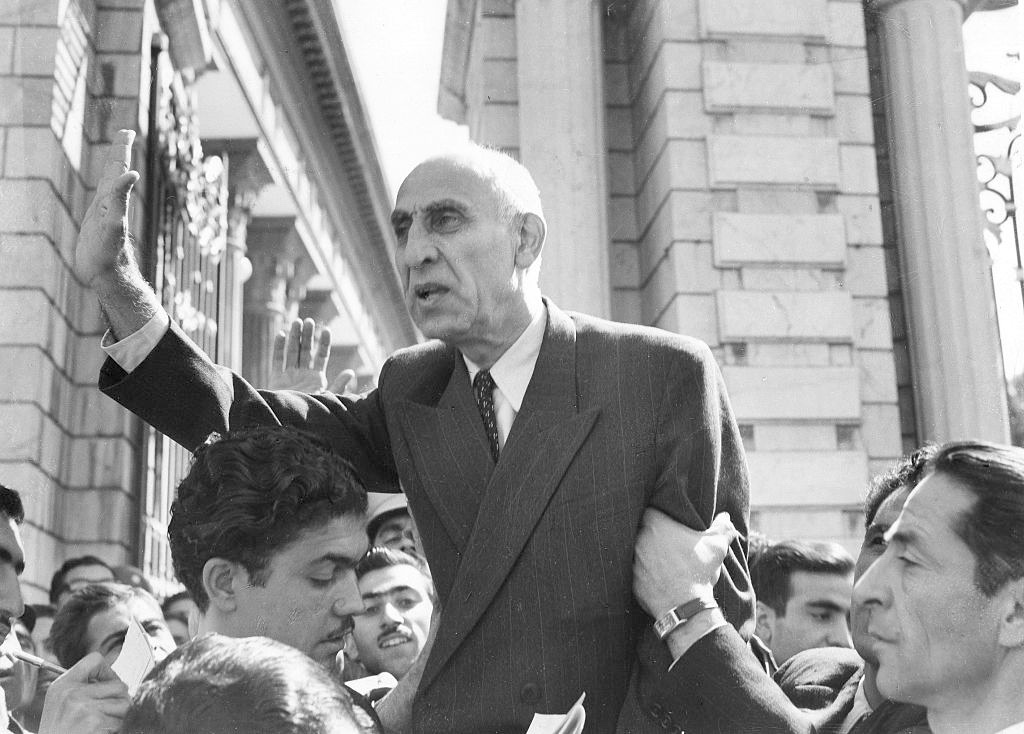
An aristocratic constitutionalist, Iranian PM Mohammad Mosaddegh nationalized oil but was fundamentally unwilling to build institutions of working-class power, leaving Iran’s new secular democracy vulnerable to the 1953 Western-orchestrated coup. (ullstein bild via Getty Images)
For the US government, violently imposing its will on the Iranian people is a generational tradition. The most consequential of those interventions took place in 1953, when US and UK intelligence overthrew Prime Minister Mohammed Mossadegh two years after his government nationalized oil reserves, previously under the monopoly of the Anglo-Iranian Oil Company (AIOC).
Mossadegh, a vector of anti-imperialist sentiment in a country long at the mercy of foreign powers, commanded broad support that encompassed both Marxist organizers and Shi’ite clerics alike. But when the pressures of a British-led embargo and Mossadegh’s plans to restructure the oil industry threatened the interests of Iran’s financial and religious establishment, the unity of the anti-imperial front soon crumbled, and Mossadegh’s refusal to empower a working-class mass movement sealed his government’s fate.
The Fracturing of a Broad Coalition
National fervor initially concealed the fragility of Mossadegh’s liberal-led coalition. He rose to power as the leader of the so-called National Front, a broad coalition of nationalist, pro-democracy, liberal, and socialist tendencies that mobilized for fair elections, freedom of the press, and the nationalization of Iran’s oil economy in the face of a British monopoly and Soviet encroachment. In the heady, patriotic years after its founding in 1949, the movement had been financed and supported by the bazaaris, Iran’s traditional merchant class, who expected nationalization to transfer the oil monopoly from the British into their own hands.
Instead the bazaaris encountered blockade-induced hyperinflation, paralyzed trade, and the dawning reality that Mossadegh intended to place the country’s oil under the control of the newly created National Iranian Oil Company (NIOC), a vehicle for state-led capitalist development whose revenues he would use for large-scale infrastructure projects, public welfare, and a secular education system.
Most of the ulema, Iran’s clerical establishment, similarly abandoned Mossadegh’s coalition when their material interests were threatened. Initially they viewed Mossadegh as an ally, sharing a mutual hatred for foreign, non-Muslim interests that choked Iranian sovereignty. Once the British and Soviets were checked, however, the dominant factions of the clergy viewed Mossadegh as their greatest threat. To them, his vision of a secularized society represented an assault on Iran’s religious identity, while his plans to build a modern welfare state undermined what they saw as their traditional role in providing alms for the poor and containing proletarian unrest.
The British blockade, throttling the revenue from land rents and customary religious taxes, hurt the ulema as much as it did the bazaari — a problem that they largely blamed on the prime minister. While some clerics remained steadfast to the anti-imperialist cause, the ulema’s most powerful strata were prepared to abandon Mossadegh by 1952.
As the British embargo wore down their profits, many Iranian elites demanded a settlement with the British or the Americans, even if it meant allowing Western officials to manage the oil fields — a settlement Mossadegh refused to make. Rather than capitulate to the British or negotiate with a third-party mediator like the Truman administration, the government issued bonds and restricted imports, but it balked at more radical measures like rationing and heavy taxation on the wealthy. The attempt at moderation satisfied few.
Western Spies and the Shah
In late 1951, Winston Churchill’s incoming Tory government accelerated secret plans to forcefully remove the Iranian premier. While President Harry Truman officially refused to participate in an actual coup, he authorized the CIA to undermine Mossadegh by other means. The CIA and MI6, only nominally working toward different objectives, built up a network of key interest groups and oversaw a meticulously planned campaign to discredit Mossadegh through hushed conversations and trusted proxies embedded in Radio Tehran and other media outlets. By the time the Eisenhower administration lent its support to what they euphemistically termed a “countercoup” in early 1953, the oppositional groundwork and money channels were already in place.
Two chief architects of the coup were Secretary of State John Foster Dulles and CIA director Allen Dulles, two of US history’s most fervent backers for subverting any country they decided was too close to the Soviets, driven as much by their own deep ties to the AIOC, the precursor to British Petroleum, as their Cold War ideology. It did not matter that Mossadegh was a constitutionalist liberal who opposed Soviet concessions just as stridently as he opposed the AIOC monopoly. This intervention was driven by more than just revenge for the loss of capital or reflexive paranoia of Soviet influence; it was a corrective, violent measure against a government and movement that threatened the core logic of Western imperialism and capital accumulation.
Western intelligence cultivated potential allies by tarring Mossadegh as a left-wing radical and Russian stooge, but few of those accusations could withstand genuine scrutiny. Mossadegh was, in fact, a liberal reformer who sought to develop a capitalist economy free from foreign imperial extraction, as well as a ferocious critic of the proposed Soviet oil concession in 1944. His frequent clashes with the Moscow-aligned Tudeh Party drove a wedge within the Iranian left, creating a splinter faction that formed the left flank of his National Front in 1948. Nevertheless, Western propaganda provided convenient narratives that Mossadegh’s opponents embraced to further their immediate economic demands on the Iranian leader.
Sensing Mossadegh’s vulnerability and increasingly alarmed by his politics, Iranian reactionaries gravitated toward the shah, a potent symbol for millions among the urban poor and rural periphery and one of Mossadegh’s more dangerous antagonists. Though some of the monarchy’s powers had been circumscribed in the wake of the Anglo-Soviet occupation in World War II, the shah still commanded the armed forces, presided over a court that doubled as safe harbor for anti-government plotters, and wielded the constitutional right to appoint half the members of the Senate, which he used to stack it with landlords, royalists, and rich merchants who systematically vetoed Mossadegh’s reforms.
The shah and the ulema made for stranger bedfellows. The royal father and son had taken measures to weaken the latter’s influence beginning in the 1920s, absorbing traditional clerical domains like education and law into the secular state. In the long term, however, those efforts merely pressured the ulema into adapting and embedding themselves deeper into elite political circles. Older members of the clergy, often drawn from high-status families, used their connections to obtain state scholarships and government offices for their sons, creating a professionalized generation capable of opposing the government from within the state apparatus itself.
Despite this history, Mossadegh’s apparent desire to promote secular nationalism, and more fanciful rumors that he would adopt anticlericalism in the Soviet model, convinced his opponents in the ulema that his leadership posed the most existential threat — one which allowed no room to maneuver. Overcoming their historical animosity, and coaxed by US and British agents, court and mosque willingly made common cause against a prime minister they viewed as a mutual foe.
Western intelligence deliberately stoked the reactionary alliance of the shah, bazaari, and ulema by sending agents provocateurs, disguised as pro-Mossadegh partisans, to threaten religious and business leaders with “savage punishment” if they dared to criticize the government. One Ayatollah Seyyed Mohammad Behbahani, fists full of American cash, dispatched letters bearing the insignia of the Tudeh Party, threatening to hang mullahs from lampposts across the country. Ayatollah Abol-Ghasem Kashani, Mossadegh’s erstwhile ally in his drive to nationalize the oil industry, made subtle but defiant statements that elevated the conflict from a political dispute to a theological struggle.
Western intelligence took particular note of Kashani, a cleric who held particular sway over the urban poor who relied on the mosque’s alms to survive day by day. Kashani, at odds with the government over secularism and domestic power-sharing, was already in the process of breaking with Mossadegh, but the CIA egged him on further with a mix of private solicitations and public subversion, including a flyer that showed a cartoon of Mossadegh sexually molesting the ayatollah.
In the months leading up to Mossadegh’s fall, Kashani did not bother to hide his defection. Prior to a trip to Mecca in August 1952, Kashani, through his ally, the deputy president of the majlis, warned Mossadegh that the parliament might take matters into its own hands should Iran’s economic situation continue to unravel. It was a brazen flex of his status, as Kashani was powerful enough that Mossadegh made no attempt to arrest him as he had with other political rivals.
Stuck in the Middle
Facing total obstruction from the Right, Mossadegh could have relied on left-wing allies like Khalil Maleki, one of the leading Marxist organizers who had split from the Tudeh Party in 1948. But the prime minister, an aristocratic constitutionalist with imperial blood, was terrified of a proletarian uprising and fundamentally unwilling to build institutions of working-class power.
Rather than cultivating an independent, organized mass movement capable of defending his government from its foes, Mossadegh tried only to take control of the royalist armed forces and fight foreign and domestic subversion from the top down, with the fractured and unreliable state as his weapon.
This cast the Soviet-aligned Tudeh Party as the only viable street power on Mossadegh’s left flank, which began organizing rallies in support of the government for fear that its replacement would pose a greater existential threat to Iranian workers. Mossadegh declined to fully embrace them, but neither did he dispel the red-baiting claims of his opponents with a forceful disavowal, and so he ultimately pleased no one.
From pulpits across Tehran, many clerics preached to their working-class congregations a narrative that Mossadegh’s tolerance for secular factions was paving the way for godless Marxism. Others, like the Ayatollahs Mahmud Taleghani and Seyyed Reza Zanjani, maintained that socialist politics, far from acting as a rote, secularizing force, represented Islamic justice in its purest and most egalitarian form. But Mossadegh, believing that religion belonged in the private sphere regardless of its stripe, preferred to fight his battles in the majlis and the Hague rather than elevate progressive clerics.
An emotional speaker in his own right, Mossadegh was hardly averse to mass mobilization, but up to the end of his political career he maintained an aristocratic disdain for the more unruly work of street-level theology and violent resistance. His opponents bore no such compunctions. Through local fixers like the wealthy Anglophile Rashidian brothers, the CIA and MI6 funneled millions of dollars to buy the loyalty of the military officers and street gangs — local toughs, traditional wrestlers, and guild enforcers who long enjoyed the patronage of the bazaari elite and worked with them to enforce control over the markets and neighborhoods. Over the last century, the ulema and bazaari had followed a familiar pattern of joining forces whenever a political crisis threatened their power; now, armed with foreign backing, they prepared to make a crisis of their own.
Completing the Coup
In February 1953, Mossadegh paid a visit to the Imperial Palace to bid the shah and Empress Soraya farewell before they left on an extended European vacation. During the visit, a massive crowd, mobilized by Ayatollah Behbahani’s network of local organizers and royalist gang leaders, gathered outside, imploring the shah not to leave the country out of fear that Mossadegh and the Tudeh Party would seize full control of the state. Kashani, Behbahani, and other clerics personally stoked the fires, with the former loudly despairing that “if the shah goes, everything we have will go with him.” This theater had its desired effect: it cast Mossadegh as devious and power-hungry, helping create a sense of panic among the broader public that any delay in overthrowing the prime minister would result in an irreversible communist dictatorship.
The February crisis proved to the coup organizers that sufficient opposition could be mobilized against Mossadegh. Just to be sure, Western intelligence and their Iranian allies continued to undermine Mossadegh and let the economic stranglehold inflict damage through the spring and summer. Mossadegh then committed a forced error in early August by holding a rigged referendum, in which 99.9 percent of participants voted to dissolve the majlis and give him the power to make laws by executive fiat — a move condemned by even some of his National Front allies as dictatorial and unconstitutional.
Feeling the tide of popular opinion, or at least a critical mass of coercive power, aligning on their side, the CIA and MI6 decided to pull the trigger for Operation Ajax on August 15. To provide the necessary legal cover for the military to move against the prime minister, CIA agents induced the ambitious but terrified shah, hemming and hawing until the last minute, to sign a royal decree (firman) that dismissed Mossadegh and appointed General Fazlollah Zahedi in his place.
The insurrection went poorly. Clumsy execution and warnings by Tudeh infiltrators allowed Mossadegh’s loyalists to uncover the plot, arrest some of the conspirators, and send the shah flying abroad. Tens of thousands of Tudeh-led demonstrators, celebrating the failure of the coup and the shah’s departure, proceeded to tear down royal monuments, call on the government to officially declare a democratic republic or regency council, and clash with the demoralized remnants of the pro-shah mobs. Mossadegh, on the other hand, publicly dismissed the coup attempt as merely the act of a few rogue army elements.
On August 18, the prime minister, insisting that removing the shah was unconstitutional, unnerved by escalating proletarian unrest, and even, at this hour, listening to the US ambassador’s threats to withdraw official recognition of his government, ordered state police to clear the streets of anti-monarchist crowds. This removal of his only organized, working-class defense was just what Kermit Roosevelt — the CIA’s man in Tehran — needed for a second gamble, even after Washington considered aborting the whole operation.
On the morning of August 19, with the militant left nowhere to be seen, hired provocateurs disguised as pro-Mossadegh partisans swarmed the capital, burning and looting their way through mosques and shops. Hours later, a second, larger wave of royalist thugs, led by gang bosses like Shaban “the Brainless” Jafari and backed by soldiers and tanks from the Tehran garrison, violently attacked government loyalists and Tudeh members under the pretext of crushing a supposed “communist revolution” that Mossadegh had already scattered the previous day.
Mossadegh was captured and placed under house arrest for the rest of his life. Most of his closest associates were imprisoned in less comfortable conditions; others, like his foreign minister, Hossein Fatemi, were tortured and executed. Zahedi assumed the premiership, the shah reclaimed his power, and the Anglo-Iranian oil company was safely reorganized into a Western consortium.
Mossadegh died in 1967, while still under house arrest. Ayatollah Zanjani, the progressive cleric he had kept at arm’s length, personally washed his body and performed the customary prayers as the former prime minister was laid to rest under the dining room’s floorboards.
Over his twenty-six years in power, the shah would ruthlessly crush all domestic dissent using SAVAK, a notoriously brutal secret police force trained by the CIA and Mossad. The United States and UK had pulled off a cynical intervention that secured their oil, placed a friendly regime in power, and destroyed Iran’s pro-democracy opposition. In doing so, they offered a costly historical lesson that liberal anti-imperialism, terrified of its own working class, cannot withstand the power of foreign capital and domestic reaction. Mossadegh’s failure ensured that the next anti-imperialist revolution and regime would be of a wholly different character.
In the face of US and Israeli aggression, that reactionary regime, itself a bitter outgrowth of imperialist overreach, demands submission while violently subjugating women, crushing dissent, and siphoning wealth into a militarized state-capitalist hierarchy. US-led economic sanctions and proxy warfare, and now open war and a naval blockade — all justified as an attack on an inhumane government — serve to further injure the Iranian people and insulate a ruling class eager to proclaim itself their shield against a foreign enemy. Yet mass uprisings and strikes across Iran that began last December, steadfast in their opposition to both the ruling theocracy and the United States, have proved that even the most violent crackdowns and calculated appeals to national unity cannot easily overcome a population pushed to its breaking point.