Meet Rae Huang, the Progressive Pastor Running for LA Mayor
Reverend Rae Huang is running for mayor of Los Angeles on a platform to expand the public sphere: social housing, free buses, a public bank, and public movie theaters. She explains how her political vision was shaped in part by her Christian background.
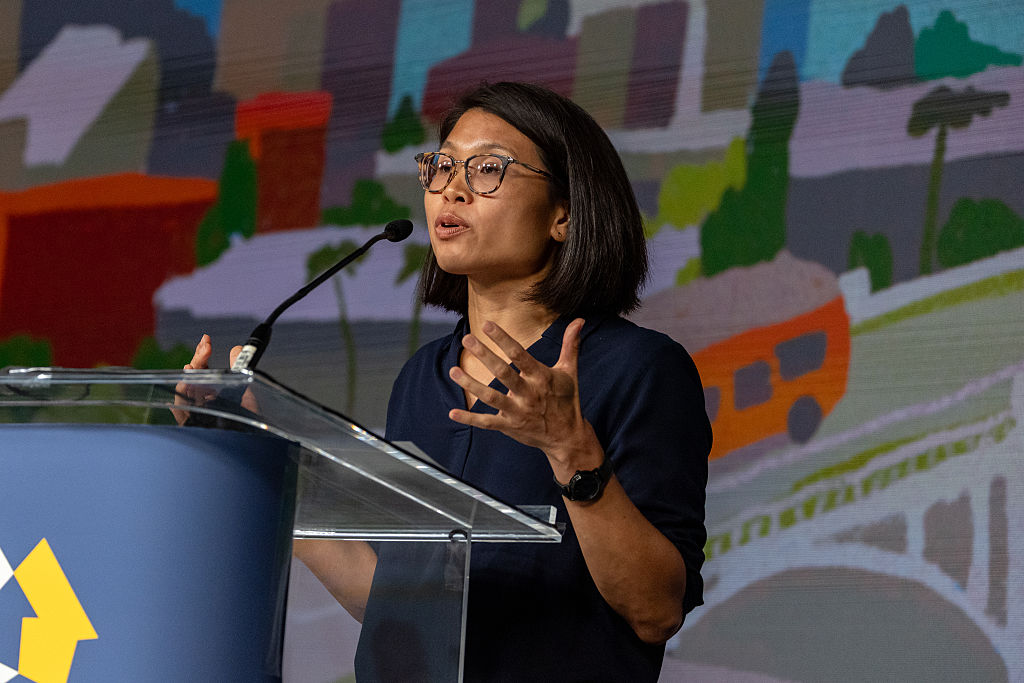
Growing up in the church, Reverend Rae Huang volunteered at soup kitchens. Then she began to ask: Why do the same people keep coming back? The answers led her to run for Los Angeles mayor on a progressive affordability platform. (Jason Armond / Los Angeles Times via Getty Images)
- Interview by
- Ben Burgis
Rae Huang is a pastor and community organizer. She’s been a visible presence in the landscape of left-wing activism in Los Angeles for many years, and now she’s running for mayor.
Most progressive voters I’ve talked to seem to agree that Huang would be their first choice (and the somewhat more moderate Nithya Raman their second choice) if elections here used ranked-choice voting. Since they don’t, many are anxiously eyeing the polls and weighing a pragmatic calculation that Raman has a better chance of making it into the runoff against the hope for a Huang breakthrough.
Whatever you make of these debates about horse race and strategy, though, I thought Huang laid out a compelling vision of how the city could and should change when we spoke earlier this week. This transcript has been edited for length and clarity.
Ben Burgis
I know a big part of your platform is about housing. Let’s start there.
Rae Huang
We need to build out socially owned housing where you pay based on your income instead of what the landlord feels like raising rent to that year. So maybe when you started renting, it was 30 percent of your income. Then after ten years, it’s now 40 percent of your income, and it’s going to keep going up, right? And eventually you get forced out.
What we need to do is to move housing out of the speculative market and into the hands of community land trusts. We need to support the development of co-ops and shift resources toward public housing. There are all these tools that we can use to get there.
There’s the Tenant Opportunity Purchase Act and the Community Opportunity Purchase Act, right? Basically, an “Opportunity Purchase Act” is when you give first right of refusal to a particular stakeholder instead of offering it first to a developer hoping to flip those units and sell them at market rate. So the Tenant Opportunity Purchase Act is when you allow tenants in the building to buy it. The Community Opportunity Purchase Act allows communities — mission-driven nonprofits, community land trusts, that kind of thing — to buy those buildings.
Land banking is another tool where, when land becomes available, the city can purchase it and add it to our land bank. Right now, we’re mostly doing the opposite. We’re selling city land left and right to generate revenue, and we’re losing this extraordinarily important resource that we have so little of. If we hold onto it, and if we actually expand our bank of property, of land held in the public interest, then it ensures that people have a place to live. Let’s say thirty years from now we have a smaller population, and instead of housing, what we really need is libraries or parks. The more that we are able to retain in the land bank, the more we can ensure that we’re providing for the public good.
Ben Burgis
And that’s just one part of your focus on infrastructure.
Rae Huang
Clean and green infrastructure. And under that, I talk about fast and free buses. Zohran Mamdani pitched this as well for New York. They’re struggling politically to make it happen, but it’s a great idea. And the crazy thing here is that in Los Angeles, the cost of fare collection is honestly about the same amount of money that we’re collecting in fares right now. They basically cancel each other out.
Also, the majority of assaults on bus drivers happen during altercations about fares. We can end that. And then for remaining safety issues, we already have a model of traffic ambassadors, which is different from armed police. Traffic ambassadors walk around the bus to make sure everybody’s safe. Somebody’s having a panic attack, they can help that person. Someone’s lost, they can help that person.
Ben Burgis
From a public safety perspective, devoting police time and resources to making sure people pay their fares seems crazy.
Rae Huang
Seems nutso! And we’re paying money to do that when we could make the fares free. And at the same time, research has shown that if you make buses free, you’ll increase ridership by 30 percent. That’s huge for safety. A busy bus is a safe bus.
Ben Burgis
People think of LA as a car city. . . .
Rae Huang
Yes. But I’ve talked to so many people who didn’t have cars when they first moved to LA. Maybe they were coming from other cities with better public transportation, or maybe they just didn’t want to spend the money. And so they actually start off riding transit. The reason they switch, the reason they decide they need a car, is because of the state of our transit system.
Ben Burgis
And the busier the buses are, and the more of these traffic ambassadors there are, the more comfortable people feel taking them.
Rae Huang
Exactly. It just becomes part of the culture of the city of Los Angeles.
Ben Burgis
Speaking of Los Angeles culture, one thing that might surprise people is your proposal for public movie theaters.
Rae Huang
We’re losing the culture of going to the movies and watching them on the big screen. Everyone’s just watching things at home now. The city buying up some theaters so that we can actually host and support our local industry, the film industry, can be part of how we shift that culture back. People in LA should actually be able to afford to see the movies made here.
Ben Burgis
That one definitely speaks to me! But let’s maybe switch gears to some bigger issues.
Rae Huang
Let’s talk about the public bank!
Ben Burgis
Yes, please.
Rae Huang
There is a public bank in North Dakota, and roughly nine hundred public banks worldwide. We know public banks work. And having a city-owned bank would mean the city could take out major loans for our infrastructure — money we would otherwise pay to line the pockets of a private bank on Wall Street. And it would allow us to provide smaller loans to small businesses and even microloans to vendors like Angelenos with food trucks, who often struggle to get funding. These are ways that we can immediately help support our own. And of course, when the money comes back, then it’s actually growing our municipal coffers. It’s kind of a no-brainer.
Ben Burgis
While this has obviously been a conversation about local issues, we also can’t avoid the national context. Last year, anti–Immigration and Customs Enforcement protests led Donald Trump to send federal troops to occupy Los Angeles. That could happen again, especially with a robustly left-wing mayor. Trump has a consistent pattern of these kinds of authoritarian crackdowns in cities and states that are controlled by his political enemies.
Rae Huang
The way I see it is that Donald Trump responds to leaders who step up and stand up to him. If you are a pushover, he’ll just keep pushing you over to get what he wants. But in Chicago you saw the mayor stand up to Trump, and eventually he gave up. I think Trump respects people who don’t back down — and, more importantly, so do Angelenos.
Ben Burgis
I want to end on a more personal note. You are a pastor, and you’re running to lead a big pluralistic city of people of all faiths — including lots of people like me who are nonbelievers. I’d love to hear about how your religious faith informs your perspective.
Rae Huang
My faith is very personal to me. It grounds me.
I haven’t spent my life thinking that I want to run for mayor of the second-largest city in the nation. What I have always felt called to do, though, is to serve people, and to serve God by serving people.
In Sunday school, you learn to love thy neighbor, care for the orphans, care for the widowed, care for the unhoused. That is the theme throughout the whole Bible. It’s not whether or not you’re gay, it’s not whether or not to have an abortion. It’s concern for the poor.
When you start off in church, you maybe go to the soup kitchen. And then, as you get older, you begin to ask: Why do the same people keep coming back? Why are they still hungry? It’s because they don’t have enough money. And then you ask: Why don’t they have enough money? You just keep asking these why questions. And then eventually, you realize: this is a solvable issue.
Ben Burgis
There’s a classic quote that I’m sure you know from Archbishop Hélder Câmara, where he says, “When I give food to the poor, they call me a saint. When I ask why they are poor, they call me a communist.”
Rae Huang
I’ve got that quote on my wall. It speaks so much to my experience of growing up in the church and then asking the why questions, which has led me to where I am today. At the end of the day, I am not running for office because I care about being a politician. I’m running for office because I know that our communities desperately need radical change.