A Pro-Palestine Lawmaker Accused of Supporting Terror

Rima Hassan

The recent highly publicized arrest of France Insoumise lawmaker Rima Hassan was the latest step in a campaign to vilify her. She spoke to Jacobin about the criminalization of Palestine solidarity.
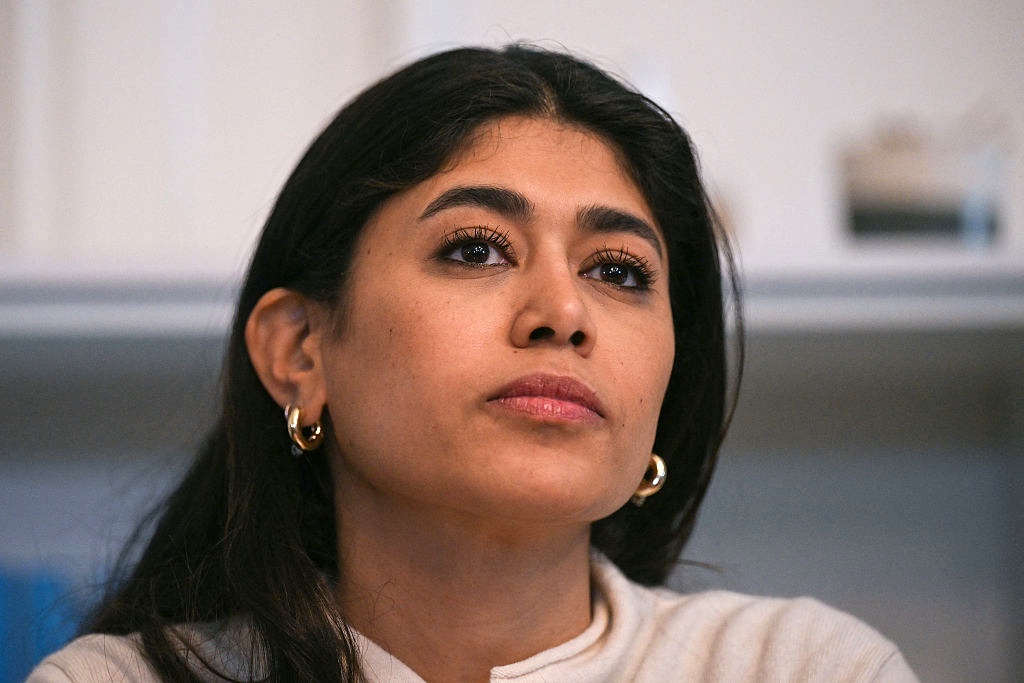
An image of Rima Hassan's face.

Rima Hassan’s arrest and court case are the latest in a long list of attacks on Palestine activists in the West. (Blanca Cruz / AFP via Getty Images)


Interview by
Christophe Domec

“It’s the first time the police has sought this type of charge for a tweet,” Rima Hassan explained, a month after she was arrested and held in custody for charges relating to “terrorism apologia.”

A post on X on March 26 earned Hassan, a leading voice in the Palestine movement and a prominent figure in the left-populist France Insoumise party, an investigation by the Paris district court ultimately leading to her widely covered arrest on April 2.

The police had received complaints after she shared a quote by Kōzō Okamoto, a member of the Japanese Red Army who took part in the 1972 attacks on Tel Aviv airport, killing twenty-six people.

“There was a desire on the part of the court to overlook my parliamentary immunity and to secure my arrest,” Hassan said, adding that she was deliberately targeted with a “flagrant délit” charge, usually reserved for people caught in the act of committing a crime.

Elected officials in France, like Hassan — a member of the European Parliament (MEP) — usually receive immunity, protecting them from being held in custody — but a flagrant délit charge is one of the few exceptions.

The last time MEPs were arrested and taken into custody was during the “Qatargate scandal,” when police raided parliamentary properties and seized over €1 million in a cash-for-influence scheme.

“It seems extreme that I would face the same type of charge for a tweet,” Hassan, a lawyer and jurist, told me.

Her arrest and court case are the latest in a long list of attacks on Palestine activists in the West, she added. “It is not an isolated incident. It fits into a global context of repression of these voices.” This rings true for Hassan herself, who has fast become one of the most recognizable politicians in Europe advocating for Palestinians’ rights.

Born stateless in a refugee camp in Syria before coming to France at age nine, she has always said her experience as a child of the Nakba informs her role in politics. “I’m an activist with a cause to carry. I’m not here to smooth things over,” she said.

Her record shows it, too. This year alone, she stood out as one of the loudest voices advocating against the Yadan Law, a bill which would have seen France effectively ban criticism of Israel.

Hassan also launched the European Citizens’ Initiative (ECI) to suspend the EU-Israel free trade agreement, which broke records when it received over a million signatures in three months.

But her activism goes beyond her role as an elected official. Last year, Hassan joined the Freedom Flotilla Coalition in its mission to bring life-saving medical supplies and food to Gaza, an action for which she was detained by Israel alongside activist Greta Thunberg.

This is why she has become a target of the courts, the media, and the government, she explained. In the past two years alone, there have been a total of sixteen investigations into Hassan’s words. The recent charge leading to her arrest saw police going many steps further than they had before. While most of those sixteen complaints were dismissed on first examination by the court, prosecutors resorted to more radical measures for the Kōzō Okamoto post.

In the weeks following the arrest, investigative online platform Mediapart revealed prosecutors had tracked the MEP’s phone, requesting records of her location dating back three months. They also asked the French national rail company and Air France for Hassan’s travel records, before seeking further information from Europol.

For Hassan, it’s yet another chapter in a long series of attacks by the French establishment, both from the billionaire-owned media and members of Emmanuel Macron’s government.

For days following her time in custody, the main story that ran on CNews, a twenty-four-hour Fox-style news channel owned by conservative businessman Vincent Bolloré, was that she supposedly had illegal drugs on her — an unconfirmed detail leaked to the press while she was still in custody, later reiterated by prosecutors. Several days later they cleared her of all drug charges after tests proved she only had a small amount of CBD on her person.

“It’s a war in the media as well: ‘Rima was arrested’ — that is an image that allows people to believe I have done a very bad thing,” she said.

Hassan’s status as the establishment’s favorite pariah was perhaps best exemplified by the numerous calls from hard-right and conservative politicians to have her stripped of her French citizenship for defending the rights of Palestinians in the face of genocide and colonization.

Last year, Bruno Retailleau — today leader of the conservative Les Républicains and at the time France’s interior minister — joined the calls for her denaturalization.

For Hassan, the reasons for the charge of “extremism” against France Insoumise are clear. “The issue is not that we are demanding the retirement age be moved back down to sixty. What we have not been forgiven for is our line on the Israel-Palestine conflict.”

Following her arrest, Hassan spoke to Christophe Domec for Jacobin to discuss the fallout of the scandal, her formal complaint with the French broadcast regulator over false reports of drug charges, and the repression of pro-Palestine voices in Europe.


Christophe Domec

You have said this is the first time an elected official in France was held in custody over an online post. Why do you think prosecutors sought these unusual charges in your case?

Rima Hassan

I’d call what’s happened to me as political and judicial harassment.

The Paris Court is linked to the government. Whether we like it or not. It’s linked to the Ministry of Justice. And it was the speaker for the ministry himself who leaked information about my arrest to journalists. Every statement he made while I was in custody had to do with supposed synthetic drugs in my bag. So the spokesperson for the Ministry of Justice is implicated.

The first report made about the Kōzō Okamoto tweet was made by the Paris police prefecture under the orders of the interior minister. The second report was a far-right MP. And there were two more reports to the police that were made while I was in custody because they found out. Like vultures, they swooped in. Those were submitted by the OJE [European Jewish Organization] and the LICRA [International League Against Racism and Antisemitism].

So, you have the involvement of the Ministry of Justice, the involvement of the Ministry of the Interior, and all these pro-Israeli lobbies that for two years have been participating in this harassment. Their objective is to obtain a conviction.

I am truly being surveilled, and oppressed.

Starting with these sixteen police complaints against me in the span of two years — that’s a complaint on average about every month and a half. And those are just the ones prosecutors have decided to examine; there are others that were dismissed immediately.

There was a desire on the part of the court to overlook my parliamentary immunity and to secure my arrest.

It’s also a war in the media as well. “Rima was arrested” — that is an image that allows people to believe I have done a very bad thing. In reality, being held in police custody is common procedure for this type of charge [flagrant délit]. But it’s the first time police sought this type of charge for a tweet.

The last time an MEP was charged with a [flagrant délit] was during the Qatargate scandal, when elected officials were found with suitcases full of cash given to them by Qatar. That’s a case of [flagrant délit] — they were found with cases full of money, that’s corruption. That means they were not protected by parliamentary immunity. It seems extreme that I would face the same type of charge for a tweet.

Christophe Domec

What other complaints were made against you?

Rima Hassan

Paris district prosecutors have considered claims against me simply for citing a poem by Mahmoud Darwish.

There was one for using the word “uprising” when referring to the student “uprising for Palestine” and I was made to appear [at the police station] where I was asked if I instead meant to use “intifada” and suggested I was calling for an insurrection in France.

There was another [complaint] when I quoted Frantz Fanon. The Court of Paris decided to investigate it, and I was interrogated. It was eventually dropped.

So, there are some complaints which do not hold up: at least thirteen don’t hold up. But in my view, none of them do.

Christophe Domec

What do these attacks on your statements through the courts mean for the broader movement for Palestinian liberation in Europe?

Rima Hassan

Today we’re dealing with a situation where leaders are ready to sacrifice democracy, the rule of law, individual freedoms, and freedom of expression in order to protect an order — a colonial order — which is one of unconditional support for the State of Israel.

We are facing an authoritarian drift. And it goes beyond Palestine. We are now in a struggle to preserve the rule of law. It is being sacrificed. Today it is affecting me, but who’s to say that in a little while it won’t affect journalists, trade unions. That’s what’s at stake.

Christophe Domec

Since the arrest and the widely reported but false information that you were in possession of illegal synthetic drugs, your lawyer has lodged a formal complaint with France’s broadcast regulator, Arcom. Why did you think this was important?

Rima Hassan

During my custody, information was leaked. Police officers — but I also believe the spokesperson of the Ministry of Justice — released information to journalists and, without showing any caution, mainly did suggest I was in possession of drugs. That’s where the misinformation started.

The prosecutor’s communiqué came out at 11 p.m. after my release from custody. But the information was already in the press from early afternoon. So it had leaked beforehand. That’s why I referred the matter to Arcom.

But prosecutors also failed to rebut those drug allegations [when they found out the tests came back negative]. They waited until April 9 to issue their own release to the press. That’s six days [after the results came back], even though they knew.

Christophe Domec

What else do you think has been misconstrued about your arrest?

Rima Hassan

The most important thing is to place it in the context of this harassment campaign involving all these reports to the police.

This latest one that led to me being held in custody comes after fifteen previous complaints. It comes with the involvement of the Interior and Justice Ministries — with the drug report coming directly from the police prefect. And the information leaked from the spokesperson of the Ministry of Justice.

Then, we still don’t know who gave the orders to track my movements over a period of three months. That requires collaboration between services across different ministries. It’s undeniable.

There was also the circumventing of my parliamentary immunity through the [flagrant délit] charge. In all other cases, I benefit from immunity and it would have to go through a procedure at the EU Parliament level.

Christophe Domec

Why do you think you have become the target of such intense attacks both in the courts and in the media?

Rima Hassan

There has in fact been a media campaign targeting me on two fronts: first, for the pro-Palestinian voice I carry, and second, for my work in France Insoumise. The issue is not that we are demanding the retirement age be moved back down to sixty. What we have not been forgiven for is our line on the Israel-Palestine conflict. That’s what’s at stake. That’s the moment the tide turned.

In previous police interviews, as well as this one, I got these absurd questions, which showed ignorance on the subject of Palestine and the caricature that has been made of Palestinians. Pro-Palestinian voices and Palestinians themselves — if you’re actually Palestinian it’s even worse — are always treated as suspect.

Even in the Arab world, as enemies within, [Palestinians are thought to be] a somewhat uncontrollable people who, throughout history, with whatever little means they had, managed to do things that shook the world. And I think there’s a kind of fear, and a suspicion, that is amplified and that is indeed colored by state Islamophobia. That’s for sure.

Christophe Domec

Do you think the characterization of France Insoumise has changed since the killing of the neofascist Quentin Deranque in Lyon in February? It seems like accusations of the party being violent have increased since then.

Rima Hassan

This was already the case before the Deranque affair. There were already repeated controversies around France Insoumise. We were accused of being disruptive, antisemitic, etc. But what was truly unforgivable [for parts of the media and the establishment] was this split on the Left around the genocide in Gaza.

Broadly speaking, the traditional left in France is in part still a Zionist left, let’s be honest. You have many voices in the Parti Socialiste who are openly Zionist, many of whom express unconditional support for Israel. What upset the Parti Socialiste is that I broke all those taboos on the Palestinian question. Armed struggle, right of return, Zionism, and the last taboo I have helped blow open is the [supposed sanctity of the] two-state solution.

I no longer believe in it, and I’ve finally managed to convince France Insoumise to create a working group, which I will coordinate and will launch in September. It will serve to think through alternatives to [the] Oslo [Accords] with a group of experts.

It’s the heart of the Left’s problem, which is that they want to be pro-Palestinian but only engage in very polished, very humanitarian discourse that is not at all political.

I’m on the radical left. I don’t base my approach to these issues on France’s political structure. I’m an activist with a cause to carry. I’m not here to smooth things over. That’s not my role.

Christophe Domec

How can we push the Left to reframe their narratives around the conflict?

Rima Hassan

This ultimate refusal to hear Palestinian political voices means we are completely blinded. We won’t understand this struggle unless we understand that these are refugees who have been in constant revolt ever since [the Nakba].

If we don’t understand that, for example, why [Yahya] Sinwar’s memoirs written in prison say, “I am a refugee, I am someone from a family that was dispossessed” — as long as we do not have a response to the question of reparation, you will always have situations like these.

I myself am living proof. I haven’t gone through what Gazans have. I’ve had the privilege of a second exile, a Western passport.

But there is not a single day in my life when I don’t think of myself as a Palestinian refugee, coming from a history of dispossession, whose family is buried in a refugee camp, who lived through that humiliation across multiple generations, who knew the loss of a homeland, who knew uprooting.

And regardless of the status of Palestinian refugees — whether they’re in camps, in the diaspora, in Gaza, internally displaced — they continue to claim this right of return.

As long as leaders do not hear Palestinian voices, they will always fall short of any solutions.