Abdallah A., a Nonperson Because of His Instagram Posts

Abdallah A. lived in Germany since he was two months old and last year gained German citizenship. But now he’s been stripped of it because of pro-Palestinian Instagram posts, in a disturbing legal case that points to the rise of citizenship-on-probation.
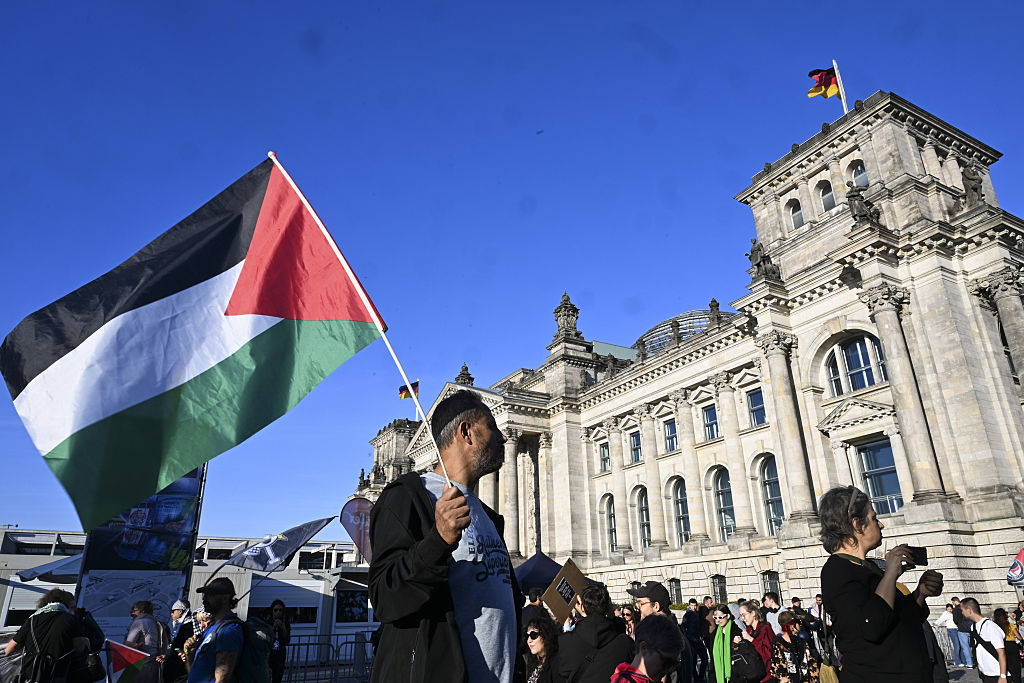
A man holds a Palestinian flag in front of Berlin's Reichstag government building.

Right-wingers successfully lobbied for a person to be stripped of German citizenship because of his pro-Palestine Instagram posts. (Halil Sagirkaya / Anadolu via Getty Images)


Abdallah A. was born in Lebanon in 1990, but from the age of just two months he lived in Berlin with his Palestinian family. Germany is where A. grew up, went to school, worked, and waited to become a German citizen. In September last year, he finally received a German passport. But only a few weeks later, the state of Berlin revoked his citizenship.

The trigger was a series of press inquiries sent to Berlin authorities, including the State Office for Immigration (LEA) and the domestic intelligence agency. The inquiries came from hard-right news portal Nius, newspaper Berliner Zeitung, and influencer and Weltwoche columnist Anabel Schunke. The case revolves around social media posts related to Palestine and Israel. This emerges from documents that are now part of emergency proceedings before the Berlin Administrative Court, obtained exclusively by Jacobin.

At the center of the case is Germany’s 2024 citizenship reform. While the move made naturalization easier in some respects, it also expanded the process by introducing a formal commitment to Germany’s special “historical responsibility” — using language critics consider deliberately broad and open to interpretation. Particularly since October 7, 2023, and amid debates over alleged “imported antisemitism,” critics argue this has created significant room for arbitrary evaluations of political speech.

A.’s case shows how quickly such interpretations can lead to consequences. In a press inquiry sent to the LEA on September 26, pundit Schunke described A. as an “alleged antisemite and supporter of terrorism.” She referred to the fact that A. had posted a photo of his newly obtained German passport on Instagram the day before. “How can people like this be naturalized in Germany?” Schunke asked in her inquiry. She also asked: “Are you planning steps to review and potentially reverse this man’s naturalization?”

A few days later, Wiebke Gramm, head of the LEA’s naturalization department, forwarded Schunke’s and other press inquiries to Claudia Vanoni, the Berlin Senate’s representative for the domestic intelligence service, requesting a “timely assessment.”

The press inquiries centered on an Instagram story that Schunke had attached to her inquiry as a screenshot and which, according to Nius, was also included in its inquiry. A. had apparently posted it on Instagram. The image shows two men with a Palestinian flag and backpacks from behind — seated, masked, facing the sea. The men are wearing green headbands. Their clothing and the seaside setting suggest they are members of Hamas’s armed wing in Gaza.

This interpretation is not entirely clear: no weapons or slogans are visible in the image. But it is certainly possible. Small bars at the top of the image indicate that the Instagram story was one of roughly twenty stories A. had posted or reposted that day. On Instagram, he captioned the image with the phrase “Heros [sic] of Palestine” alongside a green heart emoji.

A second social media post cited by the authorities to justify revoking A.’s citizenship depicts Sheikh Ahmad Yasin, the Hamas cofounder who died in 2004. On the platform Threads, A. added a heart emoji and a Palestinian flag emoji to the image in April 2025. The Berliner Zeitung also referred to a video of Yasin that A. allegedly posted.

Berlin authorities interpret these posts as a clear expression of sympathy for — or affiliation with — Hamas. In doing so, they rely heavily on assessments by the domestic intelligence service. In response to the LEA’s inquiry, the agency sent Gramm an evaluation stating that while A.’s Instagram account had not previously been known to them, his posts indicated sympathies for Hamas.

As one of its sources, the domestic intelligence service cited an X account called @RakMakkabi, which regularly shares anti-Palestinian and at times openly racist content. A post by that account — apparently the first to publicly connect A.’s naturalization to the Instagram story in question — received more than 4,000 likes on X. It was published only hours before Schunke’s press inquiry to Berlin authorities and had previously been amplified by the columnist herself.

The LEA subsequently initiated proceedings under Section 35 of Germany’s Citizenship Act to revoke an already completed naturalization on grounds of “fraudulent deception.” Authorities argue that A. falsely affirmed his commitment to Germany’s constitutional order during the naturalization process. Central to the case is the required declaration acknowledging Germany’s “special historical responsibility for National Socialist injustice and its consequences, particularly for the protection of Jewish life.” Since the 2024 citizenship reform, this declaration — under Section 10 — has become an explicit naturalization requirement.

This line of reasoning runs through subsequent decisions as well. “As only became apparent after your client’s naturalization, he is an affiliate of. . . .  HAMAS,” states a March 2026 response by the Berlin Senate to A.’s lawyer, Alexander Górski, rejecting his appeal against the revocation of citizenship.

In response to detailed press inquiries from Jacobin, a spokesperson for Berlin’s State Office for Immigration and the Senate administration stated that authorities could not comment on administrative proceedings concerning specific individuals.

Thomas Oberhäuser, a lawyer and chair of the executive committee of the German Bar Association’s Migration Law Working Group, considers the case of Abdallah A. legally and politically significant. Oberhäuser — who is not involved in A.’s case — says it is beyond dispute that the strengthened pledge to protect Jewish life was also a response to pro-Palestine protests since 2023.

What matters in this case, he argues, is ultimately less the expression itself than the presumed attitude behind it. In a sense, the burden of proof has been reversed: authorities must now retroactively infer whether a person holds views that contradict the protection of Jewish life. “The authorities now have to demonstrate that a statement was meant in exactly that way,” Oberhäuser says.

He considers concerns that citizenship law is being used to sanction political speech understandable. “This is exactly what I have long feared — and what is legally possible: the legislature has granted authorities a ten-year window during which they can revoke naturalizations deemed to have been unlawful,” he explains.

How politically charged the case has become was evident in the media and political response. Nius, Bild, several Berlin local outlets, as well as press agency dpa and, through it, major publications such as Der Spiegel, Die Zeit, and Süddeutsche Zeitung all covered A.’s denaturalization extensively. Even Berlin’s mayor, Kai Wegner, weighed in. “Commitment to the free democratic basic order during naturalization is not a mere formality for us,” Wegner wrote on X last November. “Anyone who believes they can deceive the system can see how consistently Berlin authorities will act.” In the same post, Wegner linked to a Bild headline reading: “Naturalization reversed: Berlin takes German passport away from Hamas fan.”

“I explicitly support this,” Germany’s interior minister, Alexander Dobrindt, commented on the case, according to dpa, on the sidelines of a Germany’s Federal Criminal Police Office conference in Wiesbaden. In comparable cases involving dual nationals, authorities should proceed in the same way “once we identify them,” he said.

A. rejects the accusations. “My solidarity belongs solely and exclusively to the Palestinian people — my people,” he states in the emergency appeal submitted by his lawyer, Górski, obtained by Jacobin. He says he never intended to express support or sympathy for Hamas “in any way whatsoever” and rejects violence as a means.

Jacobin spoke extensively with A. about the case. Clearly shaken by the situation, he describes the removal of his citizenship like a disaster hitting. “I learned to speak here in Berlin,” he says. “My friends are here, my life is here, everything.” The revocation of his belonging to Germany therefore feels all the more absurd to him. Many people in his social circle, he says, distanced themselves after the media coverage. “There’s now a great deal of fear among friends and family.”

A. also firmly rejects the authorities’ accusation that he deceived them. “I acknowledged the historical responsibility,” he says. “Germany bears a responsibility.” Criticism of Israel, he argues, must be clearly separated from that. His criticism, he insists, is explicitly not directed against Jews. Abdallah A. considers the social media posts cited as evidence to have been taken out of context. “I never mentioned Hamas,” he says. “For me, it was primarily about the Palestinian flag.”

Abdallah A.’s case increasingly appears as a litmus test for how far German authorities are willing to stretch the interpretation of the reformed citizenship law. That is also why the emergency proceedings, in which A. is now fighting the revocation of his citizenship, are supported by Amnesty Germany and the European Legal Support Center (ELSC).

“To our knowledge, this is the first case in which citizenship has been revoked immediately over social media posts without any criminal proceedings or administrative offense proceedings concerning those posts,” Paula Zimmermann, Amnesty Germany’s expert on freedom of expression and assembly, told Jacobin in an interview.

According to Zimmermann, the case creates the impression of a “two-tier system of free speech”: fundamental rights for people who were not born in Germany but later naturalized appear to exist under an additional condition. She sees the case as an instrumentalization of immigration and citizenship law and suspects that authorities are attempting to make an example out of A. She also places the case within the broader political narrative surrounding so-called “imported antisemitism.”

Zimmermann says it is particularly striking that A. isn’t a prominent activist within the Palestine solidarity movement. She believes the case is intended to have a chilling effect. That such an effect is already taking hold is echoed by Basem Said, a Berlin-based educator who knows A. personally and has closely followed the case. “For us Palestinians, the loss of citizenship represents intimidation,” Said says. “Many people are now extremely afraid to express their opinions.”

If the revocation stands, A. would become stateless. It remains unclear whether — and for how long — he would still be allowed to remain in Germany. For Oberhäuser, the case exemplifies how citizenship law has changed in recent years: naturalized citizens now effectively live for ten years with the uncertainty that authorities could revoke their citizenship again — amounting, in practice, to a form of “citizenship on probation.”

Zimmermann likewise sees the case as part of a broader pattern. “We are increasingly seeing attempts to sanction the exercise of freedom of expression or assembly through immigration law — even where there has been no criminal conviction,” she says. She points to the case of the “Berlin 4”: four activists whom Berlin authorities sought to deport last year following Gaza protests under pressure from the Berlin Senate. In one of those cases, a Berlin administrative court recently ruled the deportation unlawful.

Górski, A.’s lawyer, strongly rejects the Berlin authorities’ characterization of the case. He argues that officials are constructing a worldview out of isolated social media posts without providing context or substantial evidence. According to Górski, the case exemplifies how political and media campaigns increasingly shape state action. Since October 7, 2023, he says he has observed a growing pattern in which right-wing media outlets, NGOs, and individuals deliberately report pro-Palestinian social media content to authorities. A “spirit of denunciation” has taken hold in Germany, Górski told Jacobin.

He now represents several people facing attempts to revoke naturalizations over social media posts. “The danger is that citizenship becomes citizenship on probation,” he says. Naturalized Germans, he argues, are being subjected to an entirely different standard when it comes to freedom of expression and assembly. That this unequal treatment is being justified in the name of protecting the free democratic order is, in his view, a cynical contradiction.

For A., the consequences are tangible. While he is not currently facing immediate deportation, the revocation of his citizenship could push him back into a precarious immigration status. The loss of citizenship, Górski argues, amounts to an existential form of exclusion: “Suddenly, you are being told: you do not belong here.”