Donald Trump Is on a Mining Offensive in DR Congo

The Trump administration wants a new sphere of influence in the Democratic Republic of the Congo. US businesses are already rushing in, but many locals insist their mineral wealth should be for the Congolese themselves.
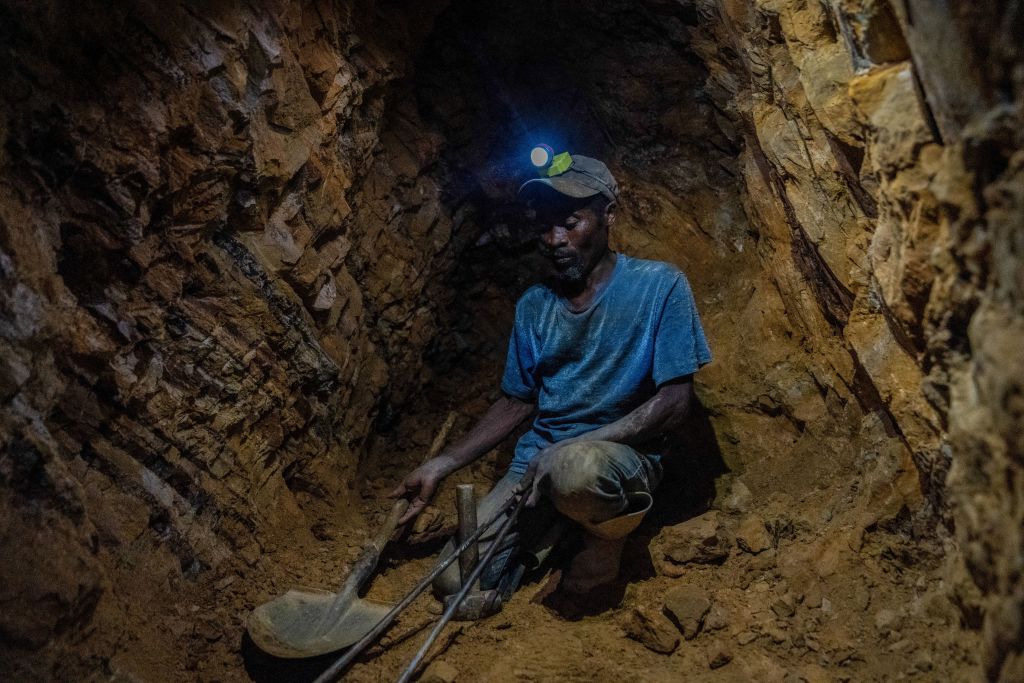
A man mines for gold in the South Kivu province of the Democratic Republic of the Congo.

Defense contractors and Silicon Valley firms are pushing for greater US intervention in the Democratic Republic of the Congo. The Trump administration is only too happy to oblige. (Glody Murhabazi / AFP via Getty Images)


The decapitation of Venezuela’s government. Saber-rattling over the annexation of Greenland. The US and Israeli war of choice against Iran. The opening months of 2026 have seen a dramatic escalation in Donald Trump’s bellicose militarism. And if much separates the three crises, what they share is the US president’s quest for American control over strategic flows of raw materials, whether that’s China’s oil and gas partners in Caracas and Tehran, or the more distant prospect of Arctic mineral wealth.

Elsewhere the US resource offensive is playing out with far less bombast. Take the relatively quieter push to carve out an American sphere of influence in a country that once seemed peripheral to US designs: the Democratic Republic of the Congo (DRC). A sprawling country in the heart of equatorial Africa, the DRC boasts considerable resource reserves, including copper, cobalt, and lithium. Metals like these are key for high technology applications such as microchips, electric vehicle batteries, and the most sophisticated weapons systems.

Already underway during Joe Biden’s administration, the US rapprochement with the DRC picked up speed with Trump’s return to the White House, when authorities in the capital, Kinshasa, purportedly approached the incoming US president to seek support in their protracted battle with breakaway militia groups in the eastern Kivu and Katanga regions. It was capped off this past December with the signing at the White House of a “strategic partnership” between the United States and the DRC.

Providing for special US access to the DRC’s mineral wealth, that accord followed up on last summer’s much-touted “peace agreement” between the DRC and Rwanda, a country that supports the March 23 Movement (M23) paramilitaries in their devastating civil war with Kinshasa. Despite the White House’s claims to have ushered in a new era of peace in the DRC, fighting persists to this day. On March 2, the United States slapped sanctions on the Rwandan military for its continued support of anti-Kinshasa militia groups.

To some observers, Trump’s warming to Kinshasa builds on the minerals-for-protection approach first concocted in the spring 2025 minerals agreement with Ukraine. For now, the US government’s direct engagement with the DRC is largely limited to support for president Félix Tshisekedi — whom Trump praised as a “brave man” at the February 5 national prayer breakfast in Washington — and diplomatic advocacy for US investors. Yet American defense contractors, such as former Blackwater (now Constellis) chief Erik Prince, are openly pining for closer security ties. Agents of Vectus Global, a new Prince-owned security company, were reportedly involved alongside forces of the central government in the early January battle for Uvira, an eastern DRC city abutting Lake Tanganyika.

Viewed from Congolese civil society, there is little doubt that the US push is about anything more than business. Without more democratic control of the country’s mineral wealth, the fear is that the people of the DRC could once again be left with a minimal share of the benefits as US capital embarks on an investment spree that seems most of all primed to grease the wheels of corrupt governance — and the balance sheets of foreign corporations. “Anti-corruption has been totally thrown aside by the American administration,” said Jean-Claude Mputu, a spokesperson for the Congo n’est pas à vendre (CNPAV, “Congo Is Not for Sale”) collective. “The Congolese population lives atop vast mineral wealth, but they don’t benefit from it because money is siphoned off by local elites, and because the foreign corporations that poison our soil pay off our political leaders so that they don’t face legal pursuits.”

Influence Wars

The Trump administration’s attempt to carve out a foothold in the DRC is not without obstacles. The country is already under the sway of US rivals like China, whose companies are currently estimated to control some 80 percent of the DRC’s mineral wealth, including many of its prime, most secure assets. Tshisekedi, for his part, has opened the door to a surge in US investment, but seems just as keen to play competing foreign interests off each other. US industry insiders hope that Washington’s offer of a more proactive partnership, in contrast to Beijing’s hands-off approach, can level the playing field. But there are few signs that China looks unsettled. On March 26, the DRC and China strengthened their ties with a new minerals cooperation agreement, which includes provisions for greater local processing of metals.

Leading the US counteroffensive are a new roster of investment funds, mining consortiums, and “exploratory” mining start-ups, all backed with critical US diplomatic support and public funding. Since Trump’s return to the White House, they are together laying the groundwork for a revived US sphere of influence in the DRC.

One actor to emerge in the US resource push is a relatively obscure company called Orion Resource Partners, which manages some $8.6 billion worth of global mining investments. It is now plying its entry into the Congolese market, having already established a foothold in places like Guinea and Namibia where it harvests bauxite, iron, and lithium. With financial backing from the US government, Orion founded last October the Orion Critical Minerals Consortium (Orion CMC), a combined investment vehicle which raised $4 billion in capital.

In February, Orion CMC announced a partnership with Anglo-Swiss mining major Glencore, which ceded a 40 percent stake in its DRC operations to the US-led consortium in a deal valued at $9 billion. The partnership will give Orion CMC and its investors, including the US government, control over a share of the output from Glencore’s DRC copper and cobalt mines. In March, Orion CMC likewise provided financing for US-based venture Virtus Minerals’ acquisition of Chemaf, a Dubai-based mining corporation active in the DRC since the early 2000s.

Under both Democratic and Republican administrations, the US government has been closely implicated in these maneuvers. In 2024, the Biden administration pressured the Congolese government to block the sale of Chemaf to the Chinese firm Norinco. The Trump administration has lobbied Kinshasa to sideline executives at the state-owned mining group Gécamines who opposed the handover of Chemaf to US investors.

Another critical gauge of support is the financial backstop provided by the US International Development Finance Corporation (DFC), which is propping up the private companies leading the US offensive. Founded in 2019 during Trump’s first term, the DFC is chartered to facilitate the projection of US economic interests abroad, providing seed capital for investments in external raw material supply chains. In December 2024, the Biden-era DFC provided over $500 million in backing for the construction of the Lobito Corridor railway designed to facilitate the extraction of minerals toward the Atlantic coast of Angola from landlocked Zambia and the southeastern DRC. The DFC’s $600 million investment in Orion CMC last fall is being billed as its largest capital injection to date, speaking to its strategic importance in Trump’s African mining push.

Then there’s the US tech sector. Silicon Valley is also carving out a direct stake in African mining, with its all-hands-on-deck bet on artificial intelligence feeding expectations of a surge in demand for critical minerals in the coming years. In the early 2020s, Tesla CEO Elon Musk was even rumored to be considering an acquisition of Glencore, the world’s largest mining conglomerate in terms of annual revenue.

KoBold Metals, a mining company founded in 2018, claims to use artificial intelligence and advanced research methods to chart out unexploited deposits of mineral wealth. The company counts among its investors Breakthrough Energy Ventures, a fund founded in 2016 by Bill Gates and whose stakeholders include Mark Zuckerberg, Jeff Bezos, and Michael Bloomberg. In an agreement signed last summer with the DRC government, KoBold was granted seven exploratory permits for lithium, coltan, and rare earth deposits across 1,600 square kilometers of territory.

Everybody?

When US mining major Freeport-McMoRan moved to sell its DRC assets to Chinese firms in the mid-2010s, it looked like American capital was throwing in the towel. Faced with the steep costs of mining in a region riven by instability — and the litigation risks inherent to working in a business climate plagued by endemic corruption — US companies seemed at a structural disadvantage to the state-backed behemoths of the Chinese mining sector.

Ten years later, and a new generation of US corporations are back — and ready to get their hands dirty. They can also expect a long leash from a US administration that wholly assumes the transactional nature of its resource offensive in the DRC.

A 2025 investigation on Orion’s activities in Guinea from the Platform to Protect Whistleblowers in Africa (PPLAAF) uncovered evidence of bribes to Guinean officials to expedite mineral exportation, alongside other environmental and due diligence abuses. A 2023 industrial accident by an Orion subsidiary resulted, for example, in the spilling of some 7,500 tons of bauxite — an incident that the group’s executives sought to cover up. Internal sources told PPLAAF that the firm has yet to commit $15 million in pledged community investment contributions, as the profits of the country’s minerals systematically avoid the grasp of local populations.

“What is particularly worrying about Orion’s conduct in Guinea is the overall mismanagement and the fact that their sole and immediate interest is profit, regardless of working conditions and the effects on local communities,” said PPLAAF Executive Director Jimmy Kande:

This sets a precedent that should have alerted the DFC and prevented it from backing Orion as its operational arm on the continent, given the corruption allegations and environmental crimes that have been investigated, including by Guinean authorities, and which remain subject to ongoing proceedings.

Orion CMC’s deal with Glencore also has the US government–backed entity potentially entangled in one of the more sordid corruption cases in the recent history of DRC mining.

The deal brings the group — and its investors, including the DFC — into implicit partnership with Israeli mining billionaire Dan Gertler, who has been under sanction by the US Treasury Department since 2017. In its decision to sanction Gertler under the 2012 Magnitsky Act, the Treasury deemed that the Israeli mining magnate “amassed his fortune through hundreds of millions of dollars’ worth of opaque and corrupt mining and oil deals in the Democratic Republic of the Congo.” Thanks to a scheme to pay Gertler’s mining royalties in euros and not in dollars, Gertler has continued to skim off wealth from his partnerships with Glencore.

In 2017, the US Treasury estimated that the shortfall for the DRC’s budget, resulting from those dealings, amounted to some $1.3 billion. Musk has denied vying for the full acquisition of Glencore, but one study suggests that Tesla’s agreement to purchase six thousand tons of cobalt per year from the Anglo-Swiss firm results in $4–$5 million of annual royalties for the Israeli billionaire.

“Dan Gertler is perhaps the individual who has most profited from Congo’s mineral wealth. He built a massive system of corruption that was sanctioned by the US government, but which has been skirted with the complicity of Glencore,” said Mputu, of the CNPAV collective. “Everyone seems to have made their peace with this situation. With Trump’s return to power, one of our concerns now is that those sanctions get lifted to allow Orion to work with Glencore.”

The DFC and Orion did not respond to a request for comment.

But there can be little doubt that other priorities are taking center stage as the US returns to the DRC resource race. Trump, for his part, did not mince his words when he celebrated last December’s deal from the White House: “We’re going to take out some of the rare earth, take out some of the assets and pay. Everybody is going to make a lot of money.”