Socialism Has a Future. Central Planning Doesn’t.
Central planners had a rational vision: replace the anarchy of the market with conscious coordination. Vivek Chibber explains why calculation and incentive problems undermined that vision, but a different sort of socialism can still flourish.
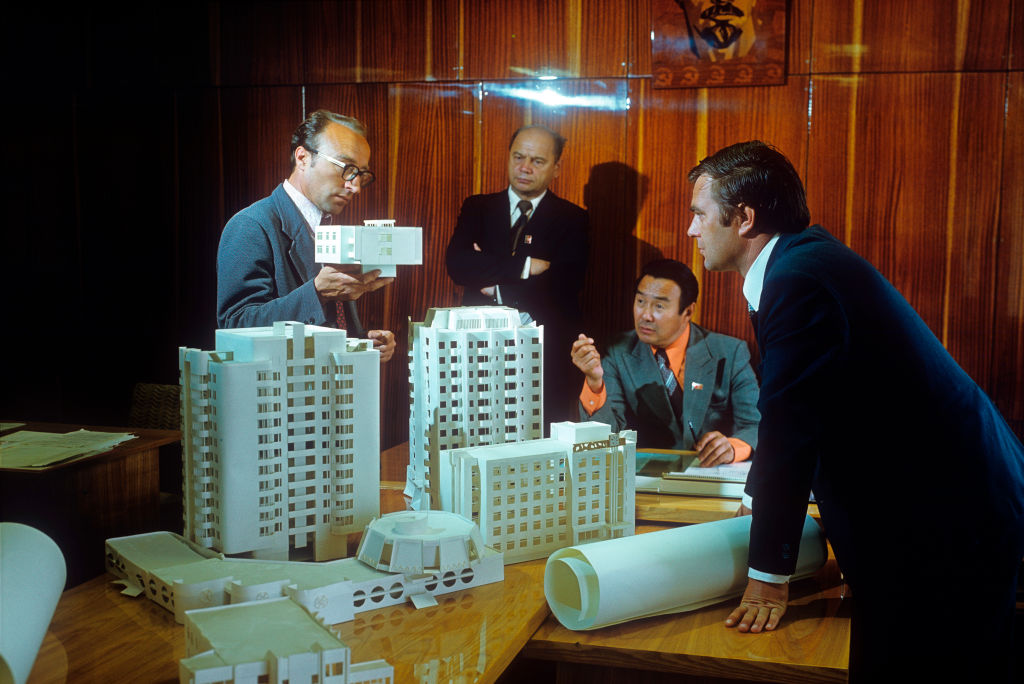
Even supercomputers won’t solve the problems inherent to central planning. But that doesn’t mean we don’t need to replace capitalism with something better. (Mark Redkin / FotoSoyuz / Getty Images)
- Interview by
- Melissa Naschek
Over time, the Soviet Union developed a system of centralized planning that became synonymous with socialism. How did the system work? What did it get right? And why did it ultimately become so associated with shortages and stagnation?
On the latest episode of the Jacobin Radio podcast Confronting Capitalism, Vivek Chibber and Melissa Naschek discuss the ambitions and challenges of economic planners, and why the defects may be hardwired into the structure of central planning.
Confronting Capitalism with Vivek Chibber is produced by Catalyst: A Journal of Theory and Strategy and published by Jacobin. You can listen to the full episode here.
Melissa Naschek
We’re talking about the dilemmas of having a fully planned economy. This is something you introduced in our previous episode on market socialism. It might be counterintuitive for listeners to hear that you’re going to be critical of a planned economy, especially because socialists have often equated socialism with a planned economy. Why do you disagree or take issue with that?
Vivek Chibber
The basic reason is that it failed. We ought to be skeptical, as any rational person ought to be, because when you see something failing over and over again, it means that there might be intrinsic problems with it. Some problems not just with how it was implemented but the very idea of the thing.
Melissa Naschek
We’re going to spend a lot of time specifically on the Soviet Union, because that’s the most important, canonical example. There were other planned economies besides the Soviet Union’s. But I think this will also give us a good anchor for exploring what a planned economy is, what planned economies were able to accomplish, and why ultimately they pretty much all failed.
To start with the Soviet Union, what were the goals the Soviets had in mind when they were trying to use the state to plan the economy?
Vivek Chibber
It’s good to study the Soviet example, first of all, because it was the most ambitious of all the planning efforts. It was also the one that was tried the longest. The Eastern European attempts really started in the 1950s, but the Soviet Union had about a twenty-year head start on them. Its attempts at planning unfolded over half a century. So it’s a wider canvass on which we can draw to make our assessments.
The picture that emerges from the Soviet experience is that planning was made extremely difficult because of the difficult conditions in which it was carried out. But it’s also the case that when you look at the institutional features of how they planned, the problems that emerged from it are probably going to be general, wherever it’s attempted, whether it’s in a poor country or rich country.
Whatever you think about the Soviet example, the single most important thing for the Left today is that you cannot afford to ignore it.
There is a feeling among many socialists that because the Soviet Union was a dictatorship or because it wasn’t a rich country, because planning was tried in an agrarian country, the conditions in which it was carried out were so forbidding, were so difficult, and were so far removed from the traditional vision that Karl Marx and Marxists had about how socialist planning should be institutionalized, that that experience doesn’t count.
And my view — and this is not just my view, much of the economic and historical literature from left and right also says this — while many features of Soviet planning were organic to that country at that time, there are very many more features that are going to be intrinsic to any attempt at planning. Therefore, studying the Soviet experience really is a must for anyone who is thinking about a non-market-based, alternative society.
Melissa Naschek
So what you’re saying is that the issues that the Soviet Union experienced with a planned economy weren’t just because of the historical circumstances they were in; there are fundamental issues with trying to implement a fully planned economy.
Vivek Chibber
Yes, exactly. The conditions — the facts about Russian history and the conditions in which the Soviet Union was built — made things worse, but they are not what made planning fail per se.
Defining Soviet-Style Planning
Melissa Naschek
When we say “planned economy,” we’re trying to contrast it to a capitalist economy. What are the key differences there?
Vivek Chibber
If you take planning at its word — if you take the vision that planners had — what it amounts to or what it is trying to achieve is replacing all the instruments and mechanisms for allocation of goods and services and for the dynamic development of an economy, taking all the signals that the market has and replacing them with a conscious, coordinated planning in terms of directives coming from a central authority as to what to make, how much of it to make, and where to send it.
Think of it as replacing the price signals of the market and the profit motive with conscious directives coming from authoritative bodies, a planning commission in the federal government and localized planning committees.
Melissa Naschek
In the Soviet Union, that authoritative body was the one-party state.
Vivek Chibber
Yes, it was the centralized state. Now in principle, you could have many political parties in a planned economy, so it doesn’t have to be a one-party state. But one thing that the Soviet Union had, which probably any other one would also have to have, is a central planning body or commission, which coordinates the economic activities of the economy as a whole.
If you don’t have a centralized commission, you’re going to have some kind of decentralized independent planning bodies in, say, every state of the country. But if every planning body in the fifty states of America plans for its own state, you don’t have a planned economy — you have fifty planned economies.
So if you’re going to plan in a country, you can have decentralized planning institutions like local committees, statewide committees, planning commissions at the level of the state. But any viable planning of a national economy has to be centered in a nation-level body, like a national planning commission. So whatever local bodies you have will have to be accountable to the central one.
Melissa Naschek
I’ll use the term “communist” just because the Soviet Union’s ruling party was called the Communist Party. What was communist about this way of running the economy?
Vivek Chibber
Let’s make a distinction here. On the Left, we often say there’s a difference between “big-‘C’ communism” and “small-‘c’ communism.” So what you’re saying is you’re going to call it “communist” because it was a Communist Party. That’s Communist Party with a big “C.” What’s communist about the Soviet Union in that sense is trivial: it’s communist in the sense that it was ruled by a communist party.
But that’s not what you mean. What you’re asking me is, in what sense did this align with the Marxist vision or the socialist vision of communism? That’s small-“c” communism, which betokens a society that’s an alternative to a capitalist market-based society.
So what was communist about the Soviet Union in that sense, small-“c” communism? The Soviet economy was communist in that it was an attempt, if not to eliminate the market altogether, to at least push it back as far as it could. And the truth is the planners never entirely eliminated it. They couldn’t.
What they did achieve was a substantial reduction of reliance on the anonymous signals of the market. And they did in fact put into place a system where the people running the factories and the agricultural cooperatives essentially decided what to make and how to make it by taking directives from the plan, at least in theory.
Now, one of the reasons it fails is that they didn’t, in fact, do what the planners were telling them to do. We’ll get into why that was the case.
Melissa Naschek
These are the famous five-year plans. What did the planning process, as directed by those five-year plans, actually look like?
Vivek Chibber
One way to start is by asking, why have five-year plans? The reason is that if you’re trying to direct the economy as a whole, you need to have a vision of the direction in which you want it to move.
You’re trying to industrialize. You’re trying to become more technologically dynamic. So you have to have a moving horizon for assessing whether the actual investments and production decisions that are taking place are in line with where you’d like the economy to go. You need to have a rolling budget, as it were.
Think of your household. When you have an income coming in and you’re trying to figure out what to do with it, you always say, “Let’s have a monthly budget.” Or you say, “Let’s try to have a sense of where we want to go week to week, month to month.” Every consciously planned entity in the world has some kind of plan for itself, whether it’s the household, you as an individual, or whether it’s the national economy.
The Soviets, you might say, arbitrarily decided, “Let’s have a horizon of rolling five-year plans.” It could have been seven; it could have been three. They settled on five. The main thing is that they settled on a rolling horizon.
The five-year plan essentially was taking the economy as it is now, and then looking at what the gross domestic product is, what proportion of the labor force is in this sector or that sector, how the weight of agriculture in the economy compares to the weight of industry, and then saying, in five years, we’d like to be in a different position — maybe with fewer agricultural workers, maybe with more of a machine goods industry, maybe with more consumer goods.
So then you ask, how can we get there?’ And then, to get from here to there, you lay out what proportions you’ll have to reinvest your national savings in. How much should we invest in textiles? How much should we invest in steel? How much should we invest in the consumer goods industry? Then you have to operationalize that.
The way they operationalized it was by having, within the five-year plans, rolling one-year plans. In order to meet your five-year objectives, you say, “That means for each year, we need to have X amount of progress in our investment, in the production of these goods, in the production of those goods.” Therefore, they would revisit every year how much progress they had made toward the five-year plan. The annual plan is broken down into monthly endeavors, et cetera, et cetera. That’s what planning essentially was.
Planning was consciously directing the flows of investment into the sectors that you deemed to be the priority sectors, discouraging investment from sectors that you deemed to be superfluous or unimportant. Then the key — the really hard part — was figuring out how to incentivize the managers of your factories, the managers of the agricultural cooperatives that you had, to follow the dictates of the plan, because you cannot rely on price signals.
Normally in capitalism, what do managers do? They want to make profits. The way to make a profit is by trying to sell, at the lowest price possible, the best-quality good that you can. Nobody’s telling you what to do. You’re just saying, let me look at the prices. Let me look at my costs, and let me now judge how much to produce and where to send it, given the cost that I’m having to pay and given the demand for this good.
Melissa Naschek
Friedrich Engels talks about how one of capitalism’s defining features is the anarchy of the market, which is the opposite of the planning that you’re describing — thinking through, strategically, where would we want to invest in our economy, versus what parts of the economy are not really producing the things we want in our society. In capitalism, money goes where people think it’s going to make a profit.
Vivek Chibber
One way to think of it is there’s no we in capitalism. The we is just every individual firm, every individual enterprise. And the only planning they’re doing is, “How can we best make our profits?” They don’t have a vision of the broader economy. So they just do what it takes to make their profit.
The broader economy moves along its grooves through the unintended consequences of all these individual producers making their profit-making decisions. So nobody knows where it’s going to go.
What planning does is it takes on this enormous burden of saying, “We’re going to actually try to move this economy in a specific direction.” It’s like an orchestra with millions and millions of moving parts. How do we get all of these millions of parts to coordinate their activities, like an orchestra coordinates its music? The conductor in this case is the central planner. That planner has to get everybody else to follow his directions because it only works if they listen to what he is saying.
The Information Problem
Melissa Naschek
So how did all of this work in the Soviet Union?
Vivek Chibber
As I said, the five-year plan is translated into one-year plans. And the one-year plans have to be translated into immediate directives that go from the central planning commission, located in Moscow, let’s say, to the appropriate bodies that oversee production. Now it’s too big a leap to go from the central planning body directly down to each individual factory, because there are only so many people in a central planning body and there are tens of thousands of factories.
So what are they going to do? The first thing you have to do is make regional planning commissions. There’s a centralized planning commission. Then you make regional and state-level ones. And then you go from state-level ones to district ones. What happens is the directives of the plan are first conveyed from the centralized body to the regional ones. And then the regional planning bodies, however many layers they are, finally reach all the way down to workplaces, whatever those happen to be.
The managers of those workplaces — typically the manager will be elected or appointed, but whoever it is inside your workplace that does what managers in capitalism do, which is basically make the decisions — they are then told what they need to make. That’s either done in monetary terms: “You need to make a thousand dollars worth of steel.” But typically it was done in physical terms: “You need to make one hundred steel ingots. You need to make this many corkscrews. You need to make this many ball bearings.” And they’re given a time horizon. We want it by the end of the year, or we might want it by the end of eighteen months, something like that.
So there’s a flow of commands going from the central authority down to the regional ones, and from the regional ones down to the individual workplace. The workplace then is expected to make exactly that good, in that quantity, in that period of time.
Melissa Naschek
Did that actually happen?
Vivek Chibber
No. So let’s get into what has to happen for it to work.
The first thing is, how does the central planner know how much to tell the workplace to make? Because they can’t just pull it out of their hat.
So before you actually issue your directives, there has to be a prior process in which you send your people out and get a lay of the land. What are the productive capacities of every individual workplace in the country?
You have to first draw up some kind of assessment of productive capacities. Now, how are you going to do that? You cannot have factory inspectors in such large numbers that they go out to tens of thousands of workplaces and figure it out. And how would they figure it out? How would they know what the productive capacity of each individual workplace is? There’s no way to do it except by eliciting the cooperation of the managers themselves and asking them, “What’s your production record? How have you done in the past?”
You can’t rely on aggregate figures. You can’t rely on national income accounts the way we do now, because that only tells you what the national level of production is. This is an important point. You have to know how much investment there’s been going into this sector or that sector. But if you want to be able to manipulate the investment, you also have to know how much can be done by this firm, and that firm, in that workplace.
Melissa Naschek
Right, because you need data on who’s succeeding, who’s lagging, trying to figure out what factors are going into making certain workplaces successful or not.
Vivek Chibber
Exactly. So planners have to first figure out how much each workplace is capable of making. They do it by gathering information through the workplaces themselves. The workplaces have to voluntarily tell the planners, here’s what we’re capable of.
In the state of Wisconsin, there are this many factories. And according to what they’re telling us, they can make this much steel. In the state of Florida, they can grow this many oranges — things like that. On the basis of that, they now come up with an aggregate picture of where the economy is and what the productive capacities of individual workplaces are. Then they say, given these productive capacities, how much can we ask them to make over the next year? And those directives are sent down to the workplaces.
There’s information that comes up from the workplace to the planners, and then directives that flow down from the planners to the individual workplaces. That’s first carried out at the level of this one-year plan. Then each one-year plan is folded into an evolving five-year plan. And once a five-year plan is done, you make a new five-year plan. And that’s then broken down into individual one-year plans.
That’s a very pretty picture. Logically, it makes a lot of sense to do it that way.
For it to work, you need two things. First, that the information coming up from those workplaces is accurate. Second, that the directives that go down from the planners are actually followed.
In between the first process and the second, the planners have to be able to process all that information that’s come to them, and then, in a timely fashion, collate all of that information so that they can figure out how that entire economy is laid out geographically and things like that.
This did not work. The question is, why not?
One traditional answer, and it’s not wrong, is that there’s just so much complexity in this economy — there are so many moving parts, there are so many workplaces and factories — when all that information comes up, how are you going to ever know how it all fits together? Because economies are integrated. If you’re making ball bearings here, that’s connected to how many cars you’re going to make out of the ball bearings.
Melissa Naschek
Right — how do they know what to put in the directives?
Vivek Chibber
Exactly. When you start with saying, “We need so much steel,” in order to make that steel, you have to know everything that goes into making steel. And it’s all integrated. In order to have all those things go into the steel, you have to ask, “Well, how many blast furnaces do we need?” For the blast furnaces, you have to ask, “How much coal do we need?” For the steel to be made, you have to ask, “Okay, once all that steel is made, where’s it going to go? Who’s going to use it?” Trains, automobiles, and so on.
In economics, these are called complementarities or linkages. Everything is linked. If you screw up one of those links, it radiates all across the economy. So you have to be able to handle complexity at a level that just boggles the mind.
Melissa Naschek
Did that happen in the Soviet economy?
Vivek Chibber
It did not. They were not able to handle all that complexity. They were not able to in fact come up with adequately integrated models.
When there are not adequately integrated models, here’s what’s going to happen.
The directives you’re sending down to the regional bodies, and from the regional bodies to the workplaces, are going to be based on faulty information. Assume for a second that those workplaces follow to a letter everything you’ve asked them to do. If it’s based on faulty information, they will be following to a letter tremendously skewed and ineffective plans.
The number of ball bearings you’ve made is going to be inadequate in some way, because the planner didn’t fully appreciate what the links are between the ball bearings and the cars that they’re going to make, between the cars and the steel that’s going to be demanded by the cars, and so on.
Once that informational chasm overwhelms planning, planning becomes essentially like a blind man trying to figure out where to go in a very large room. He’s stumbling around. That’s the first problem. That historically has been why many analysts think planning failed.
Now, there’s a response to this, and the response is, well, computers.
Of course, if you have an actuary sitting with a marble plate in a room somewhere trying to figure out the numbers, he’s going to be overwhelmed with all this stuff. But what about once you have supercomputers that can take reams and reams of information and literally within a second process all of it into an input-output matrix in some kind of integrated model? Surely that will enable you to overcome this.
Certainly, I think there’s a lot to this. In my view, if information processing were the only reason that planning failed, I think the advent of computers should enable us to have much rosier expectations about planning.
The Incentives Problem
Melissa Naschek
You said that was the first problem. What’s the second problem?
Vivek Chibber
If information processing were the only issue, we could probably solve it. But while the information problem is one leg of the dilemma, there’s a second one, which I would describe as the incentives issue. The incentives issue has an independent logic and an independent bearing on planning, which cannot be solved with supercomputers or something like that.
The incentives issue is this. If you’re giving directives to individual workplaces, those workplaces are going to be held accountable: once we’ve given you an order, you’ve got to produce exactly what we told you. If they understand that they’re going to be punished for not coming through with whatever the plan tells them, they are going to do the best that they can to follow the plan if they can be assured that everything they need to be successful will also be provided to them.
So if you’re a car maker and you’ve been told, “I want you to make 10,000 units of this car,” you have to also be assured that you’ll get the steel, the rubber, the ball bearings, everything that goes into making the car for which the planner is responsible.
I talked earlier about complementarities. In the Soviet case, because there were so many moving parts to every plan — there were so many things that had to come together for any individual workplace to be able to deliver on what it was told — if any one of them broke down, the manager at the workplace would be unable to fulfill whatever his directives were. If you don’t get the steel you need, not just in the right quantity but at the right time; if you don’t get the ball bearings you need, not just in the right quantity but at the right time . . . if anything goes wrong, you’re going to be held accountable for that.
As it happens in the Soviet Union, everything went wrong all the time. Because transportation would break down; you wouldn’t have enough cars in the railway to deliver things. And because, at that time, information wasn’t being processed fast enough.
Suppose you’re the factory manager, and you’ve been told to do this, that, and the other, but because of all these imponderables, you’re not getting the inputs you need. What do you do? You start adjusting your expectation: you’re not going to get what you need, but you’re going to be held accountable for the plan. So how do you adjust yourself? If I’m a workplace manager and you’re the planner, if I told you my factory can make 1,000 cars a year, you then tell me, “Cool, for next year, make 1,050, because we need a growing economy,” I’m going to be held responsible for making 1,050 cars.
But my inputs don’t come in on time. And now, I’m going to be punished if I don’t come up with 1,050. I’m only capable of making 800 because of all these breakdowns. So what do I do? I think, I’m probably not going to get everything I need. It’s probably going to mean I can only make 800. So I’m going to tell them that I’m capable of making 600. Why 600? Because if I make more than 600, I’ll be rewarded. But if I don’t meet the 1,050, I won’t be punished.
Melissa Naschek
What effect did that have on the economy?
Vivek Chibber
Remember I said there has to be a two-way process of information flowing from the workplaces to the planners, and then directives going from the planners to the workplaces. For it to work, the information coming from the workplaces has to be accurate.
Because of the uncertainty and the possibility of breakdown in the provision of inputs, manpower, things like that, managers have an incentive to lie when they give the information to the planners. That means then that the information coming in is itself skewed. Even if you can process it with supercomputers, now the information is going to be unconnected to the actual productive capacities of the economy.
Of course, the planner is going to be giving directives with only a notional connection to what’s out there in the economy. That means some part of your productive capacity is going to go to waste, which means that you’re not going to be growing at the level you can.
But it gets worse. Everybody’s smart. After a certain period of time, planners figure out that they’re being lied to. Once they figure out they’re being lied to, they have to build into their directions some coefficient or level of expectation of what the quantity of the lying is. So it becomes what you might call an educated guess: Melissa is telling me she can make 600 cars. I think she can make 800. So I’m going say, “Make 900.”
Melissa Naschek
It sounds like game theory.
Vivek Chibber
That’s exactly what it is. It’s a game-theoretical situation in which each person is strategically lying to the other.
But this means planning is not planning at all. It’s a strategic game between two people about how much they can outthink the other. It’s the opposite of planning. It’s a kind of war.
If this is true, look what we’ve uncovered. The possibility of processing all that information doesn’t help you if the information coming in is garbage. And the information that’s coming in is garbage because the incentives of those workplace managers are not aligned with the incentives of the planners. That means that there’s a mismatch in the incentive structure of the economy.
Furthermore, whatever bad information is coming in is coming in as a consequence of the misalignment of the incentives, which means that a big part of what I call the information problem is actually a downstream consequence of the incentive problem.
So unless you can get the incentives laid correctly, you’re not ever going to get the correct information in order to be able to plan adequately. Planning will never be fixed until you get the incentives fixed. The question for us then is, can you get the incentives aligned so that managers stop lying to planners and planners stop trying to outflank the managers?
Melissa Naschek
Why not just let some firms fail, then, in a planned economy?
Vivek Chibber
One possibility is, “Listen, if you’re not doing what the plan asked you to do, and if I know you’re lying to me, I’m just going to let you fail.” The interesting question is, why didn’t they do that? If the idea occurs to us, surely it occurred to them, and it did.
The problem is this: If the directives you’ve been given are directives that you cannot reasonably follow because the inputs you were promised were not delivered to you, the question is, who’s responsible for the failure to produce as directed? Surely some of the responsibility falls on the planners, because they didn’t get you the inputs you needed.
I said to you, in my capacity as a planner, “Here’s your responsibility, make these cars, and the plan will give you the inputs you need.” Part of the plan is our assurance to you — because we’re not allowing you to go out and buy them on your own. I’m telling you, “Hey, just do what you’re told. You will get the inputs.”
Now, suppose you didn’t get the inputs. And then, on top of that, I tell you I’m going to let your firm go out of business. It’s not just you now; every other worker in that firm is going to suffer. And all those workers are going to say, because you’re going to tell them, “This is not my fault. If those inputs had arrived on time, I could have done what I needed to do.”
Well, the workers are going to ask, “Why didn’t they arrive on time?” You’re going to turn around and say, “Because the planner, and whoever the planner had organized to provide me the inputs, failed.” And that means you cannot be forced to take all the punishment if you do not bear all the responsibility for the outcome.
In a planned system, when the needed inputs, raw materials that every enterprise needs are not forthcoming, planners cannot be shielded from the responsibility of that enterprise or workplace not delivering and coming through. That means planners are in a difficult situation where they can’t come and say, “I’m going to let you fail.” Because now in that region, every worker, and every worker in connected enterprises who will suffer from yours being shut down is going to turn around and get really angry at that planner, at the planning bodies, and so on. You could have a constant civil war going on.
So for the planner, it’s easier to say, “Look, just do better next time. I’m not going to let you go under.” This is called a soft budget constraint.
Firms were able to say, “It’s not my fault.” So when they couldn’t make profits, when they couldn’t make the right amount of the good, they were not allowed to go under. They were just plied with more money, with more resources, in the expectation and the hope that they would do better the next time around.
Melissa Naschek
I imagine so much investment money was wasted propping up firms that should have been allowed to fold.
Vivek Chibber
Enormously. The aggregate outcome of all this is stagnation. It’s very, very low growth. Because the managers of the workplaces don’t have an incentive to innovate — they’re afraid to do so. The planners don’t have an incentive to innovate, because now they’ll throw their rules of thumb all out of whack. On top of that, money is being sunk into failing enterprises.
You put those two things together, it’s a recipe for stagnation, which after the 1960s, you really had. The entire Khrushchev–Brezhnev era, from the 1960s through the late 70s, was one of very low, slow economic growth.
The Short Twentieth Century
Melissa Naschek
In the beginning, we talked about trying to disentangle what was historically specific about the Soviet economy versus what was general, or an intrinsic problem with a planned economy. One thing I’m wondering, as you’re talking about this informational problem, is why they were lying. Was it because of problems that were specific to the Soviet Union?
Vivek Chibber
The misalignment of incentives happens because of the wariness of the managers about getting directives that they won’t be able to fulfill. And that worry comes from the fact that they think there’s going to be a breakdown where they won’t get everything they need, but they’ll be held responsible for not living up to the standards of the plan.
In a very poor country, with poor transportation and poor logistics and poor information, the chances for breakdown really increase. The question for us is, imagine a richer country like the United States, where there’s more reliable electricity, more reliable transportation, and things like that. Would that solve the problem of uncertainty and the possibility of breakdown in provisions of inputs?
To some extent, it would, but not to the extent that you need in order for planning to work. There are all kinds of reasons why the provision of inputs can break down, even in advanced settings. There can be random fires; people get sick; certain factories produce suboptimal goods.
Melissa Naschek
Someone could start a war.
Vivek Chibber
Someone could start an unprovoked war. If you’re in the United States today, there’s a war every few years.
There are all kinds of reasons things break down. When you have no slack, when you have no cushions, every time a breakdown occurs in one sector, in one factory, in one region, it affects ten, twenty, or thirty others because everything’s connected. As soon as that becomes a predictable part of the system, every player in the system starts acting strategically to protect their butt from getting punished.
Once that starts at the level of the enterprise, planners are also going to do the same. Part of it is going to be, they’re going to try to outflank the operators, but then they’re also going to start lying to the higher bodies up because planners are also held accountable for what the results of planning are. As long as there is an expected and baseline level of uncertainty, which there has to be in every economic system, you will get this kind of strategic bargaining.
In economics, they call it a principal-agent problem. You will get this problem where workplaces are not following the directives of the plan and instead are simply trying to protect themselves by strategically lying, by hoarding resources, by keeping stuff to themselves, by cutting secret deals at the local level with workers and suppliers. There is no reason to think this will ever be solved.
The dilemma is this. There is a problem of information. Supercomputers will in fact help process information better. But if the information coming in is junk, and if that junk is built into the system because of the incentives that operators have in workplaces to lie, you will not have a planning system that can be put on its feet through the advent of computers or artificial intelligence or anything like that. I don’t see any reason to think that that strategic misalignment of incentives is simply there because of Russian backwardness or poverty.
Melissa Naschek
Or Joseph Stalin.
Vivek Chibber
Or Stalin. It is intrinsic to the system. I don’t see any way around it.
Melissa Naschek
What role do you think Stalin and authoritarianism within the Soviet Union played in the planned economy not working?
Vivek Chibber
It played an important though not decisive role.
How was it important? Ignore for a second the general atmosphere of fear and intimidation and terror and all that. Let’s just think about the planners.
Because the planners feared reporting to the party that there were deep problems inside the plan. They had to fudge the figures to try to keep Stalin and the Politburo happy, because they didn’t know what kind of punishment they’d be getting. If there’d been a more open atmosphere, they could have more openly and adequately debated among themselves, and perhaps at the higher levels of the party, what was and what was not working.
Melissa Naschek
Did anyone try?
Vivek Chibber
They absolutely did try. But it was not a regular part of the system. It happened when there was a shake-up.
When Stalin dies, there was an opening when Nikita Khrushchev first comes to power, where these things were discussed quite frankly. And when Khrushchev came to power, there was in fact a loosening of the plan and the plan directives to acknowledge that we just can’t have such a tightly controlled economy because it’s not working. But that soon dried up. When Leonid Brezhnev replaced Khrushchev, there was some opening again, but that soon dried up. You needed it to be a regular part of the political system, and it just wasn’t.
But imagine that there was an open system. Imagine that there was more space for pluralism and for discussion. The fact of the matter is, you can discuss it till you’re blue in the face. As long as there are these misaligned incentives between operators of the firms and the planners, you’re not going to solve the problem. Because planners can openly talk about how they’re being systematically lied to, but they can’t create an incentive to not be lied to as long as there’s this level of uncertainty that the enterprise managers are facing. And as long as they’re held accountable for outcomes that they cannot themselves control, they will lie to you. And if they’re lying to you, all the supercomputers in the world aren’t going to be able to solve that problem.
Melissa Naschek
How did the Soviet Union last as long as it did?
Vivek Chibber
A system like this is good at treading water, and that’s what they were able to do.
Suppose the planner knows that he’s being lied to. What he does is say, “I know that with our productivity levels and our technology, if it’s used wisely, it can probably increase production by about 4 percent a year. But I know Melissa is lying to me. So whatever number she gives me, I’m just going to add 3 percent to that. It’s less than the 4 percent that I think we can do, but 3 percent is probably manageable.” It’s called a rule of thumb.
The economy moves forward by this rule of thumb that takes whatever junk information I’m getting and add a certain coefficient to it and convey that back to the workplace as what they have to do. So the economy can keep chugging along at 1 percent, 2 percent, 3 percent a year, because those rules of thumb suit both people — you know at the workplace that this is what I’m probably going to get, so if I lie enough, I can calculate what the directive is going to be. I know that Melissa is lying to me, but if I just use this rule of thumb, I’ll keep the higher-level planners off my head, and I can get it out of her.
So the economy chugged along, but it chugged along using outmoded technology. There was no incentive to bring in new technology because every time new technology comes in, it throws all the calculations out of whack.
Melissa Naschek
We talked in a previous episode about how even capitalist economies sometimes struggle to integrate new technology.
Vivek Chibber
If in capitalism, managers are kind of conservative and they’re afraid to bring in new technology unless they absolutely have to because it’s an imponderable — you don’t quite know how it’s going to fit in in your existing system — for Soviet managers, everybody had an incentive to try to just do the baseline level of production.
Melissa Naschek
One of the problems with new technology is that it’s disruptive. So if you’re talking about this economy where everything is so heavily dependent on everybody producing these exact but also kind of bullshit figures, then a huge disruption like the introduction of new technology or new machinery could be devastating temporarily.
Vivek Chibber
There was a very strong disincentive to innovate in that system. Any system like that you can imagine, it’ll chug along for a while. But if there are big exogenous shocks, if there’s a big disruption of the global economy, it becomes harder for it to recover.
Not surprisingly, when the oil shocks hit in the 1970s, when there was a big currency crisis in the wake of the oil shock, that’s when you saw the Soviets take a really big hit. They had a very hard time recovering from that.
Melissa Naschek
But it’s not just that the Soviet Union chugged along, right? They were a world superpower for decades.
Vivek Chibber
It was a fictitious superpower. The Soviet economy was about a quarter the size of the US economy, but they had to have a military budget that could rival the Americans’. You could predict that in the long run that system would fail because so much of their money was going into a sinkhole to fund that huge military.
Now, here’s a thought experiment: Suppose they hadn’t had to fight this Cold War with the United States, what would have happened?
They probably would have lasted longer, but you still had the problem that with this basically stagnant economy, with not much technological innovation, over time per capita incomes and standards of living are going to stagnate and even start going down. That is a system that’s not going to last very long.
Until you can solve the problems of innovation, growth, and technological change, no economy in a global capitalist system is going to be able to survive. And any attempt at socialism is going to be incremental. You’re not going to have a global shift to socialism simultaneously. That’s why any country that tries is going to have to figure out how to innovate, be dynamic, be productive. And that’s one big reason why myself and others say your best bet is market socialism.
Planning in Capitalism
Melissa Naschek
You’re talking a lot about the problems with the integration of the economy in a planned economy. But wouldn’t a capitalist economy have the same sorts of issues?
Vivek Chibber
Every economy has linkages. Every economy has complementary firms: one firm produces for another and consumes from another or so and so. That’s true in capitalism as well.
The difference between the centralized planned economy and a capitalist economy is that in a capitalist economy, if I fail to get the parts that I need from somebody, I can turn around and get it from somebody else. And if I fail in all of that, I’m allowed to sink. I’m allowed to go under.
What happened in socialism was the whole essence of planning is, every part in the whole is consciously directed and connected to another part in the whole. They were in fact geared toward not having any slack. Because if you have slack, you’re wasting your resources. And the whole point of planning was to not have waste.
In the minds of the Soviet planners, capitalism was rife with waste. Capitalists invested blindly. They may or may not sell their stuff. If they don’t sell it, their factory goes under, even though it’s productive, but you mothball it because it’s not making the profits you want. And that’s a waste. Even John Maynard Keynes agreed with that.
The difference is that in capitalism, because workers are forced to bear all the costs, nobody in the ruling echelons worries about it very much if a factory goes under because the people who own the factory liquefy those resources and put them somewhere else. And somebody is going to bear the cost. In planning, everything was tightly integrated precisely because you did not want to have resources sitting idle.
In capitalism, as a producer, if you don’t get the inputs you need, you can just say, “Screw it. I won’t go back to that guy to whom I subcontracted. I’ll just get them from somewhere else.” And that person you got them from now says, “Great, I’m just going to sell my stuff to Melissa. I won’t sell it to the other person.” People suffer, some firms go under, but that’s life. It’s what Joseph Schumpeter called “creative destruction”: you’re destroying a lot of assets, but you’re doing it in a way that the aggregate outcome is technological dynamism.
Centrally planned economies were built not to have slack. So when one thing broke down, there was no avenue for that manager, at least on paper, to get stuff from elsewhere. What they did was they jerry-rigged it. The managers of firms informally cut deals with other providers so that they could get the parts that they needed.
And because this is informal and they can’t tell the truth, they’re undermining the plan while they’re doing it. Because now, if somebody else is giving you the parts clandestinely that you couldn’t get from me, that person who’s giving you the parts can’t provide those parts to somebody else.
Every adjustment throws the plan out of whack.
Melissa Naschek
Is this why you’re so in favor of market socialism, to provide a little bit more of a cushion?
Vivek Chibber
What happens in market socialism is you plan in those areas where planning is known to work and where you don’t have this kind of complexity, and you leave to the market those areas where planning really has a hard time. You learn through experience what those are going to be. But what you’re doing in this process is dramatically reducing the burden on the planner about the information that they’re getting.
Suppose you’re planning in utilities. Because the time horizon of power generation is so much longer, it also means that the ability to adjust is that much greater. If something goes wrong, you have months to adjust to it. Whereas if you’re making, for example, automobiles, the time horizon is a lot shorter. You’ve got to make adjustments on the fly, and you don’t have the time to do it. So when the plan goes askew, you can’t adjust the plan.
Market socialism, in essence, is reducing the burden on the planner and in so doing is reducing the incentive for them to be lied to. Because of that, the plans have a greater chance of succeeding in those sectors of the economy where we will actually have planning. And that’ll be a fraction of what it was in the centrally planned economy.
Melissa Naschek
A lot of capitalist states have implemented aspects of what we would call a planned economy. What parts of the model have capitalist states tended to incorporate and why?
Vivek Chibber
This is best understood if you divide the world up into the Global South and the more developed economies. In the Global South, from, say, 1945 to the 1980s, there was a huge initiative toward planning, even though they were all capitalist countries. They tried very hard to do what centrally planned economies do, which is to direct the flows of investment from one sector to another, from low-priority sectors to high-priority sectors.
That’s what they were trying to do. They used many of the planning models that the Soviets had, constructing these very elegant input-output matrices of the economy that showed in what proportions sectors were connected to each other, and how once you have those proportions, you can figure out the quantities of investment that each sector should be given in order to get a growth rate of the kind you want. On paper, that’s pretty much what the central planned economies were doing too.
The difference here was, in a capitalist economy, the people controlling investment were private operators. The state had no control. So in the developing world, planners had to figure out how to get profit-maximizing firms to do what the planners wanted, rather than what the market was telling them to do. They were moderately successful at that at best, but surprisingly successful given that it’s capitalism.
In the Global North, planning of that kind, economy-wide planning, was really never attempted — except for maybe a brief period in France from, I would say, the late 1940s into the mid-1960s. No other capitalist country really tried anything like comprehensive planning.
What you had in the advanced world was what you might call sectoral planning. States planned power generation; they planned the growth of health care. These are sectors in which you were able to replace private capital or you were able to direct private capital because the way in which demand growth occurs and the ways in which the supply conditions relate to each other have a time horizon and have an ability for slack that other ones don’t. So in capitalism, you do have some degree of de facto planning in these sectors.
Melissa Naschek
Would you put something like the CHIPS Act in this category?
Vivek Chibber
I wouldn’t call that planning. What the CHIPS Act tried to do was to essentially hothouse greater levels of investment and research and design in that sector. But that’s a kind of subsidization of the sector.
For it to have been planning, you also needed to have some control and influence over output, the timing of the output, and the proportions in which it’s being done. And Joe Biden and Donald Trump before him never really tried to do that. It was basically saying to them, “We’re going to give you a whole bunch of money, a whole bunch of inputs, please use these wisely.” And they have no control over what’s being done with it.
Melissa Naschek
You mentioned in the market socialism episode that you’re very skeptical of our ability to plan in consumer sectors. But on the flip side, there are these massive corporations like Amazon and Walmart that are basically the size of a country. How do they function if not by some measure of planning?
Vivek Chibber
It’s not just Amazon and Walmart. Any firm above a baseline size engages in what we might call planning. They plan for future growth. They have to plan for the arrival of inputs. They have to plan for their manpower needs, all that sort of stuff. And you can call that planning.
You might say then that, if these firms are already doing it now, why not just translate that into economy-wide planning down the line? And that means that my verdict on the failures of planning might be a little too pessimistic.
But I think this is a misconception.
It’s true that Amazon and Walmart plan on how fast they want to grow, where their inputs are going to come from, and they reach out to the input providers and make sure they’re delivered. But two things. They’re the size of small countries, but they’re a very small part of the American economy. For the economy as a whole, they’re not very large. If you just look in terms of overall profits and value-added, it’s not like they account for a third of the economy or something.
So even if these firms had solved their internal planning problem, it’s a real stretch to say that a significant part of the American economy is now planned.
Second, they plan, but in a very un-Soviet-like way. What are they doing? They have a sense of where their inputs are coming from, what their input-output matrix is going to be, what their growth rates are going to be. But the whole point is this: if something breaks down in Walmart’s delivery services or in Amazon’s, what do they do? They immediately turn around and find another supplier on the market. They immediately turn around and create redundancies for themselves. They’re free to do that.
They are planning in a notional way, but they are freed from the essential dilemmas that enterprises had inside planning in the Soviet style, which was that if your inputs break down, there are no redundancies. You don’t have the freedom to go and find something on your own because now you’re disrupting the plan.
Because Amazon and Walmart are functioning in a nonplanned economy, if something in their individual plans break down, they go on the fly and create a new plan and find new suppliers and new buyers. That is not going to be possible in a fully integrated planned economy.
The point is, first, Amazon and Walmart are just individual firms that do their own vertically integrated planning — planning from the provision of raw materials and the ground-level suppliers all the way up into the planning of their warehouses and where they sell. A planned economy has many vertically integrated firms that then have to coordinate horizontally with tens of thousands of other firms. There’s no way on earth you can say Walmart and Amazon do that kind of horizontal planning.
Second, when that horizontal planning breaks down, to the extent that they do it, they just turn around and find someone else to [supply their inputs] because that’s the essence of a market economy. That’s not going to be how a planned economy works. If it is, then you’re not planning anymore.
I think the idea that what they’re doing is planning is wrong. It’s planning by changing the meaning of the word “planning.” Even if you had adequately vertically integrated planned firms, you still would have to coordinate tens of thousands of them in a planned economy. That’s a qualitatively different dilemma than what Amazon and Walmart face.
Lessons Learned?
Melissa Naschek
What do you think leftists should learn from the failure of fully planned economies?
Vivek Chibber
What they should learn is that the burden of proof is on us, on the Left, if we want to continue with this slogan of replacing the market with the plan. The burden of proof is on us to show that it can work. You might say that along with this ought to come a kind of humility about facts and about the world.
One of the consequences of the abject defeat of the Left over the past forty years is that it’s retreated into these very tiny little groupuscules, or even worse, online chats. Because they have no power, because they can’t change anything, they have the luxury of sticking to beliefs as religious commitments. They stick to their guns because they really are just seeking affirmation.
But if you’re going to start moving things in the world, if you’re actually going to get to the point where you can think about shaping society, it would be criminally negligent to ignore the experience of decades upon decades of planning and say to yourself, “Well, that wasn’t what my vision of socialism is, so I’m going to ignore it.”
Because if you do that, I can guarantee 100 percent you will end up repeating many of the mistakes and falling into the same dilemmas that the planners did. And you’re going to waste what will probably be the last opportunity we will ever get to try to build an alternative society. Because in history, you don’t get three strikes. You typically only get one strike. You’ll be very lucky to get a second strike.
Melissa Naschek
This is one of the things that I time and again come back to about why Marxist analysis is so satisfying and provides such a great guide for political strategy. The distinction that you provided, of what is historically specific versus what is an intrinsic problem with planning is essential to evaluating: Did something not work because of a historical situation that would have no bearing on the present day? Or are there intrinsic problems with this, which means no matter what historical situation you put it in, it’s not going to work?
Vivek Chibber
If we’re actually serious about changing the world, people on the Left, Marxist or non-Marxist, but people who are actually trying to fight for socialism, should be the most remorseless and the most merciless when it comes to facts. Unfortunately, we’re a long way from that right now.