Bernie’s Burlington Was an Experiment in Practical Socialism
When Bernie Sanders was mayor of Burlington, the spirit of socialism showed up in everything from snowplows to poetry. Writer Dan Chiasson tells the story of these years from the unique vantage point of his own experience growing up in Bernie’s Burlington.
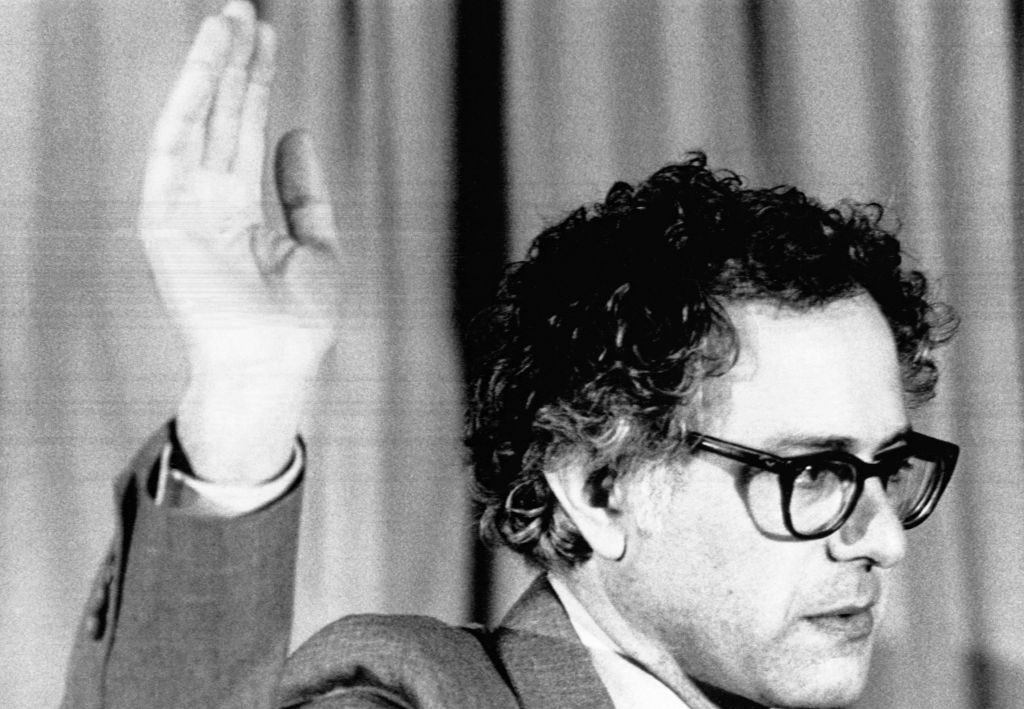
As Burlington's mayor, Bernie Sanders built a community land trust, rerouted snowplows to serve the working class, and invited residents into a process of self-governance. (Bettmann Archive / Getty Images)
- Interview by
- Natasha Hakimi Zapata
“I am a democratic socialist,” Dan Chiasson, the fifty-five-year-old author of Bernie for Burlington: The Rise of the People’s Politician, told me proudly over Zoom, his “Zohran for New York City” cap visible in the frame. Chiasson and I have known each other for over a decade — he was my professor at the poetry Master of Fine Arts program at Boston University — but this is the first time he has shared his political views directly with me. Best known for his precise and often deeply personal poetry as well as his poetry criticism for the New Yorker magazine, it likely came as a surprise to many that Chiasson’s latest book would be a nonfiction, 592-page memoir-cum-biography centered on Bernie Sanders’s time as mayor of Burlington, Vermont. But the signs had been there for some time: his childhood in Burlington has played a central role in Chiasson’s poetry all along.
Bernie for Burlington is a painstakingly detailed and deeply researched account of the eight years Sanders was mayor of Burlington and the years and circumstances leading up to his political ascent. The author was the ripe age of nine when Sanders first took his seat in Burlington’s city hall and in every sense of the word came of age during what, according to his book, seems to have been a thrilling time to be a Burlingtonian. With Reaganite neoliberalism sweeping through the nation, the Vermont city took a distinctly different path in electing a democratic socialist — and was forever changed by this decision, with some progressive programs begun under Sanders still in place today.
More than a memoir, the book reads like a lyrical love letter to the Burlington that made Chiasson, Sanders, and a whole memorable cast of characters the democratic socialists they are now. It is also a much-needed account of what can happen when a city is run by people who believe, as Sanders said in one of his final speeches as mayor, “that men, women, and children can come together in relationships that are not based on greed, exploitation, and domination — but on love, cooperation, and mutual respect.”
Natasha Hakimi Zapata
An important part of the structure of the book is that we’re getting the story from a “son of Burlington.” You were born there, grew up there, lived through the Bernie mayoral years and afterward, and maintain close ties there. You even told Bernie himself that you are a product of the Burlington he helped shape. What did a socialist, or perhaps more aptly, progressive Burlington feel and look like?
Dan Chiasson
The city is small, around 38,000, then and now, and very intelligibly laid out, almost as though to indicate the main functions and tensions of an American city. In fact, it was studied in the 1930s by an anthropologist as something of a model municipality, almost a kind of diorama of a city.
There is a steep hill rising from Lake Champlain; halfway up, city hall sits on a broad pedestrian mall, where people gather to shop and eat and dance and argue and demonstrate and march. At the top of the hill, somewhat apart and supercilious, is the University of Vermont, which looks out across the lake on one side, toward the Adirondacks, and toward the Green Mountains on the other.
The areas closest to the lake had been cleared in the ’50s for urban renewal. The immigrant families and communities were scrambled, and federal dollars began to flood the city. It had been a small, old-fashioned city, almost like a Richard Scarry–type city with cops and firefighters and postmen and parades, but corruption and poverty had become endemic. Meanwhile, throughout the ’70s, hippies had begun to move in from Arcadia and found clinics and daycares and the like. This is the stage setting for Bernie’s victory in 1981.
So I am indeed an outcome of a very weird, one-of-a-kind, low-budget American experiment. My sense of the horizon of the possible was shaped in Bernie’s Burlington. It seemed, for example, not ludicrous to aspire to be a poet. Bernie’s socialism was — partly of necessity, since other measures take time and money — articulated through the arts. I’d tried to remember in writing my book that the very sentences are cultural products or outcomes of a socialist project. In writing the book, I was paying back part of that debt.
Bernie’s successor in city hall, Peter Clavelle, told me that “a city needs a moral visionary.” What was that vision? Mainly, I think, equal access to happiness. My subtitle, before the publisher persuaded me to change it, was “The Pursuit of Happiness in One American Place.”
So, what’s happiness? It could mean relief from debt or worry. It could mean access to an affordable apartment. It might mean freedom from the fear of nuclear annihilation. It certainly meant access to beaches, a bike path, concerts, puppet shows, and circuses. It was something you could extend to little old ladies in tenements trying to access groceries and walk safely to church.
Sanders was really good on the nuts-and-bolts kind of sewer socialism stuff. He was really good at delivering plowed streets and keeping the property taxes down and fixing the curbs and getting the city the best deal on cable TV and all this stuff that really makes such a tangible difference in people’s lives. But he was also always articulating what the horizon of that politics was, and it had to do with, at the time — this is the ’80s — the trauma of living under the fear of nuclear apocalypse. One thrilling thing about Burlington was the element of guerrilla theater, as Bernie would goad and condemn “Mr Reagan” from his little lectern in city hall.
Natasha Hakimi Zapata
What made you want to write this book, several years after Bernie’s first presidential campaign and nearly four decades after he ended his tenure as mayor of Burlington, Vermont?
Dan Chiasson
As I was writing it, I began to feel that the dashed hopes of those very suspicious “losses” to the Democratic establishment in a way went underground, gathered strength, and have started to really bear fruit, the obvious example being Zohran Mamdani, the new mayor of New York City. But we’re seeing leftist candidates who espouse labor values and economic justice sprouting up all over the country, in every kind of community — sometimes just in emulation of Bernie but often with his direct mentorship.
I didn’t foresee Mamdani’s election any more than anybody else did, and the book was actually finished at that point, but my account of a campaign and the challenges of socialist governance bears on what we’re seeing on the progressive left now. I think my book is certainly the most comprehensive study of mayoral campaigning and analog politics at the end of that era. Some have said it’s, well, too comprehensive.
Natasha Hakimi Zapata
There is a sizable cast of characters in this book depicted in often delightful, certainly memorable detail — including Sanders’s longtime adviser Richard Sugarman, Debbie Bookchin, and even his brother Larry — but also many that go well beyond Bernie and his inner circle, including more than a handful with ties to the arts. I’m thinking of Bread and Puppet Theater, author Julia Alvarez, and Nobel Prize–winning poet Louise Glück. In fact, at times, it felt as if Bernie was almost a secondary character in this story. Tell me a bit about this choice — the narrative and political, maybe even ethical, reasons you may have taken this approach.
Dan Chiasson
It is an ensemble cast. I wanted to include as many named contributors as I could to the wacky experiment we called the People’s Republic of Burlington. And it happens to be the case that if you’re going to write a biography of a political rise, unlike a biography of a poet or an opera singer, it’s really about building coalitions. It’s really about getting people on board who will work like dogs for you and inspiring them. I felt that it was appropriate — both from my own political and ethical commitments, and because it was true to the nature of the narrative of his political rise, in particular — that it was the contribution of many hands. It created narrative challenges and opportunities. We follow many braided plotlines, a very dense weave.
Many of those characters along the way were unlikely allies. You mentioned Richard Sugarman, who was a religion professor at the University of Vermont, a scholar of the philosopher Emmanuel Levinas, a six-foot-four Orthodox Jew, who’s also a boxer — but who happened to be a hobby political strategist, and did a lot of snooping around in city hall, and showed Bernie that he had a path in the city of Burlington.
Or, a friend of my grandmother, a Catholic woman named Sadie White, a central figure in the book. I remember her firsthand from going to the church, and she would be at the front pew, a proper French Canadian lady like all the other ladies in the church. She had been a long-term Democratic legislator, the first woman elected to the Vermont legislature, and she was treated really badly by the Democrats.
By the time Sanders presented himself as a potential candidate for mayor, she was looking for somebody to support, and she had a Rolodex full of the names and numbers of old ladies, and she worked like a demon for Sanders. She went into those little community rooms and potluck dinners and got people registered. On Election Day, she collected their absentee ballots: these old ladies did not go to the polls in frozen March. And none of those folks were leftists, by the way — those were all culturally conservative French Canadian and Irish Catholics from the immigrant community.
Natasha Hakimi Zapata
You are well known as a poet and poetry critic — in fact, you were my professor during my MFA year at Boston University. Why should a poet tell this particular story?
Dan Chiasson
First of all, I do think that my becoming a poet is a concrete outcome of Sanders’s Burlington, and that has to do with the widening of possibilities, the widening of the spectrum of valid pursuits and passions, and even the belief that maybe you could make some kind of a living. That was all directly related to how attentive to young people and to artists the city became under Mayor Sanders.
Memory is the mother of the Muses, and I’ve always felt that my own poetry was based in particularly vivid memory for certain kinds of details that I can really call up and experience, almost as though I’m experiencing them for the first time. When I got to sitting down and putting this book together, I realized that I had made a first pass through a lot of this material in poems, and I wanted to make sure that poets were represented along with those who went on to become organizers or activists or founded food banks or founded free medical clinics.
There was considerable engagement, even from Bernie, in poetry. There’s a scene in the book where he’s just gone through this hellish campaign where his rival, a Republican, has accused him of acting like a Nazi. This was wild and rash and desperate, but Bernie’s father’s family had been decimated by the Holocaust. He was really shaken by that accusation, and he got up that night and read Dylan Thomas’s “Do Not Go Gentle Into That Good Night,” which is about a father’s death. So Sanders’s own way of relating to the world passes, I believe, through poetry, in a surprising way. I was also told that he writes his own poetry. I was told it’s not very good, but perhaps those works will come to light sometime in the future.
Natasha Hakimi Zapata
Sanders’s city hall certainly seemed to take a “Bread and Roses” approach, and that is evident in both the descriptions of the Sanders tenure and also the way that you’ve composed the book. Jeremy Corbyn, the UK’s Bernie of sorts, edited a book of poems he put out with OR Books not long ago, and he talks about how one of the reasons that he thinks it’s so important is that young people are connecting so much with spoken word and with poetry in general, that it is an important part of our political lives, and that we need to give it the place that it deserves. That seems to be something that he shares with Bernie.
Aside from his contributions to the arts and how these personally inspired you, what would you say were some of his greatest successes and failures as mayor of your hometown?
Dan Chiasson
The soft answer to that is just the feeling that there was a moderated, ongoing, daily conversation about politics and cultural change in the city. The thrilling thing about that was that we Burlingtonians were the protagonists of that unfolding story. This was a narrative politics: we had written together this arresting opening chapter, and by shaping time and political opportunity with our own bodies and actions, we were writing its chapters.
A more concrete example: Sanders knew that the very first critique of any leftist politician is going to be, “Are they competent? Can they run a government? Can they run a city government?” Because if they start screwing up, then it’s going to reinforce all the clichés about leftists being idealistic and naive and so on. So he brought in an astounding bank of talent to run city hall. One example was the city treasurer, a guy named Jonathan Leopold, who was ideologically aligned with Bernie but looked like a Wall Street banker. He wore J. Press bow ties, and he was very natty in blue suits. He was just such an amazing contrast with Bernie, who was in shitkickers and corduroys. Jonathan Leopold was an incredible accountant, and he found a $1 million windfall in the city budget at the time, which would be about $9 million today.
This became seed money that Bernie and his administration could use to set up the first community land trust of its kind in the country. The way it worked was this: the city would buy distressed properties. They would put folks in there who were in jobs, training programs, learning carpentry on the job. Some teenagers — friends of mine — did it, as did women going back to the workforce. They would fix the property up. They would sell you only the four walls. The land itself would remain owned by the City of Burlington. You’d own just the house. You could sell it back into the land trust. Your own profit was capped at 25 percent.
Eventually, the city had bought up about a quarter of real estate in downtown neighborhoods, which drove not only the cost of those properties down but also the entire market down. Suddenly, the city-owned properties are selling below market value, establishing a new market value. So it did result concretely in affordability. There were the predictable objections — funny enough, even in my own family, there were people who thought it was communism and therefore bad. The experiment markedly changed the city. That’s just one example of Bernie finding money and spending it intelligently to improve the community.
There are a couple of failures I might point to: One was a noble crusade but ultimately failed, and that was to tax the University of Vermont’s Medical Center. It presages everything that Sanders has done since around equal access to medical care and Medicare for All and so on. The city of Burlington does not have a large financial elite; the upper class in Burlington is, by and large, doctors. We have a huge hospital up there — the biggest hospital outside of Boston in New England. And people come from all around the world to get treated there.
As a result, all the BMWs, all the Mercedes, all the Porsches were driven by doctors. Now, when your doctor drives by with a set of golf clubs in the back of his Mercedes, you might just think, something isn’t quite right here. This is not “socialism” — it’s simply “I’m going into debt to pay for a new hip.” Sanders tried to tax the hospital and had a very strong base of support to do that, but it went through the courts and was ultimately shot down.
In terms of a failure of conception, he did support a very ambitious makeover of our waterfront. Burlington sits on Lake Champlain, and there was a twenty-acre parcel that had belonged to the railroads and was long abandoned. There were petroleum tanks, junked freight cars, fires. Sanders engaged the legendary architect Ben Thompson, who had done Faneuil Hall in Boston and South Street Seaport in New York, and for about four years, Bernie was crusading to have a significantly privatized development on the waterfront, condos and brasseries and that kind of place, for rich people with boats. He lost the plot. Initially, it looked potentially like a freebie, because he felt that he could find federal dollars to do this through a program called Urban Development Action Grants. It’s a long story that I tell in the book, but in the end, we got a park, and it’s a much better outcome.
Natasha Hakimi Zapata
What do you think Zohran Mamdani and others like him can learn from Bernie’s mayoralty? Are there echoes you can already see between the two mayors?
Dan Chiasson
Yeah, absolutely. There were quite deliberate echoes during the campaign, when Sanders became a pretty active mentor to Zohran, and it was ironic and wonderful that — for the first time, I think — I saw Bernie really sit down and talk about his years as mayor. It frustrated me when he was running for president that he didn’t talk more about that. That’s an executive position. It has a lot more to do with being president than being a Washington legislator. But he finally sat down with Mamdani and discussed his achievements as mayor. I saw him even get a little bit verklempt. Mamdani ended up using Bernie’s slogan, “New York City is not for sale.” Bernie used “Burlington is not for sale.”
Of course, there are major differences because of the scale of New York City; Burlington has 38,000 people, compared with 8.5 million in New York City. But in a way, what Mamdani figured out is to use social media to create that one-on-one feeling of trust we had with Sanders. Sanders, during his Burlington runs and as mayor, was indefatigable. He was on your front door, knocking. There was a public-access TV channel that Sanders put in, and he was the star of it. He also promised concrete deliverables, like keeping the property tax from going up, while Zohran is promising free buses and childcare. For Sanders, it was very important to bring in the state government, but no picnic, and it looks as though Zohran will have a similar kind of productive relationship with Governor Kathy Hochul.
I think there is a sense that the Sanders playbook, kind of writ large, is the playbook for New York City. I will say that we sent my book in galleys to the Mamdani campaign. I’d like to believe they used it, of course. They did very gratefully receive it.
Natasha Hakimi Zapata
I was pleased to see that both of them made snow shoveling a priority, which doesn’t seem exactly socialist but goes a long way toward showing what your city government can do for you in your time of need. And this can actually build support for democratic socialism overall.
Dan Chiasson
Right out of Bernie’s playbook. Sugarman, who is from Buffalo, told me that he told Bernie about “the political possibilities of snow.” He did two things, both entirely free. First, he changed the routes the plows made through the city to advantage poor and working people who had to walk to find services. The city used to be plowed from the top of the hill to the bottom of the hill. The people at the top of the hill lived in the pretty Victorians with views over the lake. The people at the bottom of the hill, who lived in much denser, poorer neighborhoods, had to wait to have their streets plowed. And second, he instituted a program called “Operation Snowshovel.” It sounds like a military invasion, but it was simply a volunteer network, coordinated by city hall, that hooked old people and the disabled up with strapping, Adonis-like UVM frat brothers and other hale sorts. That program built a lot of trust and repaired a lot of ruptures between the university and the city’s working people, who had to tolerate the partying and general brattiness of the students.