Is British Steel the Next Green Betrayal?
UK Prime Minister Keir Starmer’s dying government is planning to nationalize British Steel, but things are not quite what they seem. His proposals may lead to thousands of job losses and cash handouts to corporations.
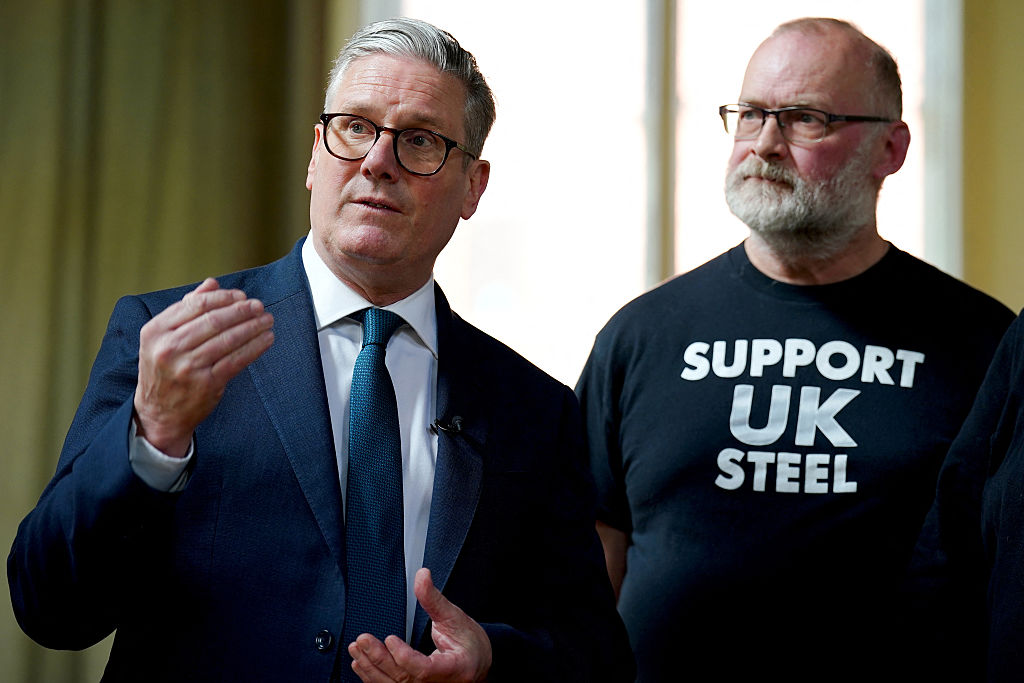
In Britain, Labour has pushed a net-zero agenda that has led to job losses for workers and bailouts for corporations. Reform tapped into anger at this failure in the local elections, but its brand of reheated neoliberalism would only deepen the problem. (Peter Byrne / POOL / AFP via Getty Images)
Just days after Britain’s right-wing party Reform won a huge number of local government seats in Lincolnshire, home of the UK’s last remaining coal-fired steel mill, Keir Starmer’s Labour government announced it will bring forward legislation to nationalize British Steel. But rather than save the mill and Labour’s remaining votes in the region, the move puts thousands of jobs at risk.
British Steel has been in financial trouble for the past half decade. The ailing firm was bought by the Chinese steelmaking company Jingye Group in 2020. But despite a range of government financial incentives, Jingye claimed they were unable to run the mill profitably, losing around £700,000 a day. In 2022, the then-Conservative government entered into negotiations with Jingye Group to support the transition from coal-fired blast furnaces to electric arc furnaces, to ensure legal climate targets for decarbonization were met.
Despite multiple rounds of negotiations, including a final government offer of £500 million in March 2025, the two sides failed to reach an agreement. In response, Jingye announced plans to shut down British Steel’s two remaining blast furnaces at the Scunthorpe Steelworks. The direct threat of an immediate operational halt triggered the government to step in with emergency legislation in April 2025 to take control of the site and keep the blast furnaces running.
The government’s decision to bring forward legislation to fully nationalize British Steel seems like a promising resolution of the saga. Yet it is far from straightforward. While Starmer has stressed that the move will protect a vital national industry and the thousands of jobs it provides, the more immediate reason for the government’s urgency was the May 7 local government election results.
The result of the local elections was, predictably, devastating for the Labour Party. Labour lost almost 1,500 councilors and control of thirty-eight local authorities, as well as falling to third in the Welsh Senedd. While the left-wing Greens under the leadership of Zack Polanski were largely responsible for winning over former Labour voters, Reform were the main beneficiaries. Nigel Farage’s party took control across regions dominated by manufacturing and heavy industry. The result has been a clamor for a change of leadership in the Labour Party. Starmer’s plan for British Steel is an effort to ward off both challenges to his leadership.
A Green Fix?
Nationalizing British industries has long been a demand of the union movement. Faced with the pressure to decarbonize production, high energy prices, and fierce international competition, bringing critical sectors back under state control offers both security of employment and a just form of industrial climate transition.
But not all nationalizations are the same, and what the Labour government is proposing is not a return to the industrial policies of the 1970s. The proposed nationalization of British Steel is far more akin to the bailouts and partial nationalizations of banks after the 2008 financial crisis. The aim is to shift the costs of turning the mill into a profitable green venture onto the state in order to make British Steel attractive to a future buyer.
Accordingly, while in the immediate term jobs will be protected and production maintained, this cannot last.
Since instituting government control over British Steel, the government has spent over £400 million to keep the mill running. Nationalization doesn’t make production profitable and, so as long as the mill is run “as is,” the cost to the government will continue to mount. To run the blast furnaces until 2028, the earliest date electric arc furnaces could be installed, will cost another £1.5 billion. Installing electric arc furnaces will cost another £1 billion. Given the government has only set aside £2.5 billion in its Steel Strategy to fund the green transformation of the entire UK steel industry, it’s not clear how long it will want, or be able, to fund loss-making production at the mill.
There are at least two further issues with the government’s plan. The first is that installing electric arc furnaces may well take longer than three years, as not only do British Steel not have an agreement for a national grid connection, they do not even have contracts in place to buy the electric furnaces, meaning the taxpayer would have to financially support the mill for much longer.
Secondly, running the electric furnaces might worsen the mill’s economic performance. The UK has some of the highest energy prices in the Global North. Which means switching to electric arc furnaces may well increase pressure on British Steel’s bottom line as they struggle with high production costs. All of which may push the government to rationalize production — and cut jobs — at the mill.
Even if the mill somehow quickly transitions to electric furnaces, and the government reforms the energy sector to make the mill competitive, jobs will still be lost. They will be lost for the simple fact that electric arc furnaces are less labor intensive, meaning the mill’s workforce will shrink.
This is what happened at Wales’s Port Talbot Steelworks two years ago. Port Talbot was in a similar situation to British Steel, and took the deal that Jingye Group rejected. The UK government gave owners Tata Steel £500 million in financial support to transition to electric arc furnaces and declared the deal a win, protecting jobs. The next day Tata Steel announced they were firing half the workforce as they weren’t needed to run the electric furnaces.
Reform cashed in on the debacle, promising to restart the blast furnaces and reopen the coal mines. Both are impossible, and it is unclear whether there is an appetite for a return to this kind of work among young Brits anyway. But the hollow promise was more than enough to drive workers to join Reform. The government’s plan to nationalize British Steel risks repeating Port Talbot’s betrayed promises by ensuring more job cuts under the guise of green jobs.
Tariffs and Plans
Starmer’s government has no real plan to save British industry. It is far too wedded to neoliberal orthodoxy to seriously consider more ambitious plans for nationalization. The furthest he appears willing to go is to introduce tariffs to “protect” industry.
Alongside the British Steel announcement, the government also proposed a change to the existing steel tariff regime. British mills currently produce around 30 percent of the steel required for domestic consumption, meaning there could be room to increase domestic production.
There is currently a 25 percent tariff on amounts in excess of specified volumes per steel product category. The government has announced this will rise to 50 percent, and tariff-free volumes will be reduced. The problem with this is that, as was the case with US steel tariffs, the tariffs are likely to cost more jobs across the UK’s manufacturing and construction sectors than they protect in the steel industry.
Starmer’s plan isn’t to save British Steel but his job. But given British Steel is being nationalized in name only to make it attractive to private investors, it’s unclear how this gamble could pay off for him and his ailing government.
The mill will be transitioned to electric arc furnaces over the next five or so years, with likely some level of blast furnace output, though much reduced. Not just hundreds of millions but billions of pounds will be spent on the project, keeping it running for years until it is profitable enough to be an attractive asset for investors. And more than likely jobs will be cut, both directly and indirectly, to reduce costs and to ensure its attractiveness to potential buyers. As with Port Talbot, workers will blame net zero and decarbonization for the loss of their jobs and likely turn to the only party promising to restore the glory days of coal — Reform.
North Lincolnshire, where British Steel has its town-sized mill, went solidly Reform on May 7.
Reform’s local election won’t save British Steel. It’s likely that victory at the national election in 2029 won’t either. Reform’s policies are largely a fusion of authoritarian crypto-bro ideas and punitive neoliberal policies. Where Reform had once promised to nationalize industry, they have since quietly walked these promises back.
Instead, they now promise to increase oil and gas exploration and roll back green policies, in an effort to make industry competitive. But neither will work, and eventually Reform will also betray the workers it pretends to support.
The tragedy is that the only way to protect workers in heavy industry is through state action — not by de-risking private investment but by investing in the creation of state industries across the entire industrial ecosystem. Decarbonization is not the villain here, the current Labour government is. But if the market still rules, net zero will politically serve much as immigration does — as a convenient excuse for the violence of neoliberalism.