Labour’s Misplaced Faith in a Capital-Led Green Transition
The Labour Party has retreated on its ambitious climate spending pledges, scrapping a plan to invest £28 billion a year in green energy. But the continued reliance on private capital to drive a rapid green transition is a demonstrably bad bet.
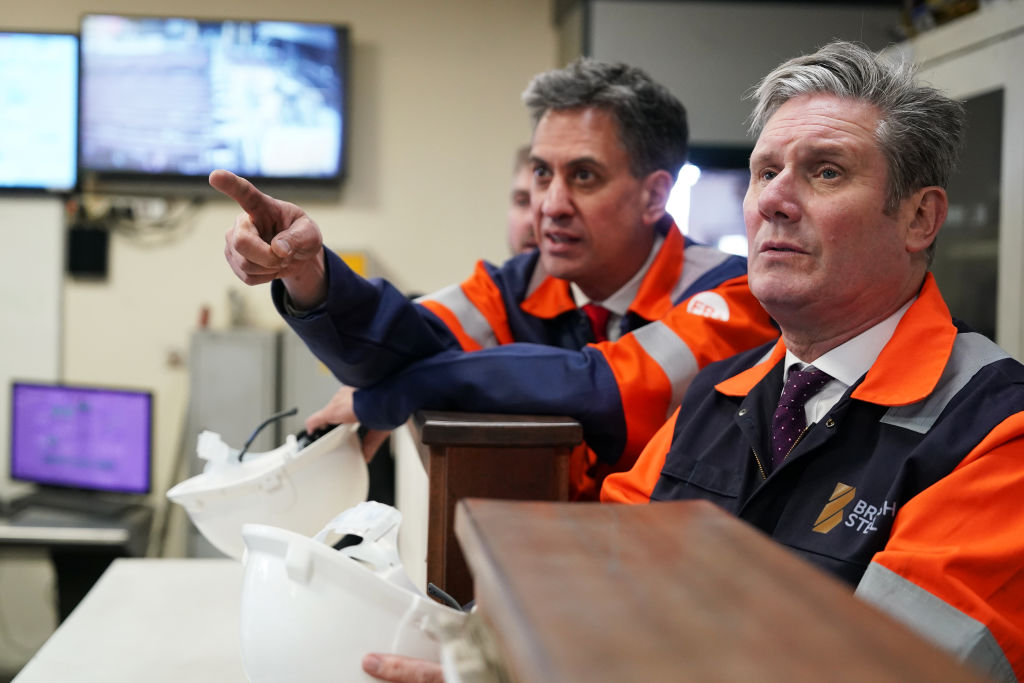
Labour Party leader Keir Starmer and Shadow Climate Change and Net Zero Secretary Ed Miliband visit the British Steel manufacturing site in North Lincolnshire on June 8, 2023 in Scunthorpe, England. (Ian Forsyth / Getty Images)
With the Labour Party officially abandoning its pledge to invest £28 billion a year in its Green Prosperity Plan, two elements of the party’s green platform remain. One is its proposed publicly owned clean energy company, Great British (GB) Energy, with initial funding of £8.3 billion, paid for through government bonds. The other is its ambitious target to fully decarbonize by 2030, for which the vast majority of necessary investment has not yet been undertaken. Despite the death knell of the £28 billion, the political contest over the green transition has only just begun.
Where the UK has had success in green energy policy in recent years has reflected a growing repudiation of market orthodoxies and a recognition of the state’s integral role in coordinating any effective transition. However, few are willing to shatter the halo around the private sector’s role as the agent of investment; the state, on this account, must merely “derisk” investment for the private sector (where the state encourages private investment by taking responsibility for potential losses — a concept critically popularized by economist Daniela Gabor and now uncritically embraced by Rachel Reeves). In other words, the conviction that the state must bring the private sector horse to the renewable water, that it will drink, and that this is the right division of labor between public and private, continues largely unexamined.
But given that all paths to delivering renewable investment must run in some form through the state, the political question then becomes how best to deploy the state’s capacities toward delivering the transition. Some proposals for an unambitious iteration of GB Energy see it as an extension of the status quo, operating more like a high-risk venture capital fund to subsidize private investment in newer renewable technologies. Against this, recent research by Common Wealth argues that such a limited version of GB Energy would be rendered untenable by the fragmentation and volatility of the for-profit private renewables industry. Instead, a green investment sprint could be undertaken by GB Energy at the scale of the whole energy system — displacing private capital, overcoming the sector’s fragmentation, and socializing investment decisions. This would deliver the necessary transition faster, fairer, and more cheaply.