Class Struggle Was a Crucial Part of the American Revolution

The American Revolution was linked to a surge of working-class political activity on both sides of the Atlantic. The struggle against British rule unfolded in tandem with another struggle over who would dominate the post-independence US.
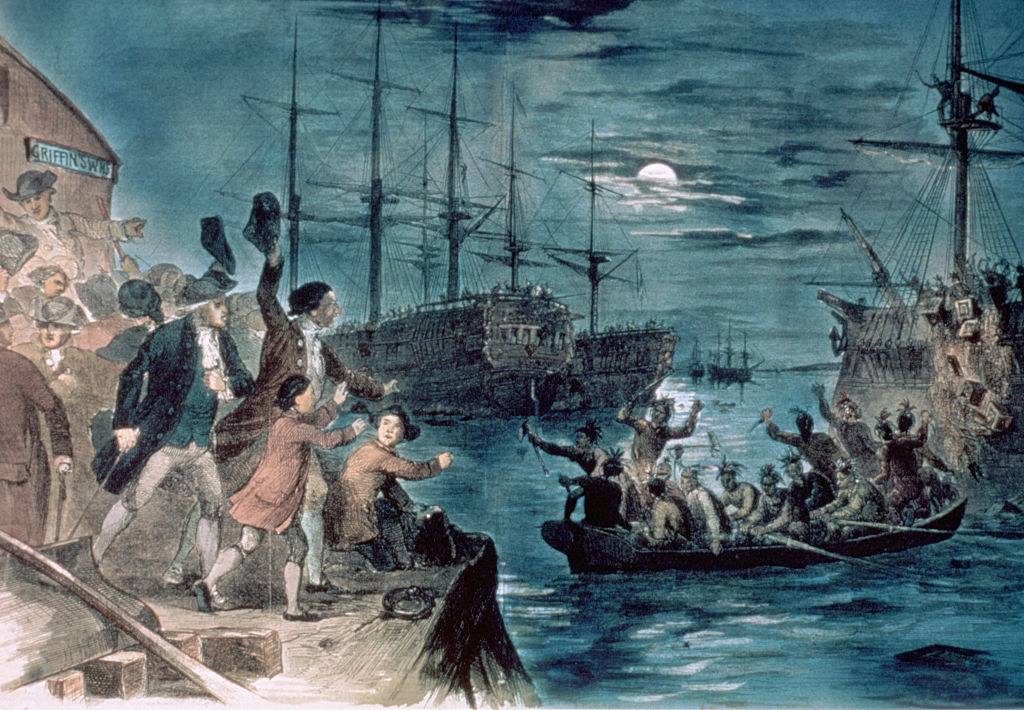
A painting depicts the 1773 Boston Tea Party.

Class conflict is a neglected but crucial theme in the American revolution. Many historians see the Constitution as the response of American elites to the threat of redistributive democratic politics. (Bettmann Archive via Getty Images)


Late in 1776, with the War of Independence underway in the American colonies, a twenty-four-year-old housepainter named James Aitken walked into Britain’s most important naval dockyard and set it on fire. The damage was significant: estimates for repairs were twice the value of the tea destroyed at Boston harbor three years earlier.

The sense of threat experienced by Britain’s ruling elite was also profound. Few people today remember Aitken’s acts of sabotage against the British war machine. But they deserve recognition as part of the wider transatlantic workers’ struggle that helped make the American Revolution.

Spirited Conduct

Three years earlier, Aitken had been in Philadelphia. There, the city’s working class had been gradually taking over political leadership since the mid-1760s. Some people were appalled by their confident sense of equality. In the words of one clergyman: “The poorest laborer upon the shore of the Delaware thinks himself entitled to deliver his sentiments in matters of religion or politics with as much freedom as the gentleman or scholar.”

Organized in patriot committees that worked consciously to cross ethnic and religious divisions, Philadelphia workers pushed forward the conflict with British imperial power. Like their comrades in Boston and other port cities, they saw the cause of colonial liberty as a chance to redress the balance of social power.

Aitken was probably in the crowd when eight thousand Philadelphians, roughly a quarter of the city’s population, turned out to demonstrate against “the detestable tea-scheme” of the British East India Company, which had (in the words of “A Mechanic,” writing in the Philadelphia Gazette) reduced “whole provinces” in India “to the distresses of oppression, slavery, famine, and the sword.”

Philadelphians already knew that a crowd in Boston had dumped their own delivery of tea into the harbor. Now merchants and lawyers from the moderate wing of the patriot movement hoped to avoid that kind of unruly violation of property. To their consternation, the Philadelphia crowd kept faith with their Boston counterparts, endorsing their “spirited conduct in destroying their tea.”

Learning From London

Such public disorder was hardly exclusive to the colonies. If anything, working-class organizers on the North American seaboard learned their steps from fellow travelers in London. There, at the heart of the empire, agitation against government corruption and tyranny was led by a similar coalition of laborers, artisans, and their middle-class allies.

John Wilkes, a leader of the London crowd since 1762, was a symbol of popular opposition on both sides of the ocean. There were riots when he was imprisoned for libel in 1768, with several supporters killed by royal troops. By 1774, Wilkes was both a member of Parliament and lord mayor of London, a perpetual thorn in the government’s side and an inspiration to many patriots across the Atlantic.

By the time James Aitken arrived back in England in the spring of 1775, the crisis in the colonies had turned into a shooting war, and an army was being mustered to put down the rebellion. Landing at Liverpool, Aitken worked his way back to London in part by signing up for newly formed regiments, then pocketing the bonus and absconding.

Much of the talk in English towns and cities was about how badly war would impact transatlantic trade — which meant, in turn, the jobs and livelihoods of working people. While merchants were divided, much of the most consistent support for American rebels came from those, including poor folk, who saw in the struggle something more than just the ups and downs of commerce.

Lawful Authority

The egalitarian and democratic impetus behind the revolution was expressed in moments of crowd action on docksides, streets, and marketplaces, but it was also crystallized in a series of revolutionary texts. Writers like the schoolteacher James Burgh railed in print against the accumulation of political power among a tiny ruling class and the subversion of representative government by executive patronage and bribery.

“All lawful authority,” Burgh wrote, “originates from the people.” Yet the poor, he noted, were “utterly deprived” of their share in power. In the final volume of his treatise, published in 1775, Burgh called for wholesale transformation of the British state. “When the people take redress into their own hands,” he warned, “woe to the tyrants.”

Others, like the historian Catharine Macaulay, made similar revolutionary calls. “Rouse, my countrymen!” she wrote in a pamphlet that predicted the spread of tyranny from the colonies to the mother country, “Rouse! and unite in one general effort.”

It was rhetoric like this that Aitken encountered when he got home from his brief time in the colonies, and that helped him conceive of his own contribution to the overthrow of imperial tyranny. “An important revolution in the affairs of this kingdom seems to be approaching,” wrote the political economist and preacher Richard Price in early 1776. It was perhaps a final chance to restore the lost liberty of ordinary citizens.

The Meanest Insect

Historians have sometimes downplayed the revolutionary nature of these British texts, comparing them unfavorably to the out-and-out attack on monarchy that Thomas Paine — himself a recent migrant — published in Philadelphia as Common Sense. In their context, though, they were just as incendiary.

Written to avoid the charges of sedition that had plagued Wilkes in the 1760s, they were easily interpreted by those prepared to grasp their scarcely hidden message. Aitken was one such reader. By the middle of 1776, he was preparing to join the struggle.

Portrait of James Aitken, British revolutionary
A portrait of British revolutionary and saboteur James Aitken (1752–1777), alias “John the Painter”

Aitken wasn’t a lone wolf. Before he went ahead with his campaign of sabotage, he traveled to Paris to consult with the patriots’ envoy in Europe, a Connecticut merchant called Silas Deane. There, he had a conversation with Deane that helps to reveal the basic underlying motive that sustained so many revolutionaries. Is it right, Aitken asked Deane, to seek revenge against those who oppress you?

“Go to the fields,” Deane replied, “and tread on the meanest insect, and see if it do not at least try to turn upon you.” The image, which goes back to the sixteenth century and the first great age of enclosure in the English countryside, recalls the rattlesnake flag used by South Carolina revolutionary Christopher Gadsden. Even the weak, it implies, have a natural instinct for resistance. That is what Aitken wanted to hear.

“Farewell Aristocracy”

Colonial elites, of course, had their own ideas, sometimes based in the same deep-rooted imagery. Consider the New York lawyer Gouverneur Morris, who would later write the preamble to the Constitution. He could see in 1774 that the colonial crisis was tending toward an increase in working-class power.

“The mob begin to think and to reason. Poor reptiles!” he famously wrote to Pennsylvania governor (and grandson of the colony’s founder) John Penn. “Ere noon they will bite, depend upon it,” he went on — and then, “farewell aristocracy.”

Morris and men like him, including many of the colonies’ most prosperous slaveholders and wealthiest capitalists, ultimately found ways to benefit from the convulsions of revolution. They built a government that helped entrench the slave system, facilitate its westward expansion, and maintain the power of monied elites at the top of American society.

With the support of many poor white people eager for access to land and the economic security that they believed went with it, they also intensified the colonists’ genocidal war against indigenous Americans. Yet from the outset, men like Morris knew their struggle had to be waged on two fronts: against Britain and against democracy.

Striking Such a Blow

Richard Price, Catharine Macaulay, and their friends, by contrast, understood colonists’ struggle as a pathway to new democratic possibilities in Britain and beyond. Their focus was less on the construction of new independent states across the ocean and far more on undermining the awesome power of the British imperial ruling class.

That was the program Aitken was engaged in when he set out to burn down the Portsmouth dockyard. Everyone knew the navy was the linchpin of British power. By taking out its capacity to build and repair ships, he hoped to “strike such a blow as will need no repetition.”

As it turned out, the fire at Portsmouth — and others that Aitken set in Bristol, second city of the British slave trade — had a less than decisive impact on Britain’s capacity to wage war. It was the loss of an army at Saratoga, followed by the full-scale French entry into the conflict in 1778, that really put the British on the back foot.

For a while, though, Aitken’s arson attacks struck fear into the British establishment. As reports of more attempted acts of sabotage came in from across the country, the king’s ministers had to face the fact that many ordinary people hoped for their defeat in the war. When a crucial rope was cut on board the ship carrying Lord Carlisle (Frederick Howard) to America for peace talks, the earl feared he was the next victim of revolutionary sabotage.

The General Effort

British wartime vulnerability created opportunities for working people and their allies all over the empire. In Ireland, crowds of Dublin artisans helped force concessions on free trade and, later, legislative independence. Yet British leaders found an effective response — driving a wedge between organized workers and their middle-class allies in the Irish patriot movement. By attacking Dublin’s incipient trade unions (alleged “sources of idleness, drunkenness, and cruelty”), they won support from the business community and headed off the imminent threat of revolt.

In London too, the long-standing collaboration between laborers, artisans, and the commercial middle class proved a point of fracture as the possibility of revolution grew too close for comfort. When huge crowds took to the streets in the summer of 1780, burning the home of the Lord Chief Justice, throwing open prison gates, and attacking centers of imperial power like the East India Company offices, it seemed as though the “general effort” Macaulay had called for might finally be at hand.

For days, city magistrates stood on their principles and refused to allow troops to quell the uprising. When it came to it, however, even John Wilkes chose to side with the establishment — he manned the defensive barricades as the crowd tried to destroy the Bank of England, shooting dead two rioters with his own weapon. At that point the army marched in, ignoring the magistrates and crushing the rebellion.

Even in the colonies themselves — now independent, republican states — the patriots’ cross-class coalition sometimes broke down into outright violence. A shoot-out in Philadelphia, known as the Battle of Fort Wilson, took place in 1779 between working-class militiamen and a group of so-called republicans who aimed to replace Pennsylvania’s democratic constitution.

As the immediate British threat ebbed away during the 1780s, class conflict emerged with increasing ferocity, erupting in armed rebellion in 1786. Many historians see the Constitution of the following year as the response of American elites to the threat of redistributive democratic politics.

Doves Will Peck

Like so many moments in working-class history, then, the American Revolution deserves to be understood neither as a victory nor as a defeat, but as a passage in an ongoing struggle. The revolution need not be dismissed as simply an origin story for the United States, and therefore for the oppression and terror that the United States has wrought. Alexandria Ocasio-Cortez was at least a bit right when she said, earlier this year, that revolutionaries fought “against the billionaires of their time.”

Men like James Aitken find their modern-day successors in those, like Ruby Montoya and Jessica Reznicek, who have used incendiary devices to sabotage the instruments of environmental destruction. Or in those, like the activists of British group Palestine Action, who have worked to incapacitate the machinery of war used to wage genocide on the people of Gaza.

The revolution in which they are involved goes beyond any national boundaries. It stems from the basic animal instinct for freedom and collective self-defense. As William Shakespeare put it, in words familiar to Silas Deane and James Aitken, “the smallest worm will turn being trodden on / and doves will peck in safeguard of their brood.”