The Vatican vs. Mar-a-Lago
Pope Leo XIV is making it impossible to reconcile MAGA politics with Catholic faith.
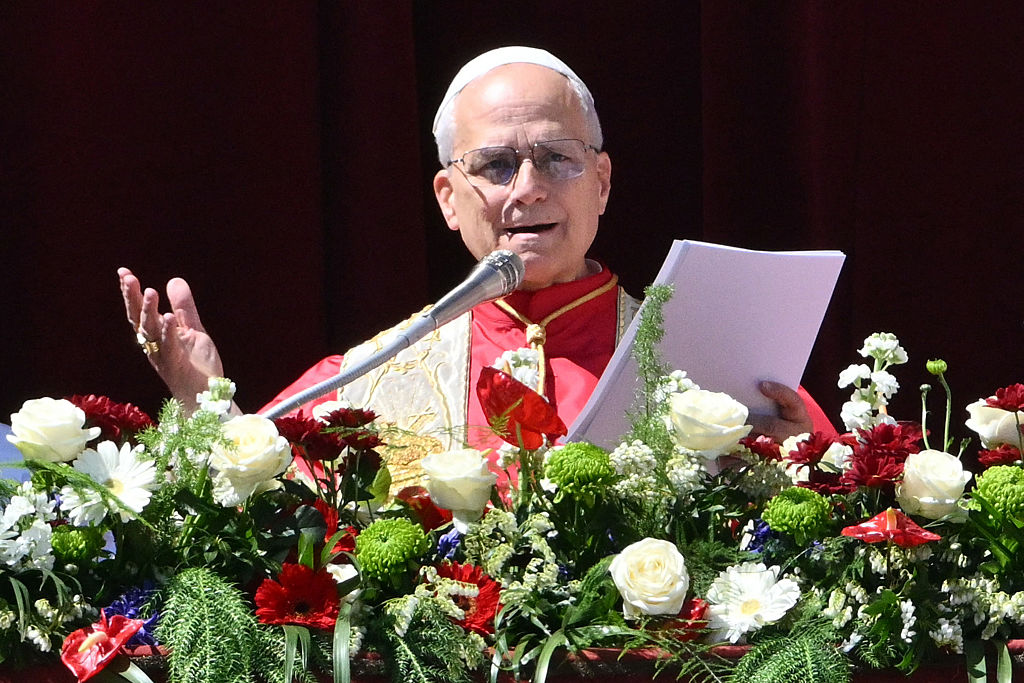
Within the US Catholic church, Leo’s interventions may decisively undercut those who have argued for a “seamless garment” of Catholic faith and MAGA politics. (Alberto Pizzoli / AFP via Getty Images)
“Even though you make many prayers, I will not listen: your hands are full of blood.” As thousands of believers filled St Peter’s Square in the Vatican for the rites of Palm Sunday this year, Pope Leo XIV chose to include in his homily these words that God speaks at the beginning of the Book of Isaiah. In the context of his brief homily, it was the last of several Bible verses Leo chose to illustrate the idea of “Jesus, King of Peace.” But in the context of the Trump administration’s ongoing war on Iran, it was immediately understood as a direct rebuke to a prayer service led by Defense Secretary Pete Hegseth at the Pentagon a few days earlier, in which he had besought the Almighty for “overwhelming violence.”
Leo may not have intended his words as a direct response to Hegseth — a pope hardly needs a special excuse to preach about peace at Easter time — but Leo did nothing to discourage that interpretation. A few days later, when asked about Donald Trump’s threat to destroy Iranian civilization, Leo unequivocally rebuked such threats as “unacceptable,” and directly asked that Americans call their congresspeople to demand an end to hostilities.
This was not the first time Leo had chosen to venture into American politics in this first year of his papacy. He had previously made public comments against the mistreatment of immigrants and against the occupation of Minneapolis. But this time, the Trump administration’s response has been far more aggressive. President Trump made a rambling late-night post on his Truth Social network to announce that “Leo should get his act together as pope”; Vice President J. D. Vance chided the Supreme Pontiff to “be careful” about what he says; and a whole series of lesser officials and right-wing media personalities lined up to denounce the pope’s statements.
When asked about these attacks by the press, Leo stated, “I have no fear of the Trump administration,” and he has gone on to show himself uncowed. At a recent prayer meeting on his tour through several African countries, Leo returned again to the theme of his Palm Sunday homily — this time not quoting the Bible but speaking in his own words: “Woe to those who manipulate religion and the very name of God for their own military, economic, or political gain, dragging that which is sacred into darkness and filth.”
Against War, for Welcoming the Stranger
While Leo may have chosen to take an unusually direct approach in his rebukes of the Trump administration’s immigration policies and wars, his positions themselves should surprise no one. While Hegseth and any number of younger, far-right executive branch staffers may love talking about holy war and appropriating to themselves the imagery of the medieval crusades, the Catholic Church in recent centuries has tended to reject this martial ideal.
Even the ancient tradition of “just war” theory, first articulated by St Augustine under the declining Western Roman Empire and refined throughout the Middle Ages, is best understood not as a justification for war but as the imposition of strict conditions and limits on the involvement of Christians in war.
While Christian societies have habitually fallen short of this commitment to peace, it has never been displaced from the Catholic church’s intellectual tradition. Paul VI’s slogan “Never again war!”, John Paul II’s call for the abolition of nuclear weapons, and Francis’s view that the conditions for a “just war” are impossible to meet in the modern world are not, as some reactionaries imagine, the infiltration of some secular political ideology into papal statements but natural developments of the church’s ancient teachings against war.
Less well known, but equally important for Pope Leo’s engagement with American politics, is the Catholic church’s tradition of advocacy for immigrants. Ever since the modern phenomena of mass migration began in the nineteenth century, the popes have been eager to promote the welfare of immigrants and to condemn their legal mistreatment. While some of this may have arisen from sectarian interest — Catholics have always been well-represented among immigrant communities — the popes have always insisted that it has a theological basis as well.
In response to the ongoing problem of refugees in Europe after World War II, Pius XII produced the church’s most forceful articulation of its teaching about migrants. Invoking the Gospel account of the infant Christ’s flight into Egypt from the wrath of Herod, he commanded Catholics everywhere to welcome and care for migrants in their midst.
In light of these teachings of his predecessors, it is not at all innovative or “progressive” that Leo XIV should condemn the brutal tactics used by US Immigration and Customs Enforcement (ICE) or call for a “universal authority” to rein in countries’ pursuit of their own interests. But to many US observers, these comments seem to have come out of nowhere — to the pleasant surprise of some and to the dismay of an administration that has been caught off guard.
The main reason for this surprise lies in the highly selective way Catholic thinking about politics has been represented for US audiences — by political pundits and even by the US bishops themselves. The public reception of Catholicism, for Catholics and non-Catholics alike, is largely shaped by Catholic bishops, nonprofits, and media figures, all of whom decide which elements of the ancient traditions of Christianity they will focus on and how they will portray them.
This is inevitable: ordinary Catholics (and other people interested in understanding the church’s doctrine) generally don’t have the time to pore over thousands of pages of historical theology or even to study the official statements put out by the Holy See. But the choices that have been made in the United States about the public presentation of the church’s political stances have not just simplified or popularized but also distorted — and sometimes actively misrepresented — what the popes have taught in an official capacity.
A New “Americanist Heresy”
Perhaps the most egregious example of this US phenomenon is the idea, widely promoted by Catholic political groups, of the “five nonnegotiables” that supposedly constrain Catholics’ political choices. Created as a kind of voters’ guide for the 2016 election by the right-wing apologetics group Catholic Answers, this idea found wide acceptance among Catholic groups and has continued to appear in church bulletins, homilies, and Catholic journalism ever since.
According to this framing, politicians with an incorrect view on the supposedly “nonnegotiable” issues — abortion, euthanasia, stem-cell research, cloning, and gay marriage — must be opposed by all Catholics, who cannot vote for them without falling into sin (for the 2024 election, a “nonnegotiable” anti-trans stance was often added to the list). And it is usually presented with the strong implication that all other issues on which the church may have a stance — war and peace, public health, economic justice, environmentalism — are merely “prudential” questions that may have better or worse answers but are always trumped by the “nonnegotiables.”
This narrowing of politics to culture war is hard to justify theologically, and it never quite won the formal endorsement of the US conference of Catholic bishops. Nonetheless, their repeated statements about the “preeminent priority” of abortion as a political issue have been widely — and perhaps correctly — understood as an implicit endorsement of this framing.
The choice of US Catholic leaders and institutions to prioritize a politics of culture war broadly aligned with the Republican Party has been consistent in recent years, but it should be understood as an American and not a Catholic phenomenon. The Catholic church in other countries also maintains a moral objection to abortion, for example, but there is almost never any suggestion of an absolute ban on voting for or collaborating with pro-choice politicians.
While they have been prepared to brook no compromise on these questions of culture war, the public intellectuals of US Catholicism have shown themselves extremely flexible in reconciling other priorities of the Republican Party with Catholic teaching. Despite John Paul II’s unequivocal opposition to the 2003 invasion of Iraq, the bishops mostly kept quiet, and influential US Catholic neoconservatives like Michael Novak, Richard John Neuhaus, and Robert George had no compunction about respectfully rejecting the pope’s judgment.
After Benedict XVI published a long and thoughtful encyclical letter defending redistributive economic policies, George Weigel took a break from his duties on the advisory council of the Victims of Communism Memorial Foundation to explain why he rejected the encyclical’s thinking, going so far as to insist that the Supreme Pontiff had been constrained by his advisors to include left-wing ideas he certainly didn’t really believe. John Paul and Benedict, of course, were no men of the Left — John Paul was fiercely anti-communist, and in his earlier career, Benedict had led the inquisitorial campaign against liberation theology. But for the US interpreters of these conservative popes, it seemed that any deviation from the Republican Party platform was one too many.
Even in these latter days, Robert Barron — bishop of a small see in rural Minnesota, celebrity preacher on YouTube, and proud member of Trump’s Religious Liberty Commission — has taken the implausible position that Pope Leo’s recent statements have no bearing on the US-Israeli war on Iran but were simply an abstract meditation on the possibility of an unjust war. In his defense of the Trump administration, Barron has even claimed that “it is not the role of the Church to evaluate whether a particular war is just or unjust,” though this is not because he is shy of bringing Catholic theology to bear on other particular policy questions: he has been industrious in offering up arguments on why Catholics must reject the specter of New York City Mayor Zohran Mamdani’s municipal socialism.
Of Decorum and Denunciation
In 2026, not many Catholics in the United States are prepared to join in Bishop Barron’s intellectual contortions. Unlike in 2003, the pope’s antiwar statements have been amplified by US Catholic institutions at the highest levels. The bishops’ conference has not limited itself to generic prayers for peace but has issued repeated statements endorsing Leo’s criticisms of the war. Three American cardinals — perhaps the most senior figures in the US church — did a joint interview on 60 Minutes defending the pope, denouncing the war, and criticizing ICE.
In an astonishing breach of protocol, the archbishop responsible for Catholic chaplains in the US Armed Forces stated publicly that the war on Iran is unjust. And this apparent consensus among the bishops is reflected among Catholic intellectuals as well — beyond the walls of the White House or the Pentagon, there are very few Catholic voices, even on the political right, that are willing to take Trump and Vance’s side over Leo’s.
After so many years of concerted efforts to yoke the authority of the Catholic church to the Republican Party’s politics (or at least to minimize any awkward differences), the US church and the Trump administration are suddenly in open conflict. What has caused this change? And why now? Without discounting the possibility of genuine moral awakening among US Catholics, we can identify factors both in Washington and Rome that have made the contradictions undeniable.
The first, and most important, is the shameless cruelty of the Trump administration — for the Catholic church, the shamelessness is more important than the cruelty. Wars of choice, attacks on civilians, and mistreatment of immigrants are not new phenomena in American history, but there have generally been efforts to provide an ideological fig leaf to cover for them.
In Vietnam, Afghanistan, and Iraq, it may have been implausible to say that we were fighting for the sake of democracy and a future peaceful coexistence. Yet the government nevertheless understood the importance of saying it, and many elements of American society believed it — or pretended to. However tenuous and transparent those ideological fig leaves may have been, they provided a pretext for US Catholic leaders and intellectuals to assume the good faith of the government and to avoid open confrontation.
But the present administration has torn those fig leaves away. The Department of Homeland Security and the rechristened “Department of War” constantly put forth statements and images celebrating state violence and even dwelling with pleasure on the suffering of victims. Even if defending these actions as a regrettable necessity once involved a degree of bad faith, celebrating them as a positive good is now far harder to justify.
Catholic moral theology has evolved an elaborate system of casuistry that can allow one to contemplate “collateral damage” with equanimity — but that system cannot be stretched far enough to justify threats to destroy a civilization. The constant deployment of explicitly Christian language and imagery by Hegseth and others in the administration further heightens the contradictions for Catholics. While Hegseth’s own theological influences are far from Rome, his constant invocation of the name of Christ in connection with military operations invites an answer from the church in a way a purely secular justification of the same policies would not.
Secondly, Pope Leo’s identity as an American makes his criticisms of US policy harder to ignore. As he himself has observed, critics of earlier popes have often argued that their views of the United States were poorly informed. Leo’s own politics have been shaped by his decades of service in Peru, but he was born and educated in the United States and delivers his critiques of US policy in Midwestern-accented English. And unlike some of his counterparts in the United States, Leo has declined to take the bite out of his criticism by speaking in terms of abstract principles: his criticism is of the Iran war, ICE, and Trump. It is far harder for US Catholics to minimize this criticism or to paper it over with vague theological abstractions when it’s delivered so directly by one of their own.
A third factor that has made conflict unavoidable is that many Trump administration officials’ and staffers’ own religious attitudes make it impossible for them to accept that Rome may not be on their side. Despite the president’s assertion that he’s “all about the Gospel,” he has never shown much interest in the actual content of Christianity. Whether or not he meant his briefly posted — and deleted — self-depiction of himself as Christ to intervene in his dispute with Pope Leo, the flirtation with blasphemy risks seriously offending even Christians who share his politics. And Trump’s claim that Leo XIV advocates for a nuclear Iran is not just baseless — it also ignores the Holy See’s long history of advocacy against nuclear proliferation. The popes’ opposition to the development of nuclear weapons dates back to 1943, when the atom bomb was still just a scientific theory.
Testing Bona Fides Against the Pontiff
If Trump himself is indifferent to the details of Catholic teaching, plenty of others in his administration do care about it — or at least are anxious to be seen as defenders of the faith. Within a few weeks of his inauguration, Vice President Vance — who converted to Catholicism during the first Trump administration — responded to critics of his inhumane immigration policies with stale talking points about “national security” and crime. But he also argued that mass deportations were consistent with the moral theology of St Augustine. Vance’s theological defense of ICE raids has been poorly rated by most actual scholars of St Augustine — including the Augustinian friar Robert Prevost, who was to be elected as Pope Leo XIV a few months later.
However, even if the argument was a bad one, the choice to rely explicitly on a theological argument in defense of his policies reflects the priorities not of a politician but of an aspiring Catholic intellectual. The 2024 Trump campaign had not made the case for its deportation policy in religious terms, and neither popular nor elite discourse in the United States is much concerned with the writings of fifth-century African bishops. Vance was fresh from an electoral victory, and the church had no practical ability to stop the Trump administration from putting its programs into effect.
For Vance and others at the heart of the Trump administration, the invocation of religious authority is not really about making an appeal to the believing public. It’s about persuading themselves that they have a divine mandate for their actions, that the authority of the ancient Christian tradition is on their side. This impulse to claim religious authority can sometimes take strange, even superstitious forms. Implausible though it may sound, Gladden Pappin, Vance’s friend and liaison to Hungary, seems sincerely to have believed that Pope Francis would endorse Trump’s efforts to overturn the 2020 election and anoint Trump’s wife Melania as Catholic queen of the Americas.
In January, Elbridge Colby, Hegseth’s undersecretary of defense for policy and another Catholic friend of Vance’s, made an unprecedented demand that the papal nuncio appear at the Pentagon. According to reports, the nuncio was confronted with demands that the Vatican align with Trump’s foreign policy agenda. These included a menacing reference to the Avignon Papacy of the fourteenth century, when, after the suspicious death of Benedict XI, a series of seven popes were obliged to live in France under the control of the French king. Pappin’s and Colby’s fantasies may have little basis in twenty-first-century political reality, but their need to believe their actions have the approval of the church — or will secure it — is sincere. Quite apart from domestic considerations about the “Catholic vote,” these figures in Trump’s administration are unwilling to dismiss or ignore criticisms from the Apostolic See.
Any effect of this papal disputation on the “Catholic vote” is likely to be limited. Catholics in the United States do not vote as a bloc, and while Trump won a majority of Catholics in 2024, this is better explained by the racial and class demographics of US Catholics than by any specific religious effect on voting. Despite the eagerness of so many Catholic intellectuals and religious leaders to align their faith with the GOP platform, the Catholic vote tipped in favor of Joe Biden in 2020.
As the Trump administration’s popularity plummets, it’s fair to assume that Catholics are turning against it as well for reasons unrelated to any politician’s criticisms of Pope Leo. But on the margins, these attacks certainly don’t help the administration. The first pope from the United States is widely admired in the country of his birth, and not just among Catholics. It’s unlikely that anyone but a hardcore segment of Trump supporters and right-wing media figures will turn on him for condemning an unpopular war.
But within the US Catholic church, Leo’s interventions may decisively undercut those who have argued for a “seamless garment” of Catholic faith and MAGA politics, leaving them in the unenviable position of having to prove that they are more Catholic than the pope. And for the many Americans who are embarrassed by the conduct of their government, and the many Catholics who are embarrassed by the political allegiances of their religious leaders and public intellectuals, Pope Leo’s testimony has shown that there is another way to be an American — and an American Catholic.
Despite his criticisms of ICE and of the Iran war, one can assume that Leo XIV also has many differences with the Democratic Party, and with the Left — though not necessarily the same ones. But in an age when the brutality, xenophobia, aggression, and cruelty of American politics have been amplified to new levels, we can perhaps all be glad that the Successor of Peter has shown a willingness to contribute to a popular front.