The CBC May Side With Trump on the Surveillance Bill
Members of the Congressional Black Caucus are staying tight-lipped about whether they will supply the decisive votes needed to pass a Trump-backed bill reauthorizing a warrantless surveillance law exploited by federal police.
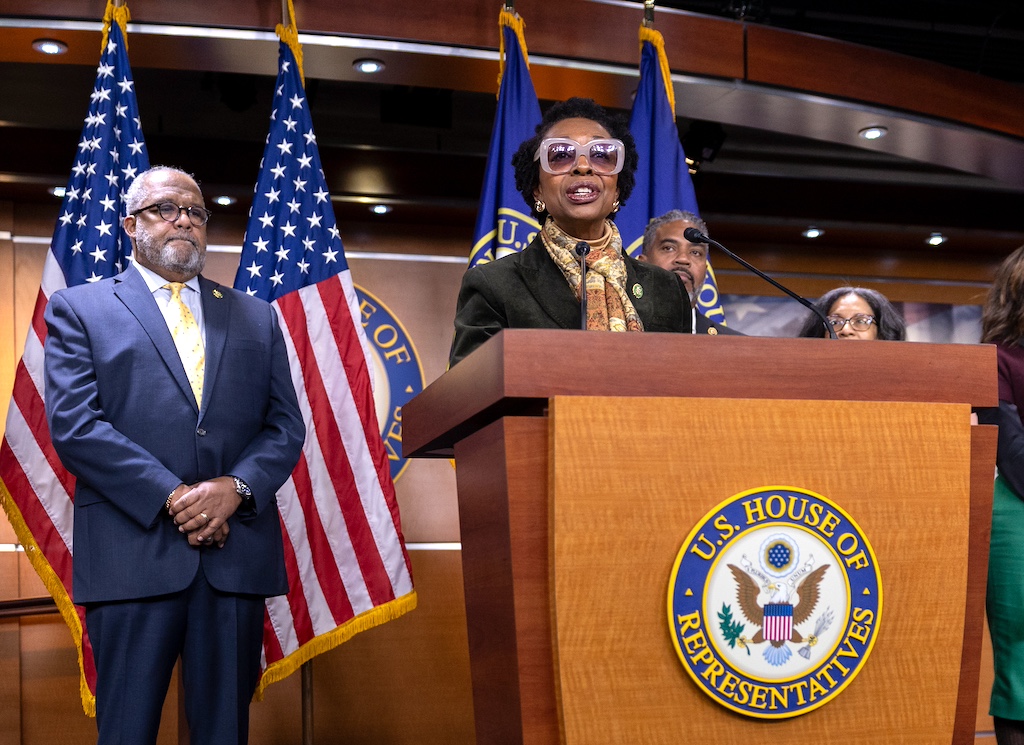
Members of the Congressional Black Caucus are largely staying silent about how they will vote on the reauthorization of a warrantless surveillance law. (Nathan Posner / Anadolu via Getty Images)
Members of the Congressional Black Caucus (CBC) are remaining tight-lipped about whether they will provide the decisive votes to pass a Trump-backed bill reauthorizing a warrantless surveillance law exploited by federal police to spy on Black Lives Matter and other activists. The silence comes even as Democratic leadership and other congressional minority groups have pledged to oppose reauthorization without reform.
A House vote on the Foreign Intelligence Surveillance Act (FISA) could come as soon as this week, before the existing law is set to expire on April 20. This Monday, the American Prospect reported that Rep. Gregory Meeks (D-NY), a leading legislator on foreign affairs, successfully lobbied the CBC leadership not to support FISA reform efforts. The Lever has since spoken to an anonymous congressional source backing the Prospect’s account.
But in a statement to the Lever last night, Meeks denied the reporting as “inaccurate.”
“I support FISA reauthorization, but the only vote I’ve been whipping is my War Powers Resolution to end the war in Iran,” Meeks said. “Whip operations are traditionally conducted by the Ranking Member of the committee that has jurisdiction over the legislation being considered. Any claim that I’m whipping the CBC on FISA is false.”
The battle on Capitol Hill revolves around post-9/11 changes to the 1978 Foreign Intelligence Surveillance Act, which have empowered the FBI to conduct extensive warrantless surveillance since 2008. The provision responsible, Section 702, has been vastly overused: according to the Foreign Intelligence Surveillance Court created under FISA, federal law enforcement misapplied Section 702 nearly 300,000 times between 2016 and 2020 — including for searches of American citizens.
Section 702 has given federal law enforcement warrantless access to the communications of protesters, journalists, and a judge, among others. That includes 133 individuals arrested in connection with civil unrest and protests taking place during the summer of 2020. Investigators were in search of “any counterterrorism derogatory information on the arrestees,” despite there being no “specific potential connections to terrorist related activity.”
House Minority Leader Hakeem Jeffries (D-NY) said this week that Democrats won’t do Republicans’ bidding on FISA. Speaker Mike Johnson (R-LA) — at the behest of the White House — has insisted on a “clean” bill, without reforming Section 702. That means the GOP has already shed the support of some hard-line conservatives who are against surveillance overreach and is in need of votes.
The Lever reached out to the offices of all fifty-nine voting members of the CBC to take a FISA temperature check — and received just one response, from Meeks.
The CBC communications office also declined to comment on the FISA vote. The Congressional Hispanic Caucus and the Congressional Asian Pacific American Caucus, meanwhile, have announced their opposition to reauthorizing the law without reform. So has the Congressional Progressive Caucus, which for the first time formally agreed to vote no on FISA reauthorization.
A notable CBC member who did not provide a comment to the Lever is Chairwoman Yvette Clarke (D-NY), who has been a steadfast critic of FISA overreach. She voted against the 2008 FISA changes, including the addition of Section 702, arguing they “[tear] apart civil liberties that Americans have relied on.”
“Congress is creating a precedent under which we will see the creation of a system that uses the private sector as a de facto spying agency for the government,” Clarke quite presciently said. She then voted against reauthorizing the bill in 2012, 2018, and 2024.
“So influential are the intelligence agencies that rely on Section 702 that they have managed to cow a long-standing reformist,” the American Prospect reported of Clarke’s silence. They cite the intelligence community’s vast influence in Congress, including an “eleventh-hour” fear campaign waged by the CIA, which last week revealed that Section 702 powers aided in its 2024 takedown of a would-be terrorist attack at a Taylor Swift concert.