Zohran Can Do Much More to Boost Organizing
Socialist New York Mayor Zohran Mamdani has accomplished much in just a few months. But one major thing is missing from his tenure thus far: activating mass participation of working-class New Yorkers in the fight for his ambitious agenda.
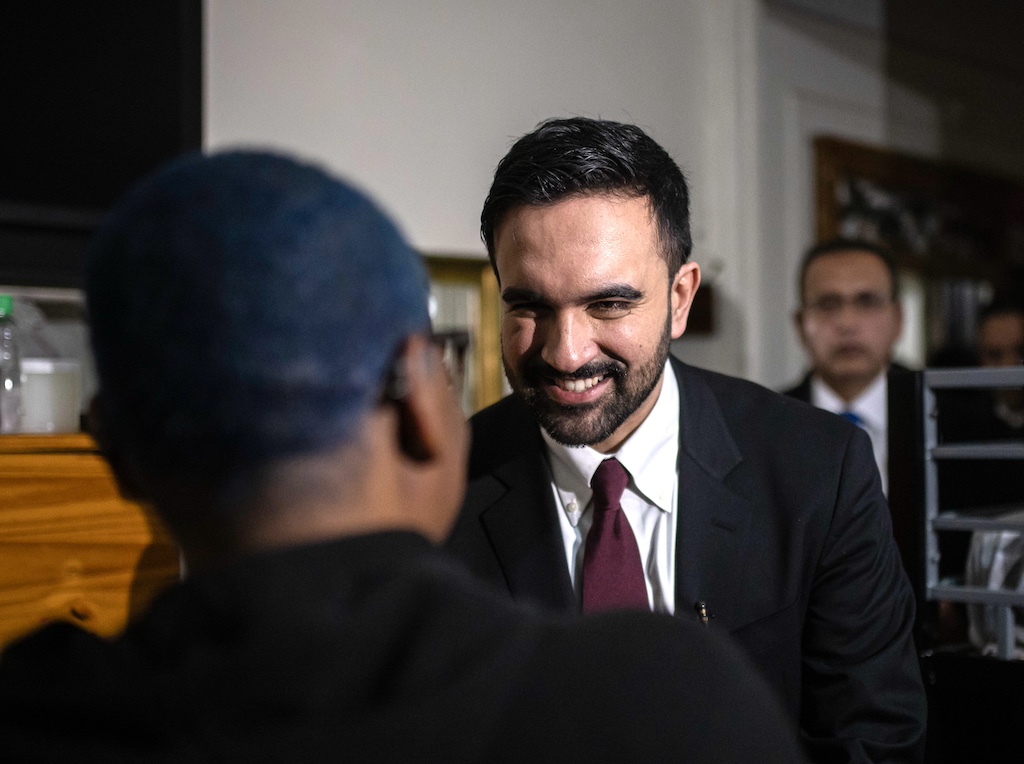
The scale of mass organizing initiatives organized by Zohran Mamdani’s administration is significantly below what is demanded by the moment. (Dave Sanders / the New York Times / Bloomberg via Getty Images)
Zohran Mamdani said the word “deliver” twenty-two times in his first one hundred days in office celebration speech. It's the administration's defining theme — and a limitation.
The mayor’s speech foregrounded his democratic socialist convictions and provided example after example of how his city hall has disproved skeptics’ claim that “the Left could debate but could never deliver.” Highlights include big wins like expanding universal childcare and pushing through a tax on secondary-home “pieds-à-terre” as well as smaller but real improvements like filling 102,000 potholes.
It’s fantastic that Zohran is delivering the goods and using his platform to advocate democratic socialism. And the tightrope act he has pulled off while engaging with New York’s centrist governor has been shrewd. But it’s a problem that ordinary New Yorkers are receiving the goods instead of helping win them.
These policy wins felt very different from Zohran’s victories in the primary and general elections. Those were experienced as our wins, because they arose not only from Zohran’s actions but also from the actions of a million voters and almost 100,000 volunteers. In contrast, the recent policy wins felt like gifts from above.
To truly transform our city, workaday New Yorkers need to get into the fight. And we need the mayor’s help to make that happen.
Who Owns the Wins?
Zohran’s campaign and early administration have rewritten the political playbook on many important questions, revealing political opportunities for the Left that, before his mayoralty, many thought weren’t there. But when it comes to actively boosting mass organizing, Mayor Mamdani still has room for improvement.
Rhetoric about mass involvement has not yet been consistently matched by deeds. Take Zohran’s election night speech. It was moving, it was rooted in the socialist tradition, and it argued that “we won because we insisted that no longer would politics be something that is done to us. Now, it is something that we do.”
What the speech didn’t do is tell the millions of people watching at home what they could do to get involved in that fight. And for the most part, New Yorkers have returned to the daily grind.
In the fight to tax the rich to pass his agenda, Zohran has put out numerous useful informational videos. But at no point has he called on or provided on-ramps to his supporters to pressure the elected officials blocking that path, nor did he attend the Tax the Rich rally put on in Albany by organizations like Our Time and New York City Democratic Socialists of America (NYC-DSA). Nor is he slated to attend this Thursday’s Tax the Rich! rally in front of Gov. Kathy Hochul’s office.
In fairness to the mayor, there’s no cost-free formula to resolving the dilemma of how to relate to Hochul, given that he simultaneously has to pressure and work with her. The mayor has to choose his battles wisely. And given that the governor did concede the pied-à-terre tax after repeatedly insisting that she would not tax the rich at all, and that city council president Julie Menin is also now pushing for increased revenue, perhaps Zohran’s approach on taxing the rich was tactically correct. Credit where credit is due: the admin has achieved a lot so far, even without much bottom-up organizing.
The problem is that Zohran’s hesitancy so far to use his massive platform to help New Yorkers join the fight has been less the exception than the norm. For the most part, the message we’ve gotten from the administration and the mayor since election night is, “We’ve got this.” It’s certainly a big improvement from decades of neoliberal neglect. But where are the viral videos about how New Yorkers can get organized to pass his ambitious policy goals?
While Mayor Mamdani’s active support for NYC-DSA’s congressional candidates like Claire Valdez has helped recruit people to the organization, fewer than two thousand people have joined since the election. NYC-DSA now has roughly 14,000 members — a big step forward from our movement’s former marginality, but still a relatively modest number compared to the roughly hundred thousand Zohran campaign volunteers and million voters who backed him in the general.
It’s true that Zohran has walked picket lines and that the Mayor’s Office to Protect Tenants is doing important work supporting some tenants’ organizing against bad landlords. Furthermore, the admin’s Office of Mass Engagement (OME) is a promising initiative. Hopefully we’ll soon see big things from OME, and Zohran’s lack of an initial focus on bottom-up organizing could be because it takes time to set up a robust new city office. On the other hand, even the best city agencies won’t have much latitude to wage big policy fights or antagonize establishment politicians — for that, you need working-class organizing outside the state.
Overall, the scale of Zohran-backed organizing initiatives is significantly below what is demanded by the moment.
Sewer Socialism
In his first hundred days speech, Zohran framed his approach as replicating Milwaukee’s famous socialist administrations in the early twentieth century: “Today we know these leaders as the ‘sewer socialists.’ But for years, Milwaukeeans knew them simply as leaders who delivered. It’s time we bring that to New York City.”
Zohran is right that Milwaukee’s sewer socialists made significant improvements in the lives of working people. At the same time, however, they always focused on building up workers’ organized strength in mass unions and the Socialist Party. As party leader Victor Berger put it, “We must have a moral, physical and intellectual strengthening of the proletariat, before all things.”
A sense of this can be gleaned from the Milwaukee Free Press’s story about the speech Berger gave at the election night rally when the socialists won the 1910 mayoral race:
Mr. Berger stepped forward, and a hush fell upon the audience as he began to speak. “I want to ask every man and woman in this audience to stand up here and now enter a solemn pledge to do everything in our power to help the men whom the people have chosen to fulfill their duty,” said Mr. Berger. Like a mighty wave of humanity, the crowd surged to its feet, and in a shout that shook the building and echoed down the street to the thousands who waited there, they gave the required pledge.
One of the core differences between the socialists and even the best of progressives was that the latter were not consistently oriented toward building bottom-up organizations. The Milwaukee Socialists’ rank-and-file political machine, combined with their leadership of the state’s entire organized labor movement, provided city hall with the power it needed to drive through legislation and shape public opinion.

Indeed, the city’s socialist mayor, Daniel Hoan, underscored that if other cities wanted to emulate Milwaukee’s success, electing “honest and competent men” was insufficient: “A permanent political party must be formed to supply encouragement and active assistance to the current executive and his administration and to ensure that successive executives carry on the desired policies.”
One of the key reasons why Socialists were successful at passing transformative reforms was that establishment politicians feared that failing to do so would enable the Socialists and their unions to convince Milwaukee constituents to vote them out in the next election.
Given that the sewer socialists lacked a majority on the city council, historian Todd Fulda notes that Mayor Hoan took “a populist approach to governing, appealing directly to the citizens of Milwaukee to support his reforms and pressure the nonpartisan aldermen to support them as well.” The same approach informed the party’s approach on a statewide level, leading the organizers to map out the legislature to figure out pressure points to flip movable officeholders.
One socialist journalist at the time noted that “many of the things that the Socialist administration has done and is doing could have been done and may have been done by non-Socialist administrations.” But such gifts from above “always had the defect and taint of something being handed to the workers with an air of benevolence.” This was no longer the case:
With every slight advantage now gained in education, social and economic conditions, the worker feels that it is his by right of the strength of the class to which he belongs. . . . This is really the great thing that the election of the Socialists to power in the city and county has done for the workers, or rather that the workers did for themselves.
Why This Matters
With Zohran delivering the goods, excellently communicating this to the public, and remaining very popular, is a focus more on bottom-up organizing actually necessary? Yes, for four key reasons.
First, it’s going to take a lot more power to pass Zohran’s most ambitious policy goals, such as free childcare for every New Yorker aged six weeks to five years and building 200,000 affordable, union-built, rent-stabilized housing units. Opposition and sabotage from our local oligarchs and their political lackeys have been relatively muted for the time being. Unless far more working-class New Yorkers get involved in the fight, it’s hard to see how the full agenda can be won.
Second, even with the most charismatic politicians in the world and the best communications game, popularity and good vibes can evaporate quickly without a strong organized base. When the first serious crisis hits (and it will, eventually), ordinary people are going to look to trusted messengers in their lives, workplaces, and neighborhoods to figure out whether they should still support Zohran or not. Until we help develop a widespread intermediary layer of organized working-class leaders — well beyond the reach of the current college-educated left — our project remains fragile.
Third, Zohran can only be mayor for two terms. If we depend entirely on his charms and brilliance to deliver wins for us, it will be much harder to sustain this momentum and to keep transforming New York into the affordable city we know it can become.
Fourth, everybody is looking to Zohran’s tenure as mayor as a model, both locally, statewide, and potentially for national executive office. We’re going to fall short across the United States and the world if the lesson learned from his time in office is just that you have to deliver and communicate well.
Even the most principled, charismatic, and competent leftist politicians on their own can only deliver so much as long as working people stay on the sidelines. And since most of our candidates elsewhere won’t be able to rely on Zohran’s astronomic charm, nor the same level of media attention, grassroots organizing elsewhere becomes even more important. We need all anti-corporate officials, Zohran included, to use their platforms and positions to directly encourage and funnel ordinary people into mass democratic organizations and largescale campaigns for change.
Zohran has articulated this vision; it’s now a question of consistently putting it into practice. As he declared in his election victory speech: “Let the words we’ve spoken together, the dreams we’ve dreamt together, become the agenda we deliver together.”