The Los Angeles Community Schools Model

Los Angeles’s public Community Schools are a model to support fights to protect public education and experiment with co-governance.
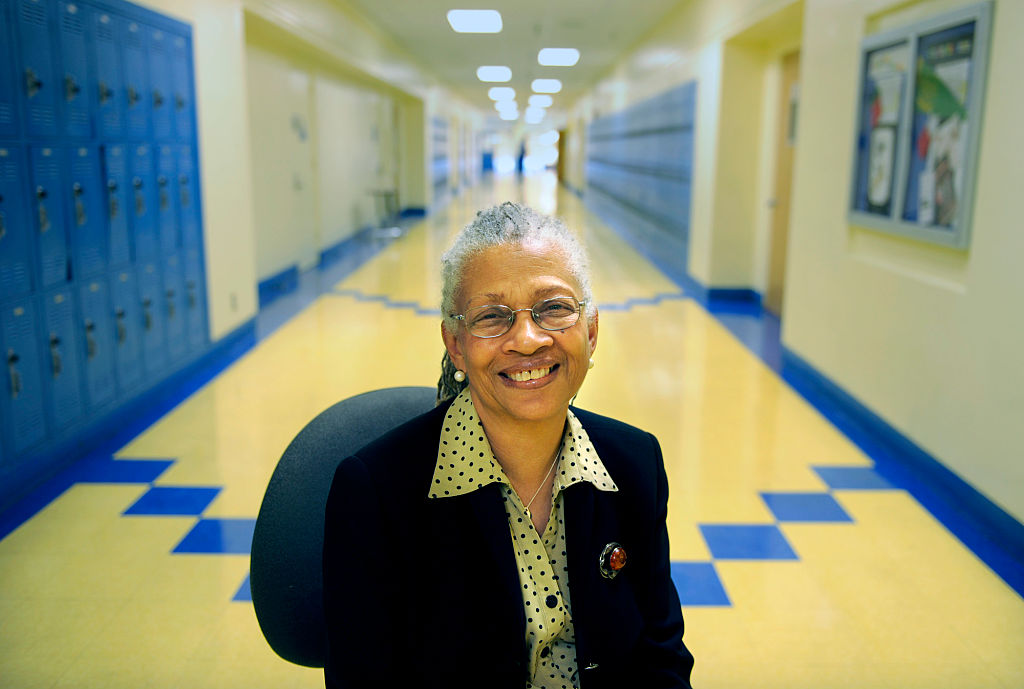
Dr Sylvia Rousseau, here seated in a hallway at Crenshaw High School, was a foundational influence on LA's Community Schools model. (Wally Skalij / Los Angeles Times via Getty Images)

As we fight authoritarianism, we cannot cede government to a struggle between MAGA and corporate Democrats. Fifty years of bipartisan neoliberal reforms have hollowed out the public sector, cutting funding and shutting working-class communities out of shaping institutions important to them. Authoritarians blamed these institutions’ failures on immigrants, black people, Muslims, and LGBTQIA people. Reversing authoritarianism requires that public institutions be run by the people. This means protecting vital working-class institutions that can serve as hubs for organizing and building experiments in co-governance in which movements and government work in tension and collaboration to improve working people’s lives.

The public Community Schools model, when embedded in racial justice and combined with labor and community organizing, can support fights to protect public education and experiment with co-governance.

United Teachers Los Angeles (UTLA) and Reclaim Our Schools LA went on strike in 2019 to win the LA Community Schools Initiative. LA Community Schools support expanded decision-making for parents, youth, and workers and receive resources to engage communities, address social justice, and provide services. They center racial justice in curriculum and school practices and are unionized. These are potentially non-reformist reforms, reforms that do not accept, and actually threaten, the status quo.

South LA Influences

The LA Initiative was deeply influenced by work at Crenshaw High School over ten years before our strike. Starting in 2007, our Crenshaw UTLA chapter, the parent-led Crenshaw Cougar Coalition (CCC), and the citywide racial justice organization Coalition for Educational Justice (CEJ) worked with Dr Sylvia Rousseau, Professor of Clinical Education at the University of Southern California (USC), and Dr Lewis King, Scholar-in-Residence at the Tom and Ethel Bradley Foundation. Rousseau and King helped us co-construct the Extended Learning Cultural Model (ELCM), which UTLA and Reclaim would draw upon to write the Community Schools proposal we took to the bargaining table years later.

Dr King grew up in Trinidad and Tobago. At sixteen, he was a leader against British colonialism and American occupation, working with the Trinidad and Tobago Teachers Union and the Oilfield Workers Union. After coming to the United States, King became professor of human behavior and psychiatry at the University of California, Los Angeles (UCLA), and served as dean of the Drew/UCLA medical school. In 1973, he cofounded one of the first substance abuse treatment programs in South LA at King/Drew Medical Center, then developed a research and development center called the Franz Fanon Institute.

Later, at the invitation of the family of former LA Mayor Tom Bradley, Dr King cofounded the Bradley Foundation. Based on work with youth, King developed the foundation’s guiding philosophy, “Intentional Civility,” later modified to “Intentional Critical Civility.”

Dr Rousseau grew up in Cincinnati, Ohio, where her maternal and paternal grandparents moved from Georgia and Virginia, determined to give their children better educational opportunities than those offered to black people in the South. After coming to Los Angeles in the late 1970s, Rousseau and her husband, a pastor, became leading figures in the South LA communities where they lived. Rousseau became the first black principal at Santa Monica High School, a deputy and regional superintendent in the Los Angeles United School District (LAUSD), and later served as an instructor at UCLA and a professor at USC.

Standing sixth and seventh from the left are Dr Lewis King and Dr Sylvia Rousseau. (Courtesy Alex Caputo-Pearl)

Rousseau has been deeply influenced by thinkers on democratic schooling, including bell hooks, John Dewey, Jawanza Kunjufu, and others. Paulo Freire, the Brazilian socialist and popular educator, had a particularly strong influence on Rousseau through his belief in the right to education for all, his centering of the overlooked knowledge of low-income people, and his practice of using dialogue about people’s lives to teach literacy and numeracy, and to co-construct action plans for liberation.

Dr Rousseau explained the foundations of ELCM:

Every child has the right to a free, public, and appropriate education made available in her or his own community and governed by a democratically elected board that represents the communities it serves. In a democracy, school boards form structured partnerships with unions and parent organizations for mutual accountability to ensure that the assets and challenges of school communities are reflected in equitable opportunities to learn for all students. Schools must be seen as integral parts of communities, connected to families; therefore the policies, systems, and structures of schooling that students encounter must be informed by the community.

As we learn from Freire, teaching and learning is dialogue in which each party informs and learns from the other. Democratic schools, therefore, are schools that acknowledge the students’ home language, culture, and community as essential assets the student brings to the school to participate in the dialogue. But, the dialogue does not begin or end with teacher and student. It is enriched by dialogue that takes place among governing bodies, between school administrators and teachers, and between teachers and parents/communities who together create a setting for meaningful dialogue between teacher and student.

Dr King described schools under colonization as creating “dependent learners,” students who could not pursue liberatory initiatives. Students had no voice in Trinidadian and Tobagonian schools and committed to rote memory the guidelines placed upon them by the colonizer’s textbooks. Education lost its value and was replaced by mimicry and neocolonial behavioral strategies. Graduates could not produce transformative action. King elaborated on why the ELCM was needed at Crenshaw:

The most profound issue for the Crenshaw child, at the time of ELCM, was that they were dependent learners, marked by passivity. We want to create students who are autonomous learners, agents in their own learning. But how do we do this? What are the issues in creating autonomous learners? Why aren’t teachers using what students already know? Why are teachers, too often, viewing themselves as the new masters of students?

Rousseau saw ELCM as an early Community Schools model:

True Community Schools intentionally create conditions under which the home and community become collaborators to enhance the child’s access to learning. When we bring children into classrooms that are imbued with a single dialogue or when ways of knowing are based only on America’s mainstream white, middle-class culture, that is a problem. At Santa Monica, we engaged everyone deeply, including students, families, educators, and staff, as participants in the dialogue for creating a school which belonged to every member of the community.

Creating Conditions Through Organizing

Education workers, parents, students, and community members spent years creating the conditions for ELCM to launch at Crenshaw. The school was built on the western edge of South LA in 1968, a victory of the civil rights movement. It was intended to draw students from both South LA and middle-class neighborhoods to the west. As funding for California schools was crippled by 1978’s Proposition 13, as LA was ravaged by deindustrialization in the 1980s, and as the corporate charter school and youth criminalization movements surged in the 1990s, Crenshaw’s student body became more low-income.

By 2001, when I arrived at Crenshaw, the students were predominantly black and low-income, and there was a growing Latino population. Amid challenges, though, Crenshaw was a vibrant school with a deep tradition of producing intellectuals, activists, artists, authors, and athletes.

Throughout the 2000s, Crenshaw staff, parents, and youth built on this foundation. Teachers Maynard Brown, Meredith Smith, Cathy Garcia, Jackie Lopez, and I led the building of a vibrant UTLA chapter and broader staff culture. We organized closely with parents and caregivers in support of funding, community voice in school decisions, racial justice curriculum, pushing back on abusive police practices, and returning me to Crenshaw after a retaliatory transfer by the superintendent.

When the State of California threatened the school’s accreditation in 2005 based on what was later revealed to be an LAUSD administrative error, parent/caregiver leaders like Eunice Grigsby, Rhonda Adway, and Glenn Windom created the CCC, with the support of Crenshaw teachers and CEJ. CEJ had grown out of the late 1990s struggle to protect bilingual education, evolving into a multi-constituency organization with strong student and parent leadership fighting for decision-making power and racial justice curriculum in schools and against high-stakes standardized testing.

Adway described the protests regarding accreditation in 2005: “I thought: My nieces and nephews go there, my grandkids went there, I’m going to go down there to do what I can. There were so many people from Crenshaw at that first community forum on accreditation. People were feeling the disrespect from the district.”

A press conference objecting to the reconstitution of Crenshaw High School. (Courtesy Alex Caputo-Pearl)

Parents institutionalized their power, as Eunice Grigsby described: “We, parents, teachers, students, and community leaders, started having meetings every Monday night in the library. Parents learned and participated more. CCC members decided to run for election in the School Site Council and Local School Leadership Council.”

Crenshaw students were involved through CEJ, with leaders like Channing Martinez, Frances Martin, Travon Hodge, and Tauheedah Shakur. Martinez, now a community organizing director in South LA, talked about getting involved in CEJ as a student in 2002. Teachers “taught us using the example of the organizing of the Mothers of East LA. They were teaching us about inequities and how to fight them.”

Struggle, Launch, and More Struggle

In 2008, significantly due to the leadership of Rousseau, King, the UTLA chapter, and CCC, the Greater Crenshaw Educational Partnership (GCEP) was formed. GCEP’s founding partners were USC, the Bradley Foundation, and the LA Urban League, and its memorandum of understanding with LAUSD gave it a comanagement role at Crenshaw. For our purposes, it served as a buffer from the district, allowing us space to create the ELCM.

In 2010, our UTLA chapter ran a super-majority workplace petition, and CCC and CEJ ran a community petition demanding that LAUSD and GCEP select Rousseau as the Crenshaw interim principal. She was appointed, allowing us to begin implementation of ELCM. Yet over the next three years, every step was contested. Some elected officials and district administrators worked with neoliberal forces within GCEP to interfere. Corporate charters continued to drain students from Crenshaw. Community organizations aligned with privatizers or, without a critique of privatization, expressed skepticism about ELCM.

Rousseau described these years:

Before I arrived, that school had 30 different administrators in 10 years. With ELCM, we organized small learning communities, or school-within-a-school academies, that gave leadership to interested teachers. We developed a model of teaching that gave students a say in what gets taught, that helped teachers learn in a way that the voice of the students is heard. Inter-disciplinary projects were taken on beyond the school walls to help students learn. It was a collaborative co-construction of who we are as a school. We tried to create a structure through which parents, staff, students, and the community could work together and make decisions collaboratively to bring about the transformation that Crenshaw needed.

King spoke of the impact on learning:

We had this opportunity to implement the ELCM using a powerful methodology, focused on student self-governance. This was within a framework which we understood not as individualism, but as the student becoming an autonomous learner, as one now establishing the ability to act and express a voice, growing in the capacity to participate in the construction of her/his own learning.

We were very conscious of the need to address “fixed mindsets” in all relationships at all levels of the effort — student, teacher, administrator, parents, service community. The intention focused on extending the context of learning in the imagination of the teacher, and extending the cultural context for learning of the child. We fought to bring learning alive again.

Business Academy students studied assets and needs in the community and presented publicly on how the city should use vacant land around Crenshaw. Social Justice Academy students partnered with Community Health Councils in paid internships studying access to fresh food in South LA, visiting markets, then presenting publicly. Other Social Justice students partnered with the Labor/Community Strategy Center and Bus Riders Union gathering data on students’ experiences with the overcrowded LA Metropolitan Transportation Authority (MTA) buses and the LA School Police and Los Angeles Police Department’s biased and criminalizing practice of ticketing students late to school. Students presented publicly at the MTA and LAUSD boards. Students led well-organized, peaceful walkouts against budget cuts.

A sign from one of the protests against the reconstitution of Crenshaw High School. (Courtesy Alex Caputo-Pearl)

ELCM centered the cultures and knowledge of black and Latino families. Business and Social Justice students partnered with Community Services Unlimited on paid internships in urban farming and food distribution, bringing lessons back to the school’s garden, which had lain fallow for years. Family members with experience in farming and entrepreneurship from the US South, Africa, the Caribbean, Mexico, Central America, and LA taught in the garden. Rousseau and King embedded the interdisciplinary projects, individual capacity-building, and autonomous learning within concepts of democracy, collective action, and social justice.

Tauheedah Shakur, a tenth grader at the time, now a community organizing director in South LA, described her internship years later:

I did the internship because I wanted to get a chance to look at my community through a different lens. When you’re so used to seeing something or not seeing something, you normalize it, so I didn’t understand that we lived in a food desert. Then I went into white neighborhoods and people had everything they needed in a 2-mile radius. This helped me in my own organizing directorship now. It gave me those tools at a young age, plus time management, punctuality, how to organize, and excel at school at the same time.

Shakur said that at Crenshaw she learned how to “write [her] own story,” pursue poetry, and highlight black experience. She reflected:

I grew up with a Grandma who wanted to make sure I knew my history, about Black history. I grew up with that. The fact that I went to schools where people were Black and Brown but people in our history books were white was really upsetting to me. At Crenshaw in the Social Justice Academy, I remember readings, movies, and questions the teachers would ask us to get us critically thinking. They turned everyday students into organizers. I am an organizer because of them.

Keeping Co-Governance Models Alive

Yet amid these accomplishments, ELCM had weaknesses. We did not adequately document the work, hindering replicability. We were not able to build enough power to neutralize privatization-aligned forces within GCEP. We did not adequately define, within broader circles, key terms like dependency, autonomy, and culture. We did not adequately nurture celebratory consciousness — cultivating joy, gratitude, and self-appreciation — because we were so often fighting external threats.

More trouble was ahead. By 2013, the LAUSD Board majority had hired a new privatizer superintendent, John Deasy. Charters continued to want control of Crenshaw. The social justice–based, rather than test score–driven, foundation of ELCM was a threat to Deasy and the charters because it ran directly against the neoliberal education model. Our coalition of the union, community, and prominent black public intellectuals was an even deeper threat.

That year, after a wrenching fightback we waged, Deasy reconstituted Crenshaw, removing over 65 percent of the staff, the majority of them black, ending ELCM. Within the constant struggle that characterizes attempts at co-governance, the privatizers had won a battle. But our learnings from ELCM helped us, six years later, win the district-wide LA Community Schools Initiative, an experiment in co-governance at a greater scale.

The second chapter of this history would begin a year after the reconstitution, in 2014, when our rank-and-file caucus, Union Power, won the UTLA election. Once in office, we knew some of the first people we would talk with about pushing Community Schools forward: Dr Sylvia Rousseau, Dr Lewis King, and the parents, staff, and youth who had built ELCM at Crenshaw.

The author would like to thank Dr Lewis King and Dr Sylvia Rousseau for their thought partnership in writing this article, and Emily Szpiro, UCLA research assistant, for her work interviewing leaders from Crenshaw and ELCM.