The War in Iran Has Triggered a Helium Crisis
The war in Iran has cut off access to a large share of global helium resources, which are needed for lifesaving medical procedures and semiconductor production. This crisis could have been avoided if the US hadn’t sold its stockpile to private companies.
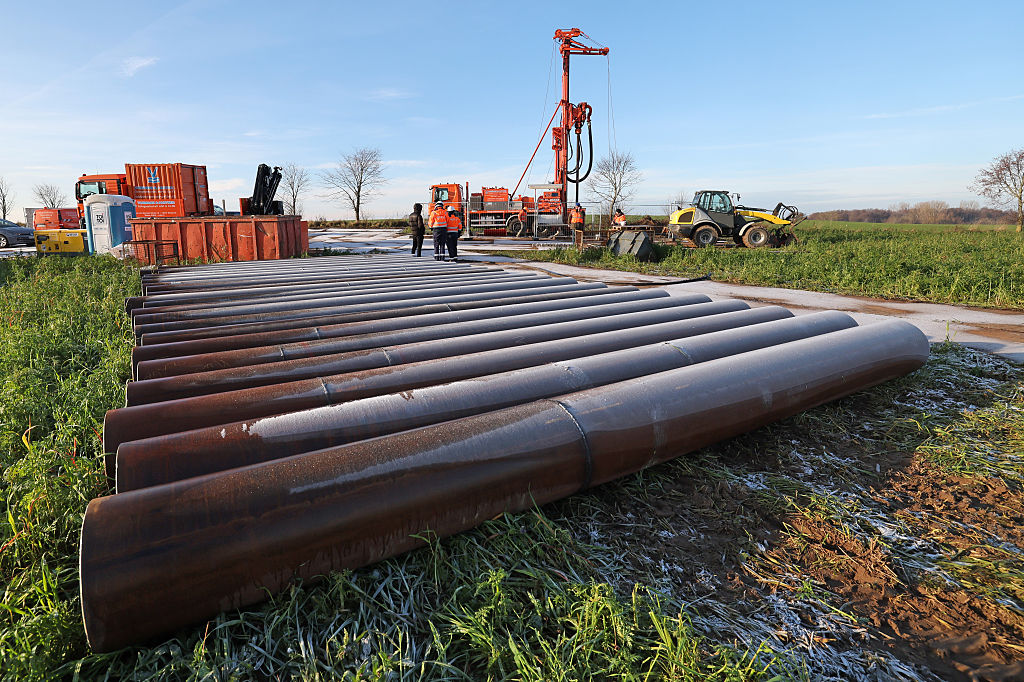
Pipes for exploratory drilling for helium lie ready in a field in Germany. (Bernd Wüstneck / dpa / picture alliance via Getty Images)
A crucial resource is being choked off from the world amid the ongoing conflict between the United States and Iran — and it’s not oil. It’s helium.
The rare, nonrenewable gas is a key ingredient for more than just party balloons. It’s needed for lifesaving medical procedures, groundbreaking research, and the current tech boom underpinning much of the US economy. The gas was also vital in the recent Artemis II mission that sent four astronauts around the moon and back.
But the war in Iran has cut off a significant portion of global helium resources, leading to a 50 percent price increase and warnings of a debilitating supply shortage. And although the United States and Iran are working to open key shipping routes in the region, the arrangement is far from certain, and the monthlong closure that has already transpired will still lead to supply shocks.
The crisis could have been avoided — if the United States had kept its Federal Helium Reserve, a national stockpile that accounted for nearly 40 percent of the world’s supply in 2013 and helped stabilize supply and prices.
For nearly thirty years, scientists, medical experts, and researchers urged lawmakers to preserve the national stockpile. Lawmakers instead spent that time selling it off bit by bit.
The privatization effort started in 1996 with the backing of President Bill Clinton, House Speaker Newt Gingrich (R-GA), and the archconservative group that would go on to write Project 2025.
As the plan moved forward over the subsequent decades, federal agencies and congressional analysts failed to accurately forecast future helium demand, repeatedly promising that the private sector could meet industry needs — despite four global helium shortages that limited lifesaving procedures and forced universities to lay off researchers between 2006 and 2023.
The country sold off the last of its helium stockpile in 2024. Now, less than two years later, the world is entering another shortage, at a time when helium is in higher demand than ever, thanks in part to the rise of artificial intelligence.
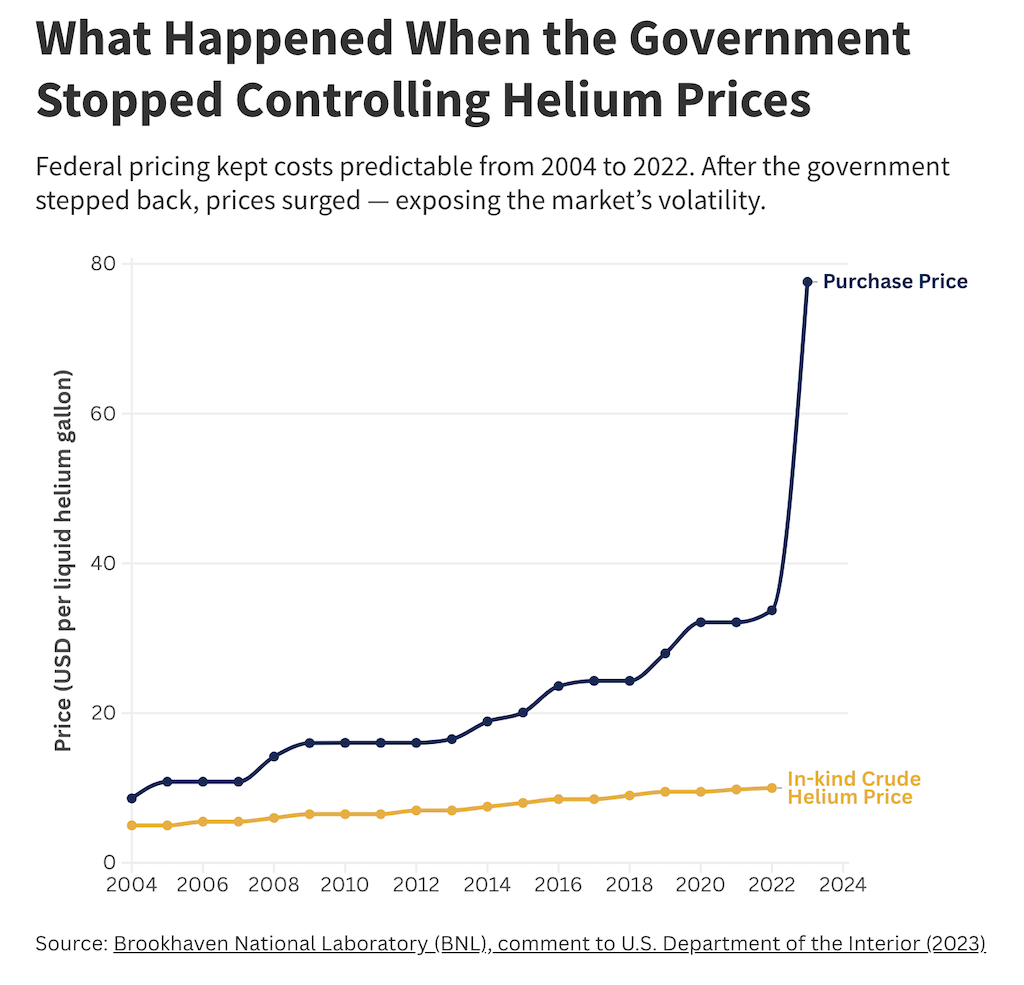
This was exactly the sort of problem the Federal Helium Reserve was designed to prevent.
“A federal reserve would have done a very similar thing as our oil reserves, it could have stabilized this price spike or at least protected the domestic industry to some extent,” said Vidya Mani, a University of Virginia professor who specializes in supply chains.
“Let’s Pop the Bubble”
Helium is a rare, nonrenewable gas formed through millions of years of radioactive decay, often accumulating in natural gas reservoirs. It is extracted through a refining process in which natural gas is cooled to a liquid form and leftover helium is siphoned off.
“Unlike ordinary goods and services that can be produced virtually forever, every unit of helium that is produced and consumed today will eventually escape Earth’s atmosphere and become one less unit available for use tomorrow,” experts warned in a 2000 congressional report.
In the early 1900s, the gas was considered to be a much safer alternative to hydrogen, an extremely flammable gas, to float blimps and other dirigibles, which were considered state-of-the-art weaponry at the time. Recognizing its military potential, Congress signed the Helium Act in 1925, which made the federal government the country’s only domestic helium producer and established a stockpile of the gas in an underground reservoir near Amarillo, Texas.
In 1960, Congress relaxed production restrictions and allowed certain companies to begin extracting helium from natural gas and selling it to the government. In the mid-1960s, government officials recognized that a radioactive isotope used in nuclear warheads decays into a rare form of helium named helium-3 and began stockpiling that as well.
The gas has proved to be a crucial resource. Without helium, doctors would not be able to conduct MRI scans; computer chip manufacturers would be unable to make semiconductors fueling much of the current tech innovation; infrared detectors on the James Webb Space Telescope, a NASA telescope orbiting the sun, wouldn’t work; and the Large Hadron Collider, a particle accelerator for groundbreaking physics research, would be inoperable.
“Today, helium fuels the development of national priority technologies in quantum computing, next-generation energy materials, and space applications,” wrote the American Physical Society, the premier advocacy group for physicists, in 2023. “Put simply, there is no replacement for helium, and America’s research enterprise relies on access to a steady, reliable supply.”
But in the 1990s, Congress and the Clinton administration viewed the helium program as an outdated federal project used to fill balloons. Gutting the helium reserve was a part of Gingrich’s and ’90s-era Republicans’ “Contract with America.”
The pro-business, government austerity blueprint was influenced by the Heritage Foundation, the conservative group that would go on to help create the Supreme Court’s current conservative supermajority and write Project 2025, the radical — and now largely successful — plan to dismantle the federal government under a second Trump presidency. In fact, the Heritage Foundation called for the helium program to be cut in 1990, 1992, and 1995.
The Federal Helium Reserve had landed in the political crosshairs because it had accumulated more than $1 billion in debt. In 1992, the Government Accountability Office, a nonpartisan congressional research office, recommended that Congress cancel the debt “since doing so would not adversely affect the federal budget.”
But lawmakers had other plans.
“Let’s pop the bubble on some of the most blimped-out government waste. Let’s put an end to all the hot air coming out of Washington,” former Rep. Chris Cox (R-CA) said in 1993, later calling the program “the poster child of government waste.”
Politicians of all stripes agreed. In 1996, the Helium Privatization Act, a long-term plan to sell off the government’s helium assets by 2015 to settle the reserve’s debt, passed the House with a simple voice vote and passed the Senate with unanimous consent, meaning no formal vote count was recorded.
Bill Clinton, who had embraced neoliberalists’ deregulatory zeal, welcomed the development.
“Today, over 90 percent of U.S. helium needs are met by private producers and suppliers,” Clinton wrote in a 1996 signing statement. “A government-operated program is no longer needed. The private sector can . . . supply the needs of all users.”
“Not in the Best Interest of US Taxpayers”
While the great helium sell-off commenced, the Helium Privatization Act built in a fail-safe. The law required the government to study “whether such disposal of helium reserves will have a substantial adverse effect on United States scientific, technical, biomedical, or national security interests.”
In 2000, as a result of those studies, the National Academy of Sciences, the National Academy of Engineering, the Institute of Medicine, and the National Research Council found that the bill would “have only a modest impact on producers and users,” that prices “will probably remain stable through at least 2010,” and that selling off the national stockpile “will not have a substantial impact on helium users.”
But those findings conflicted with a 1995 statement from the American Physical Society that found that “the overall demand for helium has been steadily increasing, and there is every reason to believe that this trend will continue.”
Sure enough, the government’s forecasts did not hold true.
In 2006, a global helium shortage disrupted industries relying on the gas. Soon, the same institutions that conducted the 2000 report were criticizing not only the privatization effort but also the 2000 government report, stating in 2010 that price and supply changes “have caused concerns about the availability of helium . . . and raised questions about the previous report’s conclusion that the sale of the helium reserve would not significantly affect helium availability.”
In that 2010 follow-up report, government researchers found “that selling off the helium reserve . . . has adversely affected critical users of helium and is not in the best interest of U.S. taxpayers or the country.”
The scientists cautioned that continuing to sell off the helium reserve could leave domestic interests relying on helium imported from Russia and the Middle East, two volatile regions, “at a time when demand for helium by critical and noncritical users has been significantly increasing.”
Another problem: the 1996 privatization law created a system that allowed a handful of helium refiners to purchase the federal helium below market-rate prices, effectively creating a taxpayer-backed handout available to just four companies.
These issues, plus another global helium shortage in 2013, left lawmakers scrambling to delay the helium reserve’s 2015 closing date. Otherwise, experts warned, US industries would have no choice but to rely on foreign helium imports.
“The failure to enact reforms of the helium program, such as those contained in this legislation, could mean an increased reliance on insecure and irregular helium supplies from Russia, Algeria, Qatar, and other foreign sources,” said former Rep. Rush Holt (D-NJ), a former physicist.
In response, lawmakers passed the Responsible Helium Administration and Stewardship Act, which allowed the interior secretary to hold annual helium auctions, open to all companies, until the reserve was depleted. The law also required the regulators to establish a twenty-year strategy for “securing access to crude helium” for clients who were previously dependent on the stockpile.
The resulting twenty-year strategy, released in 2015, supported the government’s ongoing efforts to sell off the helium reserves. While scientific and industry groups continued to warn that helium demand was likely to rise, government researchers once again concluded that “federal helium demand is expected to remain relatively flat during the period from 2015 through 2021,” adding that the twenty-year demand for helium is “also flat.”
Still, scientific and industry groups warned that helium demand was likely to rise.
The government’s twenty-year strategy failed to forecast shortages caused by trade blockades, such as Saudi Arabia blockading Qatari shipments in 2017. It also didn’t factor in maintenance shutdowns, which led to another shortage in 2019. A fire at a Russian helium processing facility in October 2021 led to another shortage.
More recently, the Russian invasion of Ukraine has choked off supplies of Russian helium, due to US and European sanctions on the country.
By 2022, the dangers of relying on foreign helium sources were abundantly clear, warned the US International Trade Commission.
“As the future of international relations remains uncertain, current geopolitical affairs will likely stress the global helium market beyond all that has occurred to date,” the commission wrote in an executive briefing. “Ultimately, a prolonged shortage could have wide-ranging effects across multiple sectors.”
“Would Be Wise to Maintain Control of This Invaluable Asset”
In 2023, as the total sell-off of the Federal Helium Reserve neared completion, the Bureau of Land Management, a subset of the Interior Department that oversaw the helium reserve, released a public request for information on if there was an “increasing risk of helium-supply disruption” and if that risk was coming from countries that “may be unwilling or unable to continue to supply the United States.” The public request noted that foreign helium production was “concentrated primarily in Qatar and Algeria.”
The Brookhaven National Laboratory, a federally owned nuclear research facility, responded in a letter that since the federal government stopped supplying the lab with subsidized helium in 2022, prices for the gas had “spiked tremendously,” a “clear sign of the instability of the market.”
Premier, Inc., a major health care logistics company, noted in another letter that helium supply had been unstable for fifteen years, at times causing hospitals to make due with less helium than they planned for.
“Given the instability of the helium supply chain for almost two decades, it is unlikely that the volatility will be fixed on its own, especially if the U.S. proceeds with sale of the Federal Helium System which would further exacerbate shortages and tighten available supply globally,” the company wrote.
These warnings and pleas failed to stop the government from selling off the remainder of its helium in 2024. In fact, the company that bought the remainder of the helium, Messer North America, Inc., wrote in a 2023 comment letter that the government should reconsider selling it.
“We continue to believe that Congress should consider delaying or canceling the sale of the Federal Helium Reserve, which has been a tremendous source of stability for the U.S. marketplace for decades,” the company wrote. “The federal government would be wise to maintain control of this invaluable asset until new global sources of helium have demonstrated their reliability.”
“You Need Helium Gas to Produce All of This”
Today the risks outlined by scientists and industries that rely on helium are no longer theoretical.
While the United States remains a major helium supplier due to private sector production, in the globalized economy, many industries rely on helium exported from Qatar, a small, oil-rich country located in the Persian Gulf that provides roughly 30 percent of the global supply.
But thanks to back-and-forth Iran and US blockades in the Strait of Hormuz, a crucial shipping route in the region, that supply has been intermittently cut off. Additionally, the global helium supply relies on roughly 2,000 containers to store liquid helium, many of which are also reportedly stuck in the strait.
The shortage is coming at a precarious time for helium demand. Artificial intelligence has dramatically increased the need for helium, since the gas is essential for making semiconductor computer chips.
“With the AI boom and the data center boom that we just witnessed, the demand for chips and integrated circuits just skyrocketed, and you need helium gas to produce all of this,” said Mani, the supply chain expert from the University of Virginia.
The AI industry is underpinning much of the American stock market’s recent gains, and experts are warning that a helium shortage could result in defective computer chips. A prolonged shortage would also force hospitals and medical facilities to compete with trillion-dollar tech companies for access to the gas.
The current situation is already prompting foreign medical associations to issue warnings on the ramifications of a shortage. On April 14, Russia announced new restrictions on foreign sales of its helium to maintain domestic price stability, which could exacerbate the problem.
As demand for helium continues to grow, a federal stockpile could have eased industry needs. Instead, the federal government now relies on a private sector that has increasingly become concentrated in conflict zones.
“No one expected the semiconductor data center boom to happen a year or two after we removed the Federal [Helium] Reserve,” Mani said. “It’s almost like [industries] are getting it on two sides: One, we don’t have a reserve, which we could have. And two, the demand side just spiked and even though we produce helium, we sell it to an industrial market or exchange . . . where it goes to whoever is the highest bidder.”