Washington Wants Its Military Base Back
In Colombia, the Left has learned to win elections but has yet to break entrenched elite rule. Will the progressive forces behind Iván Cepeda get another chance, or will a resurgent reactionary bloc transform Colombia into a permanent US military outpost?
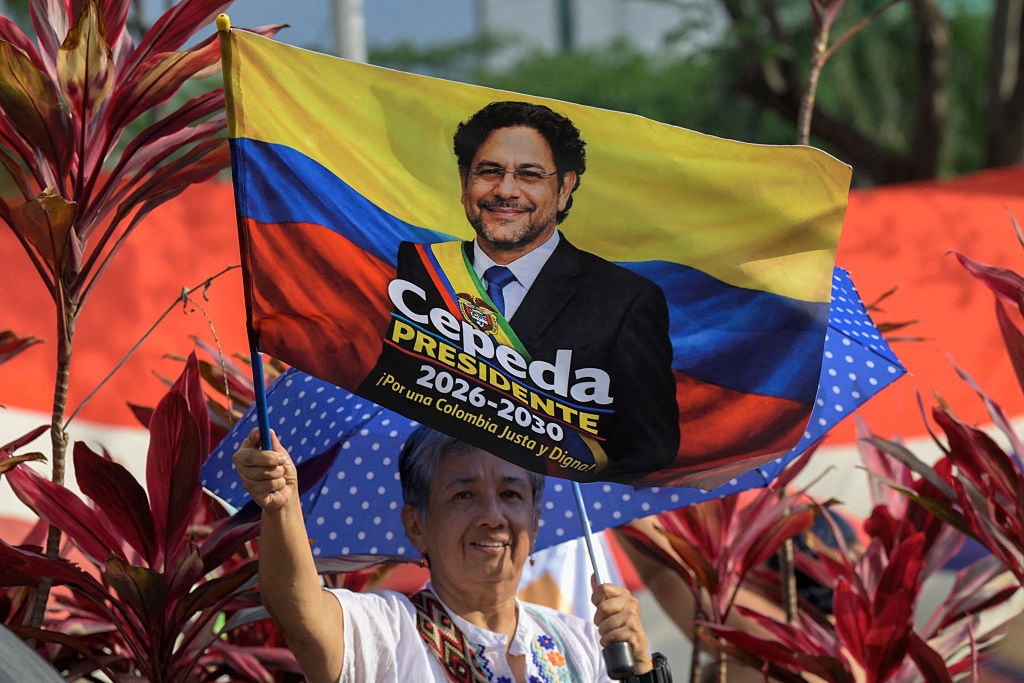
Colombia, under Gustavo Petro's leftward turn, appears the missing piece in an otherwise coherent right-wing configuration in Latin America. (Joaquin Sarmiento / AFP via Getty Images)
In the minds of many outsiders, Colombia remains trapped in a predicament straight from Netflix’s Narcos: suspended between cartels and guerrilla warfare, with the US’s Drug Enforcement Administration (DEA) and CIA operatives hovering as weary custodians of order, saving Colombians from themselves — or so the script goes. This framing reduces political violence to criminal pathology, and imperial intervention to benevolent security management. Like most enduring stereotypes, however, it contains a kernel of truth: Colombia has indeed long been both a theater of internal conflict and a strategic outpost to further Washington’s hemispheric reach.
In recent years, however, Colombia has begun to project a very different presence on the global stage. Consider the scene: a sitting president, Gustavo Petro, standing in front of the United Nations headquarters alongside Roger Waters, calling for disobedience to US military directives; hosting the Progressive International and the Hague Group in Bogotá; severing diplomatic and commercial ties with Israel; and positioning his government among the most outspoken state critics of the genocide against the Palestinian people.
The tension between these two representations, each distilling a distinct meaning from Colombia’s political conflicts and aspirations, has long existed, but rarely so starkly. While the Trump administration recasts its militarized expansion across the Americas as an anti-narcotics crusade, one that has seen missiles indiscriminately lobbed at modest vessels along South America’s coastlines, Petro’s government offers a contrasting narrative. As the Colombian president remarked before the UN in September 2025, “Drug lords live in New York, Paris, Madrid, Dubai. . . . They don’t live in the boats where the missiles fall. . . . They live next to Donald Trump’s house.”