Between Chinamaxxing and the Kill Line
A viral Chinese meme imagines Americans one mishap away from ruin, while American influencers fantasize about China as a frictionless techno-utopia. Each reveals less about reality than about shared economic anxieties.
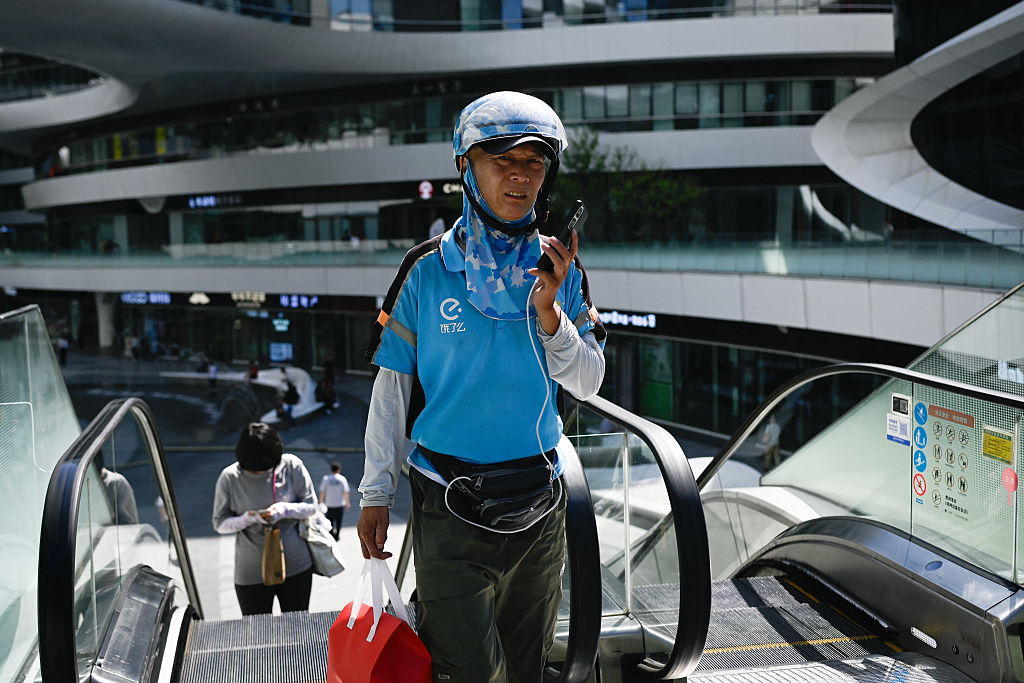
A viral Chinese meme imagines Americans one mishap away from ruin, while American influencers fantasize about China as a frictionless techno-utopia. Each reveals less about reality than about a shared anxiety neither country can quite name. (Wang Zhao / AFP via Getty Images)
On my trip to China last month, I was surprised to learn about China’s latest viral meme: the kill line (斩杀线). The term originates from video games and refers to a point at which a player’s health is so low that they’ll be defeated after a single hit. The Chinese internet has reconfigured this metaphor to create an exaggerated view of American economic precarity. According to the meme, Americans are always sitting at the cusp of a precarious “kill line.” Any minor shock such as a layoff or an accident can thrust even middle-class Americans into homelessness and destitute poverty.
Chinese state media (which never passes up an opportunity to criticize the United States) has spread the meme far and wide, including by misattributing an old video about homelessness in London to the US.
If the kill line was simply an exaggerated metaphor for American economic precarity and wealth inequality, there’d be little to object to. But its origins are deeply suspect. The Chinese influencer who coined the term and goes by the name “Squeaky King” claims to be an international student in Seattle who works part-time collecting corpses dumped in the sewer system for the county government. In his (entirely unsubstantiated) telling, these were the bodies of former middle-class corporate executives and professionals who were thrust into homelessness.
Of course, there is no evidence or photos to back up his implausible claim that a Chinese influencer on a student visa found a part-time government job hauling corpses around Seattle. The Chinese depiction of America’s kill line is more unsubstantiated conspiracy than reality.
As I learned about the kill line, I got to teach Chinese friends about “Chinamaxxing,” which befuddled them just as much as the kill line confused me. Chinamaxxing is the latest social media trend where influencers are embracing and idolizing Chinese culture. There are aspects to Chinamaxxing that are, although uncomfortably Orientalizing, mostly innocuous, such as drinking hot water, doing tai chi, and playing mah-jongg. But others that idealize life in China as zooming around cyberpunk cities in a self-driving electric SUV with a robot waiter erase the reality of daily life in the People’s Republic.
Most people in China suffer from similar social and economic crises that afflict Americans today. The United States’ extreme income inequality is well-known, but China’s is comparable. After accounting for taxes and redistribution, China becomes even more unequal because it falls under the US’s (very low) standards for redistribution. While Chinese inequality has gradually shrunk over recent years, this is mostly due to compression between the top and middle of the income distribution. Those in the bottom 30 percent have been left in the lurch.
Gen Z Chinamaxxers are the ones suffering the most from the crushing costs of college and see China as an escape from it. But while American higher education is exorbitantly expensive, the education affordability crisis in China is even more severe. Parents have to pay for high school, and tutoring is a de facto necessity to keep up with demanding curriculums.
The bottom quintile of Chinese families spend a massive 57 percent of household earnings on their children’s education. While China lacks the widespread student debt that afflicts college-educated Americans, the same problem of massive education costs is felt during the precollege years.
The kill line’s credibility has been reinforced by many videos of the very real problem of homelessness in American cities, but homelessness and extreme poverty are also major problems in China. Chinamaxxing influencers are simply blind to them because the government has successfully criminalized homelessness and driven the “low-end population” out of sight. If China’s poor aren’t at risk of falling below the kill line, it’s because they were never above it to begin with.
More critical Chinese netizens have turned the kill line meme on its head and noted China’s own kill line that disrupts the Chinamaxxing fantasy: turning thirty-five. Age discrimination in hiring is legal in China, and many job postings in tech, civil service, and blue-collar work explicitly ban applicants thirty-five or older. In addition, dismissal rates rise dramatically after workers turn thirty-five. This is because employers believe that those over thirty-five can’t keep up with the seventy-two-hour workweeks that 9–9–6 office culture demands. In China, being thirty-five is its own kill line, where an unexpected layoff can permanently condemn someone to underemployment in the gig economy.
Chinamaxxers’ longing for China resembles conservatives’ fantasies about life in medieval times. In the Right’s imagination, they’d be lords and ladies with castles rather than starving peasants working the land. Similarly, Chinamaxxers imagine themselves as China’s urban elite rather than the mass of impoverished gig workers who deliver their takeout.
The truth is that people just like imagining themselves as economically prosperous. For Chinamaxxers, this desire for material security presents itself under the guise of life in a different country.
Both the “kill line” and “Chinamaxxing” are digital projections born of the same dissatisfactions with the present. For the Chinese observer, the American kill line makes domestic struggles feel manageable by comparison. For Americans, Chinamaxxing is an escape to high-tech efficiency and economic security that feels unattainable at home. Behind these parodies lie two societies that face the same crises of alienation, unemployment, and a weak welfare state. Only by moving beyond these fictions can we build the international solidarity necessary to overcome our shared struggles.