Canada Is Redefining Who Can Seek Asylum

Forty-one years after the Supreme Court of Canada affirmed the right of every refugee in the country to fundamental justice, Canada’s federal government is denying certain classes of refugees the right to an oral hearing.
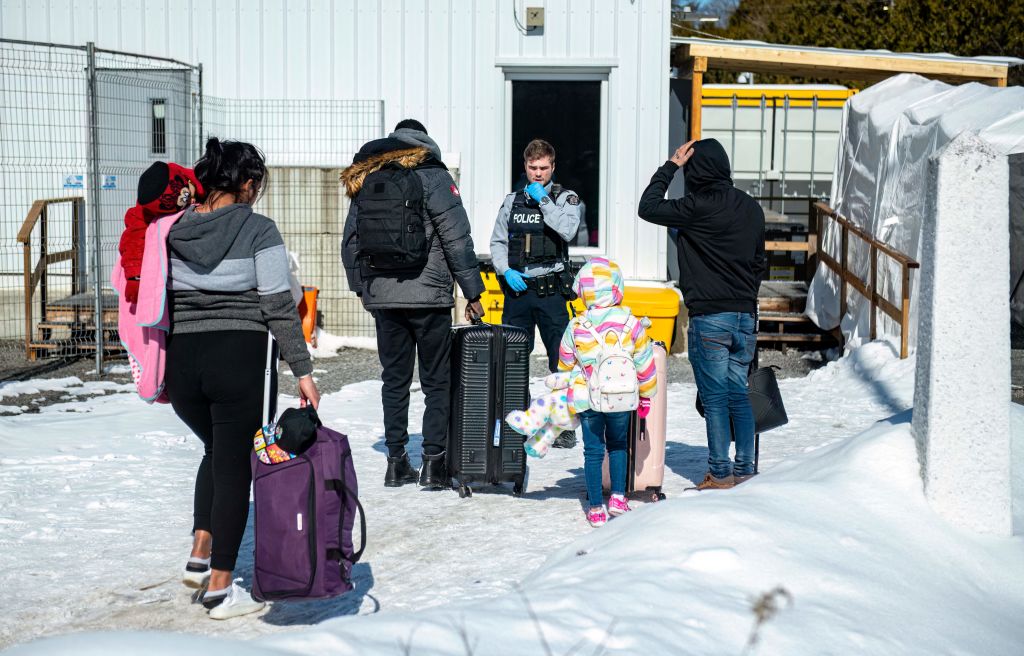
An officer speaks to migrants as they arrive at the Roxham Road border crossing in Roxham, Quebec, Canada, on March 3, 2023. (Sebastien St-Jean / AFP via Getty Images)

Hidden on the eighth floor of a white-gray building, with a massive “For Rent” sign above the door, is Welcome Collective, one of Montreal’s many clinics dedicated to supporting the thousands of refugee claimants who call the city home. It is also where Sara, a mother of three originally from Morocco, sought help after the Algerian woman who translated and filed the family’s asylum claim disappeared with all copies of the application (names have been changed to protect anonymity).

With the very real possibility of deportation hanging over the family now that their point of contact with immigration officials was gone, they arrived at Welcome Collective at their wits end. The clinic’s social workers jumped into action.

They filed an access to information request with Immigration, Refugees and Citizenship Canada (IRCC) to get a copy of Sara’s application and began the process of registering the two youngest children for school. The oldest daughter would have to forgo registering for postsecondary education because, without official refugee status, she is subject to international student fees that the family cannot afford. The family also needed psychosocial support to begin processing the persecution they faced back home and the trauma of uprooting their entire lives.

For a month or two, those seemed to be the only struggles the family would face as they waited the estimated ninety-two months for their hearing. But when the Canadian government tabled Bill C-12 on October 8, the little remaining hope Sara had for a peaceful future in Canada was shattered.

Bill C-12, also known as the Strengthening Canada’s Immigration System and Borders Act, was introduced in Parliament by the Minister of Public Safety Gary Anandasangaree “to combat transnational organized crime and those who seek to exploit our immigration system,” the minister explained at the second reading of the bill. The act would do so by tightening the Safe Third Country Agreement (STCA), expanding government powers, and introducing new limits to asylum eligibility.

The Safe Third Country Agreement

The Safe Third Country Agreement between Canada and the United States has been in effect since 2004 and mandates that refugees make their asylum claim in whichever of the two countries they first land in. The agreement rests on the principle that both countries recognize the other as safe for refugees to seek protection in.

The Canadian government currently considers the United States a safe country — despite widespread calls to end the designation — because it “is an open democracy with independent courts, separation of powers and constitutional guarantees of essential human rights and fundamental freedoms.”

There are limited exceptions to the STCA that allow someone in the US to make a claim in Canada. The most common is the family member exception, which allows claimants with a qualifying family member who has official status in Canada to make a claim there. The only option for refugees in the United States who do not meet any of the exceptions is to cross into Canada between official ports of entry. They must then avoid detection by border officials for fourteen days, after which they can file an inland claim and cannot be sent back to the US.

At least, that was until Bill C-12 was approved by the House of Commons and the Senate. While exceptions remain unchanged, the fourteen-day loophole has been closed. Also, anyone who makes a claim more than one year after their first arrival in Canada, if that arrival was after June 24, 2020, is now ineligible for asylum.

The bill also gives the governor in council — that is, the governor general acting on advice from Cabinet — the authority to cancel, suspend, or modify immigration documents like work, study, and permanent resident visas so long as it is “in the public interest.” The IRCC will also be able to share immigration-related information like a person’s status and other identifying information with federal and provincial agencies and crown corporations.

The federal government argues that these new provisions and powers will revitalize a system bogged down by fraud and abuse while also giving “border, immigration and law enforcement agencies modernized powers to be more effective now and in the future.”

But to hundreds of civil society groups and refugees like Sara, the government’s attempts to address major problems with the country’s asylum system will only inflict more harm on those seeking safety.

“No Longer Eligible”

Karim came to Canada about two years ago with his wife and three kids when threats to his life reached a peak. He had been attacked with a blade and suffered deep gashes to the side of his face. Karim knew if he did not leave Morocco then, he might not survive the next encounter.

The family first landed in Edmonton, Alberta, and eventually moved to Montreal in the hope of finding better work opportunities. But the city was not what they expected. Work was still impossible to access, and getting their youngest child into daycare was complicated. It was not until they were introduced to Welcome Collective that life started to look up.

Karim’s social worker, Selma Mezdaoui, who is also Sara’s social worker, had to intervene with the daycare and negotiate an agreement so mom and dad could look for work, prepare their claim, and find better housing — their landlord was withholding hot water even as winter settled in.

When Welcome Collective learned that the government might eliminate different eligibility categories for asylum seekers and that Karim’s family would be affected by the retroactive application of the one-year limit, Selma had to break the news.

“I helped them do the internal claim, and when I explained the law to her [Karim’s wife], she cried for hours in the kid’s area with her child playing around her,” Selma told Jacobin in an interview. “We still don’t know what’s going to happen, and the unknown is absolutely terrifying.”

One thing is certain. Every application filed after June 3 that would not be eligible for asylum under the new rules will be moved from the wait list for an oral hearing at the Immigration and Refugee Board of Canada (IRB) to the list for pre-removal risk assessments (PRRAs), a paper-based application that has historically served as the last stopgap before someone is deported.

PRRAs have been heavily criticized since their inception. For one, decisions in these cases are made by immigration officers instead of the independent adjudicators that oversee IRB hearings. There are also no avenues to appeal a negative PRRA decision. An appeal can be made to the Federal Court, but unless a stay of removal is issued, petitioners must leave the country. When it comes to positive decision rates, the IRB currently sits around 73 percent, while PRRA rates are 6 percent for those whose claims were rejected by the IRB and 30 percent for those who were ineligible for an IRB hearing.

Karim and his family are now at risk of being sent back to Morocco if their PRRA application is unsuccessful. Karim told Jacobin in an interview that if they go back, the man who attacked him “is going to wait for me at the airport.”

In Sara’s case, her husband may be facing deportation. The family could be looking at prolonged separation while also being without status, a situation that “has been documented by researchers as being akin to torture,” said Gwendolyn Muir, a lawyer reached for comment at the Migrant Justice Clinic.

Another of Welcome Collective’s social workers, Marie Cadilhac, told Jacobin about two Haitian sisters she is currently working with who had to leave the US because their humanitarian parole, granted under President Joe Biden through the Cubans, Haitians, Nicaraguans, and Venezuelans (CHNV) program, was coming to an end.

Cadilhac explained to the sisters at the time of their application that, because of Bill C-12 and their nationality, their case would be complicated. Haiti is one of fifteen countries for which Canada currently has an administrative deferral of removal (ADR) order in place. The government cannot deport anyone to a country with an ADR due to ongoing humanitarian crises. For refugees from one of the fifteen countries with an ADR whose claim is denied, they may ultimately stay in Canada but without status and with extremely limited access to public services, waiting for the government to deem it safe to deport them.

A Rushed Review and Limited Public Consultation

When the Liberal Party first tabled the Strengthening Borders Act, more than three hunded civil society organizations banded together to oppose it. The coalition is historic in both the number of organizations that collaborated and the breadth of industries they came from.

It was clear to many of them, lawyers like Muir and frontline workers like Karen Cocq, that the bill was not about improving a system underwater but rather reintroducing powers the government has not had since the interwar period.

As Cocq, the co–executive director of Migrant Workers Alliance for Change, sees it, “we are now facing a situation where the government has given itself and these police agencies the power, the leeway, the lack of oversight and the money to be able to ramp up immigration enforcement on a massive scale.”

The common front held press conferences, published briefs, and organized in their communities to show the government just how harmful Bill C-12 would be. Their criticisms focused on the new ineligibility rules, the private information sharing powers, and the new powers to cancel, modify, or suspend immigration documents.

But when the bill was sent to the Standing Committee on Public Safety and National Security for review, the committee opted to go against standard practice and not issue a call for briefs. It took an email from Tim McSorley, national coordinator for the International Civil Liberties Monitoring Group, to alert coalition members of the committee’s decision.

McSorley was told by the committee clerk to submit briefs, now limited to one thousand words versus the usual five thousand, as soon as possible.

Canadian Drug Policy Coalition Policy Director Nick Boyce submitted his organization’s brief a week before the clause-by-clause review thanks to McSorley’s heads-up. But Boyce was later notified that the brief was not translated in time. As a result, “they forwarded our brief to members out of interest, but it was not formally submitted as a brief and does not appear on the website.”

One government committee did hear from Azadeh Tamjeedi, a senior legal officer for the United Nations High Commissioner for Refugees (UNHCR), who said that “to comply with international and domestic law [the UNHCR] recommends that a mandatory hearing be added.”

The Senate’s Standing Committee on Social Affairs, Science and Technology even recommended that the controversial elements of the bill be removed in their entirety. Yet the bill has now received Royal Assent, despite Senate attempts to increase oversight.

Cocq is already thinking about how to protect refugees when the government decides to wield its new power. “I think on that, we should be looking to the US, and we should be looking to, for example, in Minneapolis, where you had people from all walks of life, from all sectors, classes, races, coming out onto the streets and saying no, and getting in the way, putting their bodies on the line to protect their neighbors.”

Meanwhile, Sara’s oldest daughter still thinks about studying electrical engineering. Mezdaoui says she is a smart girl who could do it, especially after mastering Canada’s refugee claimant system.

Karim is starting to see his children open up at school and is starting to imagine what they could achieve if they stay in Canada. As for finding work himself, “I just wishes that people would give him a chance,” Mezdaoui said, translating. “Like, just hire me for a week and see for yourself; give me a chance.”