How Work Got So Bad
Under capitalism, technological “progress” like AI systematically deskills workers, deepens managerial control, and turns the labor process into a site of conflict rather than liberation. This is by design.
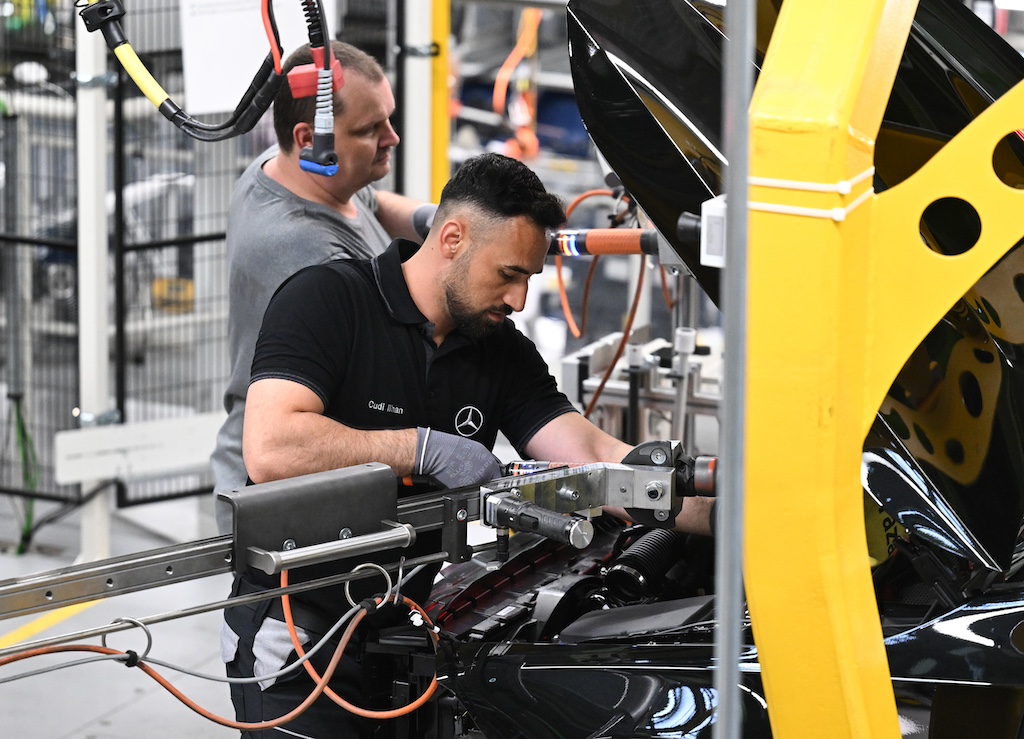
Every change in technology also brings about and requires a change in workplace relations. (Florian Wiegand / Getty Images)
- Interview by
- Melissa Naschek
Why does every new technology seem to make work harder and not easier? In 1974, Harry Braverman published a seminal text, Labor and Monopoly Capital: The Degradation of Work in the Twentieth Century, to answer that question. Combining a careful study of scientific management and technological innovation with several of Karl Marx’s key concepts, Braverman explained why workers under capitalism are gradually transformed into mere cogs in the machine.
In this episode of the Jacobin Radio podcast Confronting Capitalism, Vivek Chibber and Melissa Naschek discuss the process of managers breaking down workers’ skills and why work under capitalism tends to degrade rather than fulfill us.
Confronting Capitalism with Vivek Chibber is produced by Catalyst: A Journal of Theory and Strategy and published by Jacobin. You can listen to the full episode here. This transcript has been edited for clarity.
Last time, we talked about why AI is unlikely to cause the sweeping economic disruptions some tech companies predict. Even though we were more focused on macroeconomic issues, we also discussed how technology, such as AI, can cause mass disruption, hardship, and immiseration on the human level. And today, we’re going to talk a little bit more about what happens to workers more broadly when capitalists introduce what we’ll refer to as labor-saving technology.
Yeah. Not just labor-saving, but any technological change. The mainstream economics literature has done a very good job over the past couple of decades of noting, describing, and analyzing the mechanization of work, outsourcing, task unbundling, and offshoring. And in many ways, their work aligns with the classical Marxist analysis of this stuff.
But there’s another dimension to it, which is that every change in technology also brings about and requires a change in workplace relations — relations between managers or owners on the one hand and workers on the other. And with that, a couple of issues come up, such as how technological change affects these relations. And the second issue is whether those changes are purely driven by a desire to control workers, or whether that desire is bounded and constrained by a more fundamental drive to maximize profits. We talked about this in the AI episode.
What I think is good to do in this episode is to focus more narrowly on how technological change is reshaping workplace relations, and how the dynamics of workplace relations, in turn, affect the tempo and timber of technological change.
And to do that, we’re going to talk about one of the most interesting and important studies ever done on the role of technological innovation in the workplace, which was done by a Marxist named Harry Braverman.
Yeah. Braverman’s book is called Labor and Monopoly Capital. It was published in 1974 by Monthly Review Press. And I think it is by far the highest-selling book that the press ever published. And it is, in my view and the view of many others, one of the most important works of political economy that came out in the postwar era after 1945.
It was not only important in its own right in bringing to bear and updating Marx’s analysis of labor relations and what’s called the labor process for the twentieth century, but it’s one of the few books in the postwar era that actually spawned an entire discipline called labor process studies.
In the past, workplace relations used to be under the banner of what’s called industrial relations. But what Braverman did was he changed industrial relations from an anodyne kind of boring study of management to a study of the deeply conflictual and antagonistic relations between labor and capital in the workplace, and how the imperatives and drive of management is not neutral, but it’s centrally concerned with a political problem, which is controlling labor somehow. After Braverman’s book, two generations of scholars fanned out into different kinds of industries to study them and study how the labor process unfolds, and how the conflict between labor and capital unfolds in all of them.
So really, it’s an incredible book. Every socialist should read it. And I think it’s as relevant today as it was fifty years ago.
Could you briefly explain what we mean by the term “the labor process”?
Yeah. It’s simply the process of work inside a modern workplace, in which raw materials and inputs are transformed into sellable goods or services. So the labor process is quite literally the laboring that workers do in capitalism under the authority and direction of their employers.
In volume one of Capital, there are chapters on the workplace and how work is carried out, including the division of labor. Braverman brings all of that in under the rubric of the labor process.
Before we talk about the book, can you give everybody an overview of who Harry Braverman was?
He was an interesting person, died at a very young age, just a year or two after the book was published, when he was in his mid-fifties. He was not a trained academic. He, in fact, worked as a pipe fitter on the docks earlier in his life and then became a steelworker. Later, he entered the publishing industry before joining Monthly Review Press.
Now, Monthly Review Press had been for decades and decades the kind of signature Marxist socialist press in the United States. It was started by Paul Sweezy and his publishing partner, Leo Huberman, back in the late 1940s. It became the press that introduced a lot of the American left to Marxist political economy, no small measure to Sweezy and Huberman, and later Paul Baran’s own work. And it was that press that published Labor and Monopoly Capital.
And Braverman unfortunately didn’t live long enough to see what a phenomenon the book became. But it was, I think, not at all surprising that this was the press that brought him to the American public. And the book is written in such a way that really anybody who’s interested and alive to the issues can understand it. It was written so that workers could read it. And really, any union organizer, when they read it, they’ll recognize what he’s talking about. And it’ll, in fact, I think resonate with their own experience.
The Simplification of Skilled Work
What is the argument in Labor and Monopoly Capitalism about how technological change transforms work as capitalism has evolved?
Well, I think in order to understand it, let’s take a step back. We talked last week about how the AI revolution is just the latest chapter in the waves upon waves of technological revolutions in capitalism. And those technological revolutions are brought about as capital seeks ways to maximize its profits.
So, in order to maximize profit, it brings in new technology and then utilizes that new technology to drive down costs. And in so doing, each unit of capital, each establishment, tries to win greater and greater market share for itself. Now the question is, what’s driving them to do it? Is it the force of competition that’s driving them to do it? Every establishment is trying to beat out its competitors.
But when we talked about that last week, we left a kind of black box. We left a whole process that was unanalyzed, which is, when they do this, does it have any kinds of bearing on what’s happening inside the workplace in the relationships between labor and capital?
What Braverman latched onto was something Marx had talked about, which, I think, was a central insight of this tradition: when capitalists try to win market share, they face a couple of problems.
One is the problem of their technological efficiency — the kind of technology they’re using, how effective it is, the extent to which it drives down costs, and the extent to which it enables them to beat out their competition. That we covered last week.
The second horn of that dilemma is that if they are going to deploy that technology effectively, they have to make sure that the workers can be trusted or controlled in such a way that they don’t end up losing all the money that they sank into the technology, because the workers are, for instance, using it inefficiently or using it in a way that gets in the way of capitalists getting all their money back from it.
Or they have to deal with the fact that the workers might not want the change to their work that introducing the technology would force upon them.
Yeah. And they can either, as I said, use it badly or just sabotage it, right? So the point Marx made was that, in the process of producing goods, whatever technology capitalists use, they have to deal with the fact that their workers may not have the same goals and drives as they do.
In other words, there is an underlying conflict and divergence of interests between workers and capitalists. He has committed to paying these workers, and he wants to make sure he gets the most out of that investment. His fundamental concern, just like with a machine, is now that he has spent the money on it, he wants to get as much value out of it as he can. He wants to get as much bang for his buck. So that means when he sees a worker, he sees the wage as an investment that he wants to get the maximum returns out of.
Well, what is it that the capitalist paid for in that investment? He paid for work. He wants them to do the work at the maximum, fastest, and best quality possible.
Now, for the worker, sure, he’s happy to have a job. He came to work. He wants to keep the job. But that doesn’t mean that at the job he wants to give his employer the quality, extent, and pace of work that the capitalist wants. Why? Well, because oftentimes the pace of work is killing him. And oftentimes the machinery is dangerous. And he also knows that if he works really fast, really hard, really well, he’s increasing the productivity of his boss, which means some of that labor is going to become expendable, because as your productivity goes up, you don’t need as many people working it. So he literally might be working himself out of a job!
The way to summarize this is, what capitalists want is for the worker to give up as much work as possible. What the worker wants is to give just as much work as he can get away with. In other words, the worker wants to give up only as much work as he absolutely has to, which means he’s probably going to want to give up less work than what his boss wants.
This idea that workers become just cogs in the machine is not only a Marxist view, it’s not even necessarily a left view. It seems to be a widely acknowledged fact about work in the modern world.
If you just read Adam Smith’s Wealth of Nations, he says that in the modern division of labor, workers are turned into these kinds of instruments. He says they become “pinheads.”
So it is not at all radical in the sense of being associated with the Left. It’s just that, as economics changed as a discipline, economics became more and more and more interested in defending capitalism. And this is a late-nineteenth- and early-twentieth-century phenomenon. That’s when economists stopped looking at the labor process and the wage relation as a zone of conflict. And they quite explicitly moved to theorize it as a zone of consensus and freedom.
And interestingly, they did this because they found that the late-nineteenth-century socialist movement was using classical economic theory to ratify, to validate its accusations against capitalism. Because classical economic theory was pretty open, it said, “Yeah, what employers do is use workers basically as cogs.” And now the working class is saying, “Well, we object to this.”
And so, in the late nineteenth century, you see economics becoming much more of what we would call an apologetic discipline, which basically says, “No, it’s a win-win game. Everybody gains, nobody’s losing, nobody’s being harmed.” At that point, it’s the Left that carried on characterizing and describing work as a zone of conflict. But for the first two hundred years, that wasn’t true.
In classical economics and in Marx, the employment relationship is intrinsically and inescapably conflictual. This is the key thing.
Why is it conflictual? It’s because if employers are singularly driven to maximize profits — the only thing that matters to them is those profits. What does not matter to them is how the drive to secure profits ends up affecting the well-being, the welfare, and the happiness of their own employees.
The employees, on the other hand, are centrally concerned with their own well-being, with their own lives. Because the only reason they come to work is because they need that work as a stepping stone toward all the other things they want to do. So for them, profit maximization isn’t the goal. It’s their own well-being and welfare that’s the goal.
The main point is that the profit-maximizing drives of their bosses come into conflict with workers’ well-being again and again. And this is what Braverman puts at the heart of his analysis of the labor process, because that’s what Marx did.
Marx lays out these arguments in Capital about the nature of classes under capitalism and the mutually dependent but antagonistic relationship between capitalists and workers.
But I think what Braverman does is he adds to that by talking about, well, how is it that capitalists confront workers and try to get the most out of them, given the fact that what’s in the worker’s interest is to maintain their current position, maintain their current working conditions? Can you say how he expands upon Marx’s arguments?
Well, theoretically, there’s no difference. What Braverman is doing in terms of building his theory is more carefully elaborating what Marx set out in volume one of Capital, which is that when capitalists are trying to produce their goods, they are forced to change the workplace constantly to bring in new technology and then to harness the energies of the workers to their own ends, which is profit maximization. And that ends up harming their workers.
Marx lays that out in volume one of Capital. But the thing is, he published it in 1867. What it was looking at was the technological situation in the 1830s, 1840s, and 1850s. Now, interestingly, that’s before what we know as the modern assembly line and modern technology came into the factory.
And indeed, Marx anticipates — and you can see elements of what Braverman is actually describing, not just analyzing, in Marx. And that’s because Marx knew that the cutting edge of what he’s observing in England is going to be what fans out in the rest of the world and in England in the coming decades. So, it was prescient in that respect, but still underdeveloped.
What Braverman is doing is applying that same theoretical framework to analyze the modern factory and the modern workplace in the 1940s, 1950s, and 1960s. That’s the difference.
And what is it that’s different about that modern workplace? Well, it’s the incredible degree of automation. This is best seen in what we call the modern production line, the assembly line, what’s called Fordism. It has many, many different terms that describe it.
That was something that had just started to enter British capitalism in the mid-nineteenth century. But by the mid-twentieth century, that’s become the modal, the representative form of workplace organization and workplace technology in American manufacturing. So, essentially, what Braverman is doing is applying the framework developed by Marx to analyze and capture the essence of technological change in the mid-twentieth century.
So, let’s first say what the continuity between Marx and Braverman was.
The very heart of it, as I said, is the fact that capitalists have to control their workers. Now, as I said in the last episode, capital wants to control workers, but not as an end in itself. They’re not just out to maximize their power. They have to control workers because, as I said, the workers can’t be trusted. And the reason they can’t be trusted is that they have goals different from the employer’s.
So, there has to be some kind of control mechanism. Well, how do you control them? This is where Marx had a fundamental insight. He said, the problem for capitalists is that they want to control the workers, but the workers control the workplace. They’re the ones doing the work. They’re the ones who are making all the goods. And they have the knowledge and the skills as to how that good is made.
I’ll give you an example. If you’re a nineteenth-century watchmaking capitalist, you bring in workers to make watches. Each worker is making a watch unto himself through his own expertise and knowledge. And that’s hard. It takes a lot of skill. But the employer doesn’t know what goes into it — he just arranged the finances and the space. It’s the worker who knows how to make this thing. It’s called a craft for that reason. It’s highly complicated. It’s artisanal. It takes all sorts of knowledge and years of training.
The problem for an employer is that their employees know how to make the product. And at the end of the day, because they monopolize all that knowledge of how to make the product, they pretty much control the pace of work.
And it also introduces variability into the product itself.
Not just a variability in the quality of the product, but variability in how much of that product is made for any investment of dollars or pounds that you’ve made.
So, in other words, how much input to output you get.
Exactly. How much bang are you getting for your buck if you’re the capitalist, right? How much are you getting out of your investment? So the problem is, if they push the worker beyond a point, that worker can turn around and say, “Look, man, this is as fast as this can be done. This is it. If you want to make a watch, this is how fast I can go.”
And in that system, there’s not much room for the capitalist to push back on that.
No. So the way Marx put it was that capital has taken control over labor, but only formally, only in a formal sense. They don’t actually really control it. So he says there’s a difference between formally controlling labor and really controlling labor.
Is this his concept of formal versus real subsumption?
That’s right. By subsuming, he means you’ve taken over it, you’ve absorbed it, but you haven’t yet cracked the outer shell of the work, which is controlled by the worker. This matters because as long as he has real control over the work, he can set the pace at a level that’s comfortable to him and that aligns with his priorities, and not with the employer’s priorities.
So what Marx points out is that for capital, the real goal becomes — as a way of maximizing their profits, not as an end in itself, but as a way of maximizing profits — cracking open this black box of the worker’s skills. And increasingly, if they know how that product is made and can free themselves of depending on the worker’s skills, they can push the worker as hard as they want.
A second advantage is that, if they are no longer constrained by or held captive to the worker’s monopoly over skills, the worker becomes more expendable. And if the worker is expendable, you can hold the threat of firing them over their heads.
See, when a worker has rare skills, when they have the combination of all these talents and skills, it’s hard to replicate. If it’s hard to replicate, it’s hard to fire them. And if it’s hard to fire them, now they have something over you, right? And if you look at the workplace as a constant battleground, then each side uses whatever leverage it has. And one of the leverages that the workers have against their bosses is, “Hey, I’m hard to replace. What are you going to do?”
So really, what the employers need to do is break the monopoly that workers have over that complicated labor.
Exactly. And that’s what Marx points out in Capital in the mid-nineteenth century. And this is what Braverman says is also the essence of what’s happening in the twentieth century.
So, how do you break up the skills? You do it by breaking it down and having a division of labor, in which, instead of having one worker doing ten different tasks and thereby being very highly skilled and hard to replace, you disassemble those ten tasks and assign each to a different worker. So, essentially, what you’re doing is taking a highly complex set of tasks and simplifying them by breaking them apart. That process is creating a division of labor. Now, what does that do?
Because you have a division of labor, in and of itself, it automatically increases your efficiency now that one highly skilled worker, who was hard to replace, has been split into ten workers, each carrying out just one task. And because of that, each task is easier to learn, and because it’s easier to learn, each of the workers becomes easier to replace. That means you’ve also increased your leverage over those workers. Because each skill is easier to replace, you can tell each one of them, “Hey, I can fire you if you don’t work as hard as I want.”
Braverman examines this process and assigns a term to it; he calls it deskilling.
He says, essentially, that what’s happening is you’re taking a highly complicated, high-skilled task, breaking it down into component parts, and each worker assigned a different task is less skilled than the worker who initially embodied all those tasks. So the essence of the labor process, Braverman says, is a constant deskilling of the worker. That carries on in the twentieth century as well.
Now, what’s really interesting about his argument is that he says, as you break down the skill levels of the workers, there’s also a mental component to what the skilled worker used to do. He not only carried out highly complex tasks but also understood the design. He knew what the watch was, what went into it, and how to make it better. Same thing with carpentry, same thing with machinery, right?
What happens in the modern workplace is that as you take away the worker’s monopoly over skills, the task of designing and carefully crafting the product is taken over by management. So the creative parts of work are now monopolized by management, and the workers increasingly become grunts. That’s what he’s saying.
In fact, Frederick Winslow Taylor, who systematized all this, explicitly said, “I want my workers to be like gorillas.” I want them to be like trained gorillas, just carrying out functions and not thinking for themselves.
Alienated Working Life
I think alienation is a term that probably most of us have heard to describe work in modern life. But Braverman is also using it in a more technical, classical sense. Can you explain what alienation is as Braverman and Marx used it?
The term “alienation” comes from Marx in a very specific meaning, in a very specific timber. It’s a concept he developed very early on in his life when he was twenty-six years old, living in Paris, and he wrote these notes to himself, which he never published, in which he was describing the character of labor and the more general existential dilemmas of workers in modern capitalism. And what he said was that, as he becomes captured by capital, the worker becomes alienated from his own nature and from other people.
By “alienated,” Marx means the worker is no longer organically connected to his own needs, his own wants and desires, his capacities, nor is he organically connected to other things.
What is the connection that’s severed? Basically, there are four components for Marx.
For one, workers become alienated from what they’re making. What does that mean? The idea is that when you’re a craftsman, you’re making a beautiful chair or a table or something, it’s an expression of your own inner self. You conceive of it, you design it, you do the work, and you’re proud of it. It’s you. But when you work for a capitalist, you have no connection to what’s being made because the only reason you’re working for him is that you’re desperate.
And, not only that, but you lose control over this design creative process. It’s passing from the hands of the worker to management.
Yeah. And that’s the second component of alienation, which is, he says, alienation from your species being, that is, your own human nature. Why is that a form of alienation? Marx thought that the essence of humanity is the act of being creative and that creativity is fundamentally expressed in labor. So when you become a cog in a machine, not only are you alienated from what you’re making, but you’re not really yourself anymore. You’re not fully human anymore. And that’s a form of alienation.
Then you’re alienated from the product, in that, he says, all machines are made by people. Now, normally, Marx says, if you have a tool, you use the tool for your own ends. But in capitalism, the machine ends up using you.
This is why it’s so prescient. He’s writing this in 1840, when this process has barely begun, but he’s already seeing that when these machines come to dominate the workplace, they’re also dominating workers. The machines are running the workers, which means that a product, something that humans made, is now dominating humans. Because humans made it, it’s a product of humanity, right? It’s an act of labor. So now your product is dominating you.
So first of all, you’re dominated by the machines. Secondly, you have no connection to the product that you’ve made. Thirdly, the creative act of labor is gone because it’s management that’s controlling all the designs, all the blueprints, all the ideas, and you’re just carrying out the tasks.
And finally, because at the workplace, the capitalist is using you as an instrument and you are looking at other workers as potential threats to your own job, you are alienated from other people. Your human connection — and Marx, like Hegel, like all the great classical thinkers, thought human beings are essentially social people. That means part of your own flourishing comes out of your interactions with other people. You develop through your relations with other people.
But if those relations become a war of all against all, where you’re constantly fearful of others, either because they’re bossing you around or because you see them as threats to your job, or you get your money by dominating others — and Marx thinks capitalists are alienated just as much as workers are — all of these are unnatural ways of being.
Braverman took this and argued that the modern factory brings all these things together. And so, it is the modern form of alienation. This degradation of work is alienated work in that sense.
And the idea is that if you take away the profit motive as a driving force, it at least creates the possibility of different work conditions and different social relations between workers, other workers, and nonworkers. And so, like Marx, he thinks that as long as people spend most of their waking life working, which most people do, and the workplace is a site not just of exploitation but also of this kind of degraded condition, human beings’ lives are also going to be lives of degradation. It’s not just the work that’s degraded. Human beings are being degraded.
Now, all of this is being driven by the blind pursuit of profit. The key thing to keep in mind is that the degradation of workers that the bosses are trying to get away with is not an end in itself. It’s not coming back because they’re mean-spirited or because they have the wrong values.
It’s also not the machines doing this to people. It’s people, through machines, doing it to people.
You’re absolutely right. Technically, that enormous productive power, that enormous transfer of skills to machines, can also be liberatory for workers. Because don’t forget that you are massively increasing productivity when you do this.
And we talked in our last episode as well about how technological innovation does not actually have to be the cause of immiseration. It could be the cause for more freedom and autonomy, but the problem is that it’s being implemented by capitalists who only care about profit. They don’t care about this question of human flourishing, at least for the workers. For themselves, it means more money, more yachts, more trips to Epstein Island or whatever.
That’s exactly right. I think that there are parts of the Left that have forgotten this. Marx was a big fan of increasing efficiency and productivity, as were all the classical Marxists and socialists. And I also abide by the same thing.
I think that in the hands of capital, this technology is becoming a force for grinding people into the ground. But in a different kind of social context, all this increase in computing technology, AI, and machine productivity can actually end up doing what Marx thought was the essential precondition for human liberation, which is not having better workplaces — although that’s very important — but the essential precondition, which is doing less work. Because, of course, work should be an act of creativity.
But don’t forget, people are creative in all sorts of dimensions of their lives, and work is just one. And at work, how creative you can be is very limited because you’re trying to make a specific product, and you have to harness your creativity to the product. But outside of work, it’s limitless. And in order to develop your abilities in all their manifold dimensions, you have to have time outside of work as well, for which, if you don’t increase productivity, there’s just no possibility of doing it.
The Dynamics of Deskilling
I think we need to reconcile the process of deskilling with the fact that over time, the education put into each worker has dramatically increased, and a lot of work has become more highly skilled and technical than ever before. Does that contradict any of the processes that Marx and Braverman outlined?
I don’t think so. It’s a common objection that’s brought up, and I think it rests on a misconception. Part of that, I think, Braverman is himself to blame.
I think the word deskilling was an unfortunate choice to describe the processes they were analyzing. Because when you say workers are becoming deskilled, it’s easy to interpret that as meaning they’re unskilled. Now, deskilling and being unskilled are two very different things.
As I said earlier, what deskilling describes is taking highly complex, multidimensional tasks and breaking them down. That’s not so much deskilling as simplification. And I think simplification would have been a better term to use.
What’s happening is that work is becoming simplified. Now, commonsensically, it’s possible for very, very complicated tasks to be broken down into their different parts, but each part still requiring a certain amount of training and skill to carry out.
Think of coding, for example. Think of software engineering. Interestingly, if you look at when software engineering came about, say, forty years ago, it was very artisanal. Software engineers needed to have a lot of skills, of which coding was just one. Over the decades since then, it has been broken down into individual parts, but each individual part still requires a college education, or at the very least, a high school education.
Now, eighty years ago, or even sixty years ago, the official definition of “skilled work” in the United States was anything that required a high school education. Today, a high school education is what you use for unskilled work.
Well, even if work is simplified in some ways, it often requires skills that weren’t necessary before. For instance, many jobs that might have been more manual in the past now require a basic understanding of how to use computers. And that’s considered a quote-unquote unskilled job, but the reality is it’s not.
So what that tells us is that what counts as skilled and unskilled officially changes over time. And today, what counts as unskilled requires a level of education that sixty or seventy years ago would have made for skilled jobs. So there’s no doubt that the baseline level of, let’s say, knowledge and education that’s required in jobs today, even in unskilled jobs, is greater than it was a hundred years ago.
Now, if that’s what Marx and Braverman had meant by deskilling, then, of course, the theory would be wrong. But that’s not what they meant. What they meant was that, over time, complicated multidimensional jobs were being broken down into individual tasks. Jobs into tasks. And each task, if you compare a basic individual task in a manufacturing plant today, which, by our definition, is not very skilled, it still requires much more education than a basic task required eighty years ago in a manufacturing plant. So what gives?
What’s happening is that, over time, as the baseline level of education rises, the process of breaking complex tasks into simpler ones is still driving the whole thing.
Now, let me put this together with what I said last episode. Remember, we said that whenever new technology comes around, it doesn’t just eliminate a big chunk of the existing jobs, it also creates a demand for new jobs, new occupations, and new tasks.
So two things are happening at once. Technology is destroying old jobs, old tasks, and it’s creating a complementary need for new ones that didn’t exist before. Now, a lot of times, those new tasks, those new jobs are artisanal. Engineering was a very good example. Software engineering was a very good example of that. They’re artisanal when they’re born.
But every time, management finds that as long as workers monopolize those skills, they’re harder to control. Because they’re harder to control, management commits itself to breaking through that skill barrier. And it does that through simplifying those tasks.
Each of those tasks, on its own, can still require a significant amount of education. But the key thing is that the simplification of an erstwhile complicated task is going on.
So you should think of capitalism in this way. It keeps throwing up new jobs and new occupations because of technological change. Those new jobs and new occupations typically are born as a set of complicated skills. Over time, management then says, “Okay, we broke apart the last set of skills; now we have to break apart this set of skills.” So each of those complex jobs is always being broken down by employers into simper tasks.
There’s a dynamic process by which existing complex jobs are broken down into individual tasks and simplified, while new, complex occupations are born, which now become the new barrier, the new frontier that employers try to break down. This is happening even as the general level of education needed for workers rises. So each task at any given moment does require education, and each job at any given moment is being broken down and simplified as we go on.
The word “deskilling,” unfortunately, obscures this. Well that just means that people have to read a little more carefully. And unfortunately, people don’t always do that. But I think that it’s been fifty years since the book was written, and it’s remarkable how prescient it was, just like what Marx wrote 150 years ago was prescient.
The present history of capitalism today is still a dynamic process of creating new jobs, breaking them down so that employers can control their workers better, and workers trying to resist this as best they can.
Fighting Back
Why are struggles in the labor movement typically over distributional questions, like wages and hours of work, as opposed to questions about who controls the labor process, the questions we’re talking about now?
I think that’s a fair observation. It is true that if you look for a common denominator in all union movements, wages are probably the one that stands out the most. And I think the reason for that is that, within capitalism, money is a solution to a lot of problems. And money is also the cause of a lot of problems. So, no matter what else, you are going to take up the wage question. It’s also a question that workers can come together around.
The problem in unions is that when you have a union meeting or a committee trying to draft a contract, workers have many different needs. They have a lot of different demands, and they’re all important. Some workers need more vacation time. Some workers are worried about pensions. Some workers need free child support, et cetera, et cetera. And you’re not going to win every battle. You can’t make every demand.
The one thing that makes everything else easier for everybody is more money. So it is a way of bringing people together more easily. It is the common denominator.
That said, I think it is also important to acknowledge that, in every union movement, there have been other demands very close behind the wage issue. So the pace of work is very, very common. Limiting managers’ arbitrary authority over workers is common.
How do they do that? Well, seniority rules are a way to ensure that management doesn’t have unilateral control over everything that’s happening. Why do workers want seniority? They want a predictable path to getting promoted and a predictable set of rules about who gets fired and who doesn’t, because that way management doesn’t play favorites, but this or that worker.
So when you take a step back, and you look at these demands like seniority, grievances, workplace rules, what is that? That’s essentially trying to control the labor process, or at least trying to control the workplace itself, right?
So you’re right that wages are the most common element. But it’s not by a lot. These other issues are a close second. They loom pretty large and unions everywhere fight for them.
Why? It’s because the control is always used to prioritize profits over people, and the workers are people, and they try to limit what that authority is on management’s side. That’s true everywhere, in every region, regardless of religion or culture or anything like that.
Will We Deskill in Socialism?
We’ve already talked about the division of labor in the labor process between the creative aspects of work and the basic drudgery involved in the physical completion of tasks. Braverman seemed to suggest that the solution is to reintegrate these two aspects of work back together. Do you agree with that solution?
I don’t see how it’s a viable solution. It’s an easy inference to make that Braverman says that one of the worst aspects of capitalism is the separation of mental and manual labor.
Remember, this is what management is doing, right? It’s breaking through the worker skills, and trying to simplify the tasks, resulting in each worker knowing only one component of the overall design or whatever they’re making. The creative knowledge of the overall design is now monopolized by management, and they deploy the workers the way they deploy machines, right? That’s management taking over mental labor while workers do all the manual labor.
Braverman says this is regrettable, this is alienating, it’s degrading. So what is the solution?
You would think that the solution, then, is to bring the two back together for workers to, in a more humane society, or maybe in a more worker-directed capitalism, for workers to have more knowledge of what the product is, a lot more input in what the product is, and all that. Okay, so maybe in socialism, you will see a return to this kind of artisanal ethos, so you have creative labor.
I don’t think that’s realistic, nor do I think you’ll want that, because one of the things that the division of labor did in capitalism was to massively increase productivity. Not only that, the modern workplace, modern machines, modern factories, they are by definition entities in which you have machines setting the pace of the work for a lot of people, and the work becomes very simplified.
So are you going to dismantle the factories? Are you going to take them apart? Are you going to now ask workers to learn these nineteenth-century skills, like, you know, woodworking and things like that? If you do, it’ll set back productivity generations, right? And that lowers people’s standard of living. So it’s a kind of small-is-beautiful mentality, you know, that came out in the ’60s and ’70s.
So what, then, is the solution? Because it is also true that work sucks right now. And you don’t want a kind of post-capitalist society in which you have lots of basic income grants and free childcare, but work still sucks, right? So what’s the solution?
I think implicit in Braverman and Marx is that the solution isn’t to bring back craft work and artisanal labor, but to reassert control over the labor process and over the laboring lives people have. So I think that you won’t dismantle the factory. You won’t dismantle the modern workplace. What you’ll do is give workers a lot more say in how it’s run.
It’s not that authority is bad. Illegitimate authority is bad. It’s not that management itself is bad. You need management. In any complex division of labor, you need somebody coordinating it, right? What makes management bad is when it uses its power for the benefit of the employer and for ends like blind maximization of profits, rather than using the power in a way that’s what most of the people in society and in that particular workplace might want.
So, in my view, the solution is more of a democratization of the workplace, rather than a dismantling of the workplace. Now, if that is how we conceive of a more humane society, you can democratize workplaces that still have a very big division of labor.
And you can see how that would allow for a range of solutions that speak to the needs and wants of different kinds of workers. Maybe in some sectors, what it means is that workers are just working less hours. There are all kinds of different ways that workers could have input in deciding what adjustments could be made to the labor process to make the experience of work more enjoyable while also still proving productive for society at large.
That’s exactly right. This is what I said in the last episode, and let me repeat it. The goal of socialism is not to dismantle the productive advances of capitalism. It’s to take those productive advances and to harness them toward the greater ends that we have. One of the great benefits that capitalism is going to bequeath to us is this enormous gain in productivity over the last two hundred years or so. And that puts us in a place where we can, in a democratic setting, decide as a society that we’re going to simply work less.
Now, working less doesn’t mean that we freeze technological progress. It just means that every technological advance that comes into society poses a question for us. Technological advances, productivity advances, mean you can produce more stuff in the same amount of time or as much stuff in less time. Now, you can see what that trade-off is.
We could decide that we’ll take every technological advance and work 10 percent less than we used to, but still enjoy gains in productivity and in the expansion of the economy. Whereas in capitalism, all of it is put toward expansion of the economy and not toward working less, right?
So we still want to be able to increase the productive forces, to develop the productive forces. What we want, however, is the freedom to decide whether or not all those gains go toward an expansion of the market and an expansion of income, or some of those gains go toward more leisure time for us. Well, that’s what the point of socialism is.
And if that’s the case, it means a lot of work will still be automated. There are going to be repetitive components to it, but we will decide, or workers in each factory might decide — it depends on your model of socialism — how to bring it about.
I can’t see any version of socialism in which you dismantle the workplace and go back to artisanal farms, nor do I see any version of a sustainable socialism that doesn’t have consistent and steady technological progress.
Right. And what’s motivated our discussion of AI in this episode and last episode is the question of what’s going to happen. And part of the reason we don’t exactly know what’s going to happen is that we don’t have social planning, right? All these decisions are put in the hands of very few people who have almost total discretion, save for the basic limit that the technology itself imposes on them about when and how to implement it.
But the other thing a socialist society would offer is that when these decisions are made, we’re going to account for the hardship put upon workers as a result of disruption, and all of that can be managed. That is all already within our ability as a society to do, we just aren’t doing it because that’s not what a capitalist society does.
Yeah. You’ll have technological change, the effects of technological change, and whatever disruptions it causes will be shared. And they’ll be managed better.
I’ll just say one little thing, though. I don’t think planning makes the effects of technological change predictable. I think technological change will always have unpredictable consequences.
Right. I guess I mean unpredictable in the sense of like, well, how devastating will it be to how many people? The question of the toll it will take on people.
That’s still going to be unpredictable. That’s why you need the institutions. You need institutions that help people blunt and absorb the cost. The thing about technological change is that because all new technology links up to other sectors in the economy — sectors that don’t necessarily use that technology but are affected by it — it’s so ramified and it fans out in so many ways that it’s not possible and it never has been possible to predict down the line all the chain effects of any significant technological innovation that comes about.
What we want to do is make sure there are deliberative mechanisms in place so people who are affected can issue demands to the rest of society, like, “Hey, man, this is tearing us apart. We need to do something about it!” And the society has institutions in place that make it responsive and sensitive to what’s being said. That’s the idea of socialism.
The worst thing you can do is wave your hands and say, “Well, all the negative things that come about from technological change, that’s just because of capitalism.” If you just wave your hands and say, “Well, now we’re in socialism, we won’t have to deal with it,” I think that would be a mistake.
What we have to do is to understand that A, we want technological change. And B, we want it to be in a setting and in a form that allows us to harness its benefits while blocking all its negative effects. That’s the idea of socialism.
Harry Braverman in 2026
Why do you think Labor and Monopoly Capital, a book that was published in the early 1970s, is still an important text for leftists to understand?
The hallmark of any successful scientific theory is whether it not only can adequately explains past events but whether it can lay a framework for, in a sense, predicting future events. Now you don’t narrowly predict future events, but what you can do is predict a certain set of principles, a course of actions, a course of a trajectory that events are going to take.
Braverman said that it is in the essence of capitalism that management will try to break through the skill barrier that workers have. It’ll do it by dismantling or taking apart those skills and putting them into individual tasks and then automating it to the extent that they can to reduce the unpredictability, to reduce workers’ agency and their autonomy. That’s what he said in 1974.
Now, as a test of that is, as new sectors develop, as new occupations come in, do we find that they are subject to the same sorts of processes that he predicted? How do you test it? Well, what were the new sectors that were coming about at that time? It was software engineering. It was new technologies and computers. Now it’s things like AI.
Remarkably, from all the literature that is examining these things, you see the same processes taking place in sectors that virtually didn’t exist when Braverman wrote that book.
Yeah, it’s notable that this book does not talk about computers.
That’s because they were just coming onto the scene. For example, numerical control as a form of automating the auto industry and manufacturing was just coming about when Braverman was writing the book. But he immediately, even then, was able to spot that this would be the future of control in manufacturing. And it turned out to be true.
The hallmark of a great theory is when it can give you a framework to understand events that are occurring after the theory was promulgated. And that’s Braverman.
Why is it successful in doing that? Because I think it got to the essence of what capital and the employment relation is, which is that the employment relation rests on a fundamental, inescapable conflict of interests between employers and employees.
Once you understand that the relation is intrinsically conflictual, it’s easy to predict that what employers are going to try to do is to increase their leverage over their employees. And anything that employees have that gives them leverage against their employers is going to be seen as a threat. Their skills, the monopoly over skills, and the monopoly over the pace and the quality of work are the number-one leverage that workers have against the employers as individuals. That’s what Braverman saw.
And the academic reception of labor monopoly capital was ecstatic at first. But of course, as radicals became absorbed into academia, as they became de-radicalized, you see them finding ways to nitpick or to pick away at the book. But this is a giant. And my view is that, as long as capitalism is around, this book will remain relevant. And there’s only a handful of works you can say that about.
I don’t know how many of our listeners are familiar with this book, but I would say if there’s a list of three to five books in your life that you want to read as an organizer, as maybe a worker that helps you understand the situation you’re in, this is one of them.