How Texas Populists Almost Destroyed the Two-Party System
The Populists of the 1890s rose up against both capitalism and white supremacy in the heart of the Lone Star State. Their apparent defeat at the ballot box was rooted in nothing less than an all-out campaign of terror and white supremacist violence.
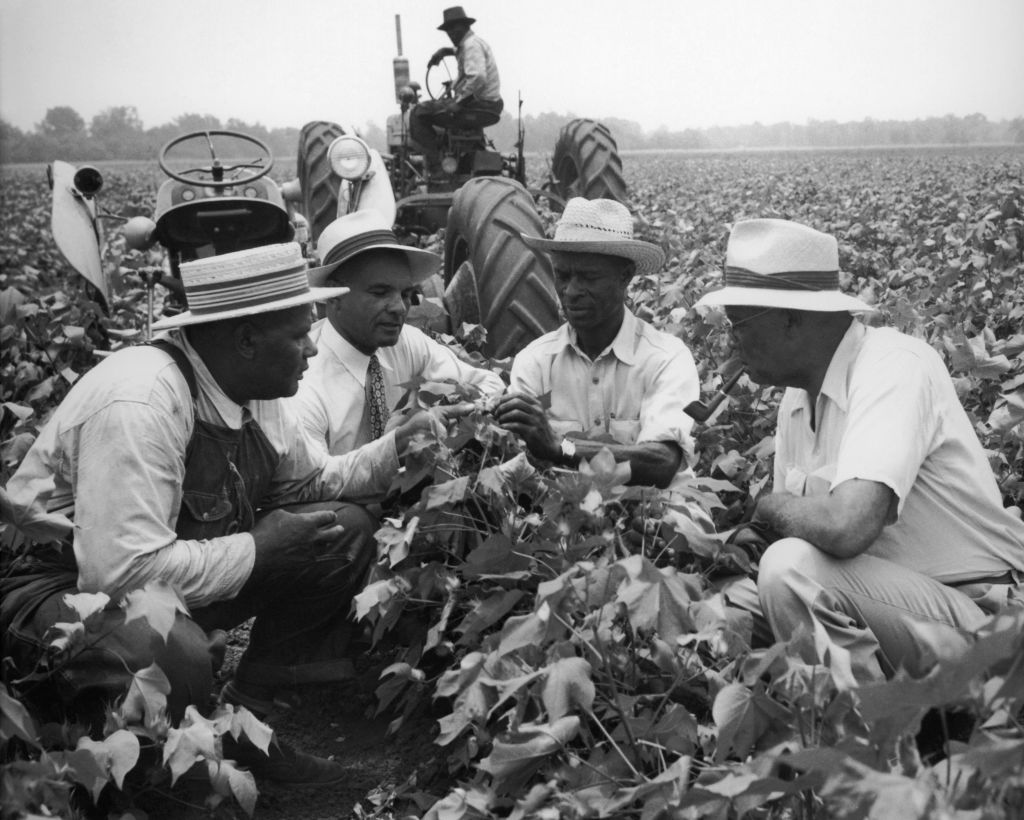
A multiracial coalition of poor farmers almost remade Texas politics — until elites unleashed an all‑out campaign of terror to stop them. (Prairie View A&M University / Historically Black Colleges and Universities via Getty Images)
In the 1890s, populism nearly unseated the Democratic Party in Texas. In the years that followed, conservative and white supremacist backlash rose to ensure that the populist People’s Party — the promising, yet imperfect, alliance between poor farmers, including between black and white Texans — would no longer be able to threaten the power of the Texas elites. The fight to rid Grimes County, Texas, a county where Donald Trump won 79 percent of the vote in 2024, is emblematic of just how severe the backlash against Populism was and how far the conservative Democratic establishment was willing to go to restrict democracy, even resorting to violence.
In those pivotal years, Populism came within striking distance of ending the two-party system in Texas. To fend it off, the Democrats resorted to ballot stuffing and election rigging. As the revolt began to crumble, Democrats initiated a series of restrictions to reinforce their hold on power, effectively barring Populists from participating in Democratic Party affairs. But for the Democrats’ left wing, this created a new problem: by liquidating the Populists from their ranks, the party’s conservative bloc became the strongest in the room. To fix this, party members turned to former Governor Jim Hogg, who had earlier so capably tied the Farmers’ Alliance into knots by offering a slow trickle of reforms. Hogg convinced Democrats to weaken their voter restrictions and, importantly, recommit to railroad and corporate reform. It took multiple election cycles, but by 1902, the more conservative (and whiter) congregations of the agrarian revolt were pulled back into the Democratic fold.
Meanwhile, Democrats also disenfranchised black voters by introducing a poll tax and “white man’s primaries” — breaking another pillar of the People’s Party broad coalition. Workers, black and white, would have to pay between $1.50 and $1.75 to vote. Many farmers were already perpetually in debt, and most made, as historian Thomas Alter II notes, “little more than $425 a year,” meaning most working Texans were effectively disenfranchised. It’s not surprising that voting rates in Texas plummeted following these “reforms.” In one fell swoop, former Populists only had one ally they could turn to — the Hogg wing of the Democratic Party — or else Democrats’ conservative faction would reign supreme. Many Populist leaders went along with the changes, embracing the trade-off for influence. Though many in leadership took this deal, a fair amount of former Populist voters rejected it. The 1902 election, the year the poll tax was officially adopted, saw the “largest opposition to disenfranchisement centered in North Texas,” a hotbed of Populism. This was no sure thing; many Populist leaders actually supported the poll tax, but among the People’s Party rank and file, “Eighty-one percent of those voting the Populist ticket in 1902 opposed the poll tax.”
Concurrent with Democrats’ disenfranchisement campaign, many whites took to the streets for an all-out campaign of racial violence and political terrorism. For example, in Grimes County, once a Populist stronghold, “a white Populist sheriff and his black deputy” were targeted by “vigilante Democrats.”
The sheriff, Garrett Scott, had held his position for years, working closely with his friend and ally Jim Kennard, a black man elected district clerk in 1882. Together with Jack Haynes and Morris Carrington, also black, who left Republican Party politics for the People’s Party, the four appeared to offer an alternative vision for small-town Texas governance. It was bad enough for Grimes County white supremacists that blacks and whites were fraternizing, but the fact that they were winning elections was flat-out unacceptable. There was little they could publicly do at the time as Populism was extremely popular in the region, across racial lines. So the town’s business elite and the white supremacists organized a White Man’s Union (WMU) in secret. Then, as the People’s Party faltered, the White Man’s Union struck.
First, the group published its bylaws in the local paper, inviting white men to put aside their differences: “What a grand picture . . . democrats and populists after all these years of strife and bitter wrangling . . . stepping out on the high plain of true American manhood.” To their black neighbors — who made up nearly half of Grimes County’s population — the WMU claimed, “The Southern white man is still his best friend. . . . But we shall insist that the white man is the most competent one to hold the offices.” Soon the union was menacingly visiting the homes of known white populists, and under the threat of violence, black men in town were intimidated from voting in local elections.
Garrett Scott urged the white populists to arm themselves in defense of their black neighbors. Some may have heeded Scott’s warning, but it wasn’t enough. The first to be killed in the terror was Jim Kennard, shot within shouting distance of the courthouse. No one was brave enough to testify, but most knew the killer to be J. G. McDonald, who had founded the White Man’s Union after losing the county judge seat in 1898. Then the state government finally stepped in — on behalf of the WMU. Against loud protestations from Sheriff Garrett Scott and the People’s Party, Texas Adjutant General Thomas Scurry permitted the local Texas State Guard to march in a parade organized by the WMU. This show of force, and Scott’s inability to stop it, foretold what was coming. Jack Haynes was killed, executed with a shotgun on his own cotton farm.
Black Texans began fleeing the county en masse, and as noted by historian Lawrence Goodwyn, voter turnout dropped over 50 percent, and People’s Party candidates began withdrawing their names from the ballot. But Garrett Scott wasn’t one to back down. He defiantly told a WMU leader to “go and get your Union force, every damn one of them, put them behind rock fences and trees and I’ll fight the whole damn set of cowards.”
Scott lost his reelection campaign, but the WMU wasn’t done with him. Days after the election, Scott’s residence above the jail was surrounded. Scott’s family members, hearing word of the WMU attack, rushed to town to help him. Scott’s brother was killed, but not before returning fire and sending his killer to justice. Meanwhile, Scott was gravely wounded; his sister dragged him into the jailhouse to escape the WMU. For the next five days, Scott holed up in the jailhouse and exchanged gunfire with WMU goons. At his side were his deputies, black and white.
On the fifth day, a group of Texas State Guards arrived to escort Garrett Scott out of Grimes County. This is how populism, and a multiracial version of governance, was defeated in Grimes County. Political and economic elites fomented a vengeful white supremacy to choke off populism’s promise, and one-party rule returned to Texas.
Given the scope of the violence, it may be surprising that socialism was able to take root in the state during this time at all. But the Texas socialists were committed to continuing the fight of the People’s Party. The next decade would see a new form of Texas radicalism rise from the ashes of Populism. As one West Texas tenant farmer wrote, “We must work together to help our brethren see the light. Give us Socialism and the religion of our Lord and Savior Jesus Christ.”