Long Before MAGA’s White Grievance, There Was Bernie Goetz
In 1984, a white man named Bernie Goetz shot four unarmed black youths on a New York City subway train. The tabloids hailed him as a fed-up everyman — rhetoric that permeated the culture and intensified a culture of white grievance and racist vigilantism.
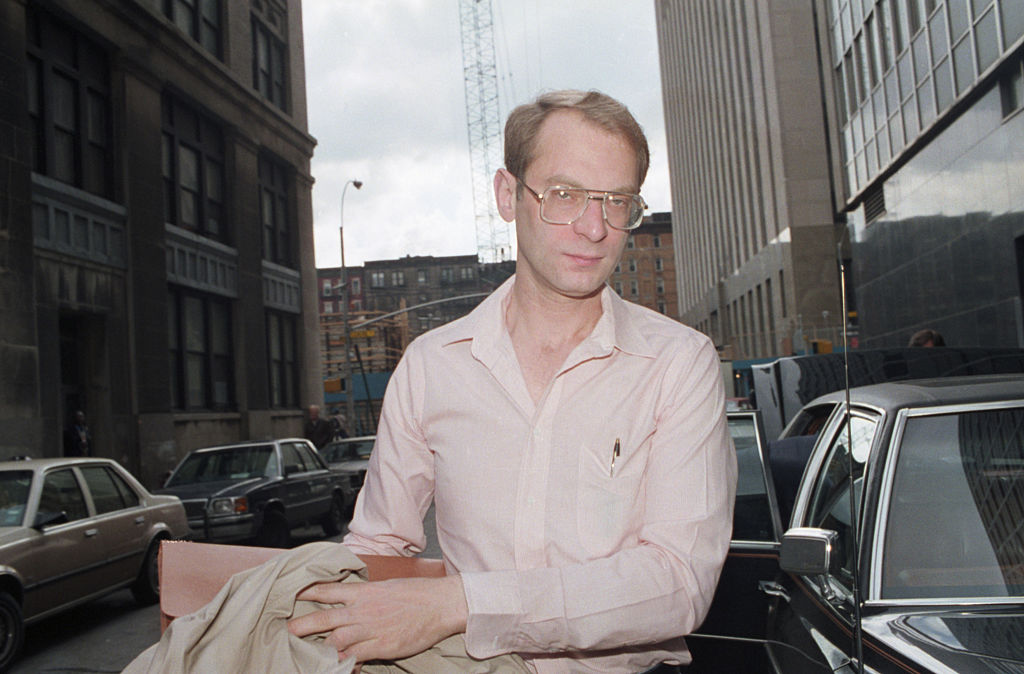
In Reagan-era New York City, a white man named Bernie Goetz opened fire on four unarmed black youths in the New York City subway. The tabloid media hailed him as a vigilante hero, setting the tone for modern right-wing racial grievance politics. (Bettmann / Getty Images)
On December 22, 1984, a pale, dweeby, thirty-seven-year-old white man named Bernhard Goetz boarded a subway car bound for Lower Manhattan. After taking a seat close to four rambunctious black teenagers — nineteen-year-olds Barry Allen, Darrell Cabey, and Troy Canty, and eighteen-year-old James Ramseur — Goetz started glaring in their direction.
One of these teenagers, Troy Canty, decided to greet Goetz. “Hey, what’s up?” Canty asked. Goetz acknowledged Canty’s greeting in a friendly, if unenthusiastic, manner.
Emboldened, Canty sidled up more closely to Goetz and, with a slight smile curling up on his face, said, “Hey, man. How about giving us five bucks?”
Canty’s request activated Goetz, who looked up and urged Canty to repeat his question. Canty assented. “How about giving us five bucks?” the youngster asked again.
Goetz slowly rose from his seat, unzipped his jacket, and turned toward the subway car window. He then dramatically spun around, removed his unlicensed .38 Smith & Wesson from his waistband, and opened fire on the four unsuspecting, unarmed teenagers.
For a few short moments, Bernie Goetz had transformed the 2 train into a combat zone, the sort of dystopian urban hellscape that so many Americans feared then and today. Miraculously, all of Goetz’s victims survived, although one, Darrell Cabey, was paralyzed from the waist down and sustained irreversible brain damage after falling into a coma.
In the minds of many Americans, however, Cabey and his friends weren’t victims at all. In fact, they supposedly embodied the decay and criminal depravity that defined New York and most other American cities in the late twentieth century. Bernie Goetz, meanwhile, became a national icon, feted as a fed-up everyman. He was likened to a real-life Paul Kersey, Charles Bronson’s character in the popular 1974 film Death Wish, who takes the law into his own hands after being victimized by street crime.
Sick and tired of the crooks, hoodlums, and other evildoers who (some observers believed) ran New York City in the austere yet greedy 1980s, Goetz stood up for the law-abiding citizen and for the principles of law and order more broadly. With a quick draw and some rapid fire, the unlikely vigilante had sent a clear, succinct message to the city’s criminal underclass: righteous people like him were taking back the subways, the streets, and the country.
“A FANTASY COME TRUE: DEATH WISH GUNMAN CAPTURED CITY’S IMAGINATION,” read one New York Daily News headline published in the wake of the Goetz shootings. “PREY TURNS PREDATOR,” screeched another.
The Pulitzer Prize–winning historian Heather Ann Thompson’s new book, Fear and Fury: The Reagan Eighties, the Bernie Goetz Shootings, and the Rebirth of White Rage chronicles, in painstaking detail, Goetz’s assault and its afterlives. According to Thompson, Bernie Goetz unleashed more than just five bullets that December day. He also unleashed a troubling new wave of white rage, one that has spawned murderous vigilantes like Kyle Rittenhouse and Daniel Penny, as well as merchants of white grievance like Tucker Carlson and Donald Trump.
As Immigration and Customs Enforcement (ICE) agents terrorize, brutalize, and murder civilians with impunity on the streets of American cities and the fascist current in US politics grows stronger, it appears that we are still living in the long shadow cast by Bernie Goetz.
Casualties of the Revolution
Goetz’s attack on Allen, Cabey, Canty, and Ramseur occurred a month and a half after Ronald Reagan utterly humiliated Walter Mondale in the 1984 presidential election. The Gipper’s historic reelection had reaffirmed the American public’s support for the “Reagan Revolution.” Leveraging widespread nostalgia for the rabid nationalism and unequally shared prosperity of the early Cold War period, this revolution offered deregulation and generous tax cuts for the rich, on the one hand, and austerity, organized abandonment, and discipline for the poor, working class, people of color, and queer people on the other.
While historians such as Brent Cebul and Nathan Connolly have increasingly pointed out continuities between the “New Deal order” forged by Franklin Delano Roosevelt and the “neoliberal order” that Reagan ostensibly inaugurated, Thompson makes the case that the early to mid-1980s were, in fact, exceptional — “a sharp break with the past.” Reagan had eagerly slashed social assistance programs built to blunt the worst effects of market capitalism, deepening the poverty and suffering of those on the margins. The president and his disciples also justified, through moralizing language, the widening gap between rich and poor, the intensifying misery of queer people and people of color in the early HIV/AIDS epidemic, and the expansion of the country’s already sprawling carceral machinery.
The situation on the ground in New York City was bleak. Still reeling from the 1970s fiscal crisis, the city government responded to the economic challenges of the late ’70s and early ’80s with crushing austerity measures. Amid deep cuts to the Department of Sanitation, trash and litter piled up throughout the five boroughs, and a fraying social safety net meant more substandard housing, houselessness, poverty, substance abuse, and crime.
Darrell Cabey was in the thick of it all in the South Bronx. Ronald Reagan had actually visited the struggling neighborhood on a campaign stop in August 1980. In a vacant lot littered with debris — and within spitting distance of two buildings tagged, in bright orange graffiti, with the words “DECAY” and “BROKEN PROMISES” — Reagan insisted that he hadn’t “seen anything that looked like this since London after the Blitz.” Cabey lived not too far away from the site of Reagan’s cynical photo op. He shared a cramped two-bedroom, twenty-first-floor apartment in the Daniel Webster Houses with his mother, Shirley, and his four brothers.
Although Shirley tried to keep Darrell and his brothers at home with “a nice TV” and a stereo, Darrell couldn’t resist the pull of the outside world. Unfortunately for him and so many other youth of color in the Reagan years and beyond, the outside world presented a wide range of dangers — from highly potent and addictive drugs to the violence of the drug trade, and from abusive and racist NYPD cops to bloodthirsty vigilantes such as Bernie Goetz.
The Goetz Family Tree
In the pages of Thompson’s Fear and Fury, the moment Goetz opens fire represents a catalyst, not a climax. The book begins with a brief vignette related to the shooting and returns to the incident on page seventy-eight. The rest of the five-hundred-plus-page book deals with the long aftermath of Goetz’s infamous assault.
In the short term, Goetz fled to New England after the shooting, triggering a massive manhunt that only ended once he surrendered to Concord, New Hampshire, police nine days later. After Goetz had been identified, he enjoyed fawning coverage in the increasingly splashy, trashy, and racist news media, particularly in Rupert Murdoch’s New York Post. The tabloid rags simultaneously transformed Goetz’s shooting victims into bona fide villains, even as Cabey clung to life at St Vincent’s Hospital and later learned that he would never walk again.
The lionization of Bernie Goetz and the concomitant vilification of Allen, Cabey, Canty, and Ramseur continued throughout the ensuing criminal trial. Despite Goetz’s own statements, which evinced his deep-seated racism and desire to inflict harm on the four unarmed youths, defense attorney Barry Slotnick seized on prevailing anti-crime and anti-black sentiment to portray the four shooting victims as aggressors.
With the assistance of the Post, which never missed an opportunity to demonize Allen, Cabey, Canty, and Ramseur, Slotnick’s strategy paid off. In June 1987, a jury of ten whites and two African Americans found Goetz not guilty of the most serious crimes with which he had been charged — attempted murder and first-degree assault.
Though justice had been denied in the criminal trial, Darrell Cabey’s civil suit against Goetz — filed in January 1985 but not decided until over a decade later, in April 1996 — yielded a $43 million judgment on behalf of Cabey and his family.
In the longer term, Thompson argues that Goetz’s attack, and the news media outlets that sensationalized and celebrated it, laid the foundation for the white rage that has shaped twenty-first-century America — from the dispiriting popularity of Fox News to Donald Trump’s election and reelection; from the terror that gripped Charlottesville, Virginia, in August 2017 to the insurrection of January 6, 2021; and from the xenophobia that legitimates ICE’s inhumanity to the killings of Joseph D. Rosenbaum, Anthony Huber, Jordan Neely, and so many others at the hands of white vigilantes.
This is an important and compelling argument, one with which everyone on the US political left ought to reckon. Yet Thompson’s thesis might have been further reinforced with an even deeper examination of the historical context in which Goetz opened fire in 1984. More specifically, Goetz’s vicious assault fit within a frightening upsurge in white power organizing and racist violence in the United States.
The neo-Nazi William Luther Pierce’s novel The Turner Diaries was published in 1978. The bible of the white power movement, Pierce’s book went on to inspire at least forty terrorist attacks and hate crimes in the US and elsewhere. (For instance, police found clippings of The Turner Diaries in Timothy McVeigh’s vehicle after the 1995 Oklahoma City bombing.)
Membership in the Ku Klux Klan surged in the latter half of the 1970s, and previously impermeable boundaries between the KKK and other right-wing hate groups became more porous, historian Kathleen Belew has shown.
These organizations grew more violent during the late 1970s and ’80s as well. Klansmen terrorized Vietnamese refugees who settled along the Gulf Coast following the Vietnam War. In November 1979, days before Reagan launched his third bid for the White House, neo-Nazis and Klansmen ambushed an anti-Klan demonstration in Greensboro, North Carolina, killing five activists aligned with the Communist Workers Party.
Joseph Paul Franklin, an avowed white supremacist, went on a cross-country killing spree in the late 1970s and early ’80s. Among Franklin’s many targets were Larry Flynt and National Urban League president Vernon Jordan. Flynt and Jordan both survived. Authorities suspect that Franklin murdered as many as twenty-two people.
The 1979–1981 Atlanta youth murders, in which twenty-nine young African Americans were snatched and slain in the greater Atlanta area, understandably aroused fears of anti-black violence or even “genocide,” a term some commentators used to describe the killings.
As historian Elizabeth Hinton has illuminated, Miami exploded in May 1980 after an all-white jury acquitted several police officers in the beating death of an unarmed black motorist named Arthur McDuffie. Within the “orgy of violence” that consumed Miami, as the Washington Post characterized it, white vigilantes burned a cross in an African American neighborhood, incinerated a black-owned grocery store, and shot and killed several black teenagers and young adults.
Finally, Joseph Christopher killed twelve black and Latino men and wounded seven more from September 1980 through January 1981.
Thompson only mentions some of these developments, which suggest that the Goetz killings and ensuing media coverage were an escalation of a growing trend of white violence fueled by racial grievance, not a catalyst per se.
This minor criticism notwithstanding, Fear and Fury is a propulsive, urgent, heroically researched, and much-needed account of the 1984 subway shootings, the world that made them, and the world they helped make.