New Study: Union Candidates Deliver for Workers

A new study from the Center for Working-Class Politics, Arizona State University’s Center for Work and Democracy, and Jacobin reveals that politicians with union backgrounds campaign more aggressively for workers and vote further left — but unions rarely recruit them.
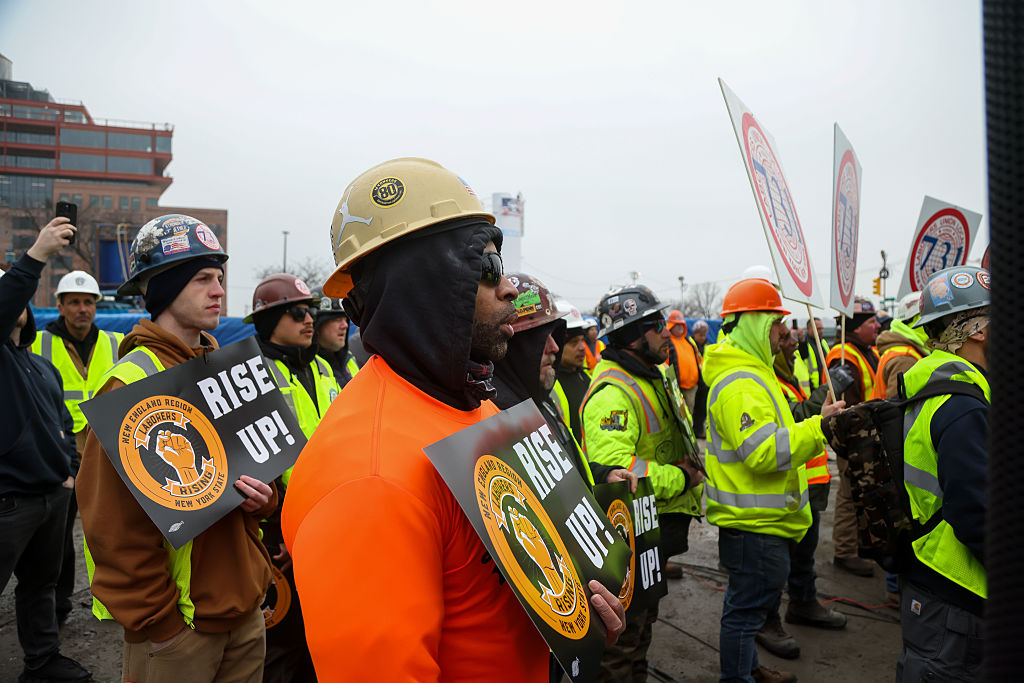
Workers hold "Rise Up" signs as New York governor Kathy Hochul, not pictured, speaks at a construction site for the Gateway Program Hudson Tunnel Project in New York, on February 17, 2026. (Michael Nagle / Bloomberg via Getty Images)

Organized labor’s political power has declined dramatically over the past half century. Union density has fallen from more than 30% of the workforce in the 1960s to less than 10% today — and labor’s footprint in campaign finance has shrunk in parallel. Meanwhile, the historic bond between unions and working-class voters has frayed. In 2024, more than 40% of unionized workers reported voting for Donald Trump, and Teamsters president Sean O’Brien’s appearance at the Republican National Convention made the depth of this realignment impossible to ignore.

Unions have responded with a wide range of revitalization strategies: ballot initiatives, new worker organizations, labor-aligned third parties. Yet one promising approach has received surprisingly little attention — the deliberate recruitment, preparation, and election of candidates who come from the labor movement itself.

This report argues that union candidates are an untapped political resource. Using original quantitative analysis of congressional candidate data from 2010 to 2022 — drawn from the Center for Working-Class Politics’ database of candidate websites — alongside 20 in-depth interviews with union-affiliated elected officials and labor leaders, it documents what union candidates do differently, how rarely they run, and what unions can do to change that.

What We Did

To understand the contemporary role of organized labor in US elections, we analyzed campaign finance data covering congressional races from 1996 to 2022. We tracked the share of donations flowing from labor PACs to candidates over nearly three decades, broken down by party, incumbency status, and candidate background.

To measure the prevalence and political behavior of union candidates, we scraped campaign websites for all congressional candidates between 2010 and 2022 and identified those who reported union membership, leadership, or organizing experience — producing an original database of candidates with union backgrounds. We then linked these candidates to their campaign rhetoric and, for those elected, to their roll-call voting records.

Finally, we conducted 20 original interviews with current and former elected officials at the state, local, and federal levels who have union backgrounds, as well as with union political directors and AFL-CIO staff. Interviews were conducted between spring 2024 and winter 2025. Taken together, this analysis offers the most comprehensive empirical account yet of how union candidates behave — on the campaign trail and in office — and why so few run.

Key Findings

1. Unions’ donations to candidates are declining in relative importance.

  • The share of donations coming from unions has declined dramatically. In the late 1990s, the average Democratic candidate received nearly 15% of all their donations from unions; by 2022, this had fallen to just 3.4% — a roughly fivefold decline.
  • This is mostly due to the explosion of individual donations and independent expenditures since Citizens United in 2010. In absolute terms, union donations have remained relatively stable.
  • When unions do donate, they play it safe — directing funds overwhelmingly to incumbent candidates rather than pro-union challengers or candidates in open-seat races.

2. Candidates and elected officials with union backgrounds are stronger advocates for the working class.

  • Union candidates run more economically populist campaigns. Our analysis of campaign websites for all congressional candidates between 2010 and 2022 finds that union candidates use 159% more pro-worker rhetoric, 66% more progressive economic language, and 51% more anti–economic elite language than nonunion candidates.
  • Legislators with union backgrounds vote further left on economic issues. Comparing roll-call votes from 2010 to 2022, union-affiliated members of Congress are more likely to vote in favor of progressive economic policies, and this holds within each party, even after controlling for district ideology, gender, race, and incumbency.
  • What makes union politicians effective in their own words? Interviews with state, local, and federal legislators revealed several distinct advantages:
  1. Understanding worker issues: Firsthand experience with collective bargaining, organizing, and workplace conditions means less of a learning curve in office.
  2. Legitimacy on labor issues: Union background confers authority — peers and colleagues defer to them on labor questions.
  3. Labor-centered agendas: They consistently prioritize worker rights and union issues in legislation, in ways that even progressive nonunion colleagues often do not.
  4. Institutional access: They maintain ongoing relationships with unions, creating durable channels for feedback and influence.
  5. Legislative strategy: Experience negotiating contracts and running democratic organizations translates directly into coalition-building and legislative skill.
  6. Voter engagement: AFL-CIO survey research finds union members are 36% more likely to vote for candidates who are themselves union members.

3. Despite their strategic value, union candidates and elected officials are rare.

  •  Our analysis of all congressional candidates between 2010 and 2022 finds that just 4.5% reported having a union background — roughly 3% to 6% in any given cycle.
  • Union candidates are far more likely to run as Democrats than Republicans, and the gap is persistent: in every cycle, a candidate with union experience is two to four times more likely to be a Democrat.
  • In 2022 (the most recent year in our dataset) there were 55 union candidates out of approximately 1,200 total, of whom 35 reached the general election and 17 won.
  • Key barriers to more union candidacies include a campaign finance system that favors the wealthy, a lack of union-run candidate training programs in many states, and the tendency of unions to recruit and support candidates only after they have already demonstrated fundraising viability.

4. Unions tend to back candidates with union backgrounds — but not working-class or populist candidates more broadly.

  • When unions spend in open-seat races, they do direct disproportionate resources to candidates with union backgrounds. Union candidates receive roughly 9% of their primary donations from labor PACs, compared to under 5% for nonunion candidates — and this holds after controlling for district ideology.
  • However, unions do not systematically favor candidates from working-class occupations more broadly, or candidates who run on strongly pro-worker or populist agendas. Apparent differences disappear once district-level factors are accounted for.
  • Interviews with union officials suggest this reflects a rational short-term logic: unions prioritize candidates who can raise money and win, rather than shaping the field proactively.
  • What unions can do differently:
  1.  Use organizing infrastructure such as canvassing, member-to-member contact and early financial support, to directly power union-member campaigns.
  2. Invest in union-run candidate training programs to identify more union candidates and build durable pipelines to get those candidates into higher office. Programs in New Jersey (75%+ win rate over 1,300 races across two decades) and Alaska (8 wins out of 12 candidates in just three years) show this approach works at scale.

Read the full report here.