Artificial Intelligence Is Already Making War More Horrific
AI-assisted warfare extends a logic with roots in the industrial warfare of the 20th century: a cold distance that turns humans into points in a dataset.
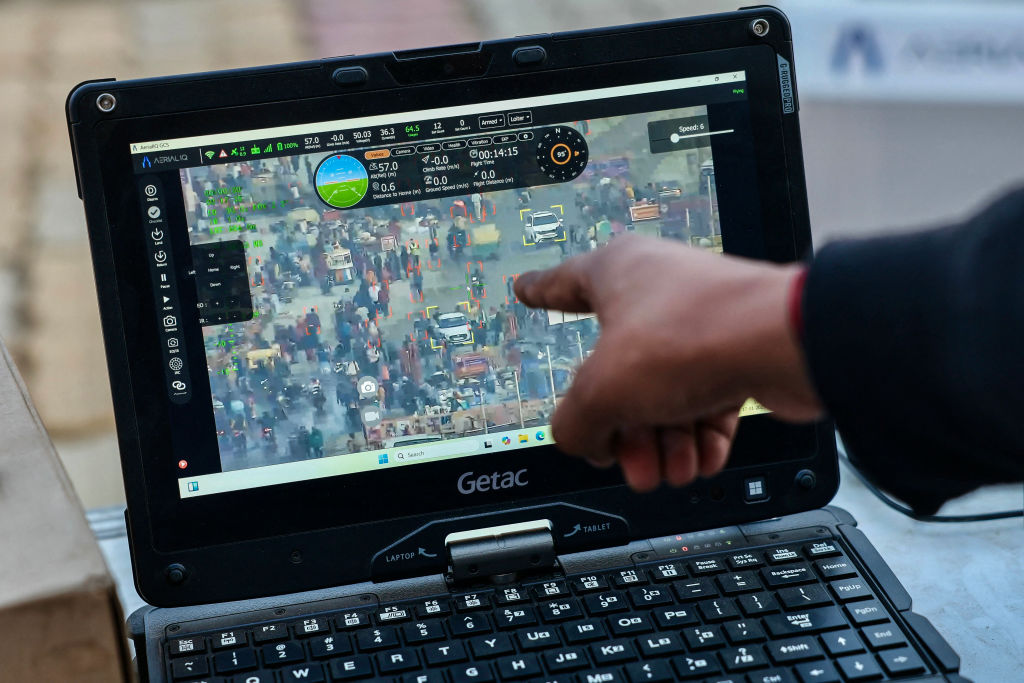
Surveillance via a drone equipped with artificial intelligence. (Niharika Kulkarni / AFP via Getty Images)
The United States is using artificial intelligence in its war with Iran. The military says the “variety” of AI systems in use is dedicated to sorting data, deployed as tools and not as agents. The chief of America’s Central Command, Brad Cooper, says AI systems assist the armed forces, allowing them to “sift through vast amounts of data in seconds so our leaders can cut through the noise and make smarter decisions faster than the enemy can react.”
AI will speed up the pace of target acquisition and firing, and thus the pace of war, death, destruction, and whatever comes in the aftermath. Cooper insists that humans make the final call. That’s less reassuring than it’s meant to be. A recent report notes that “the targets for Operation Epic Fury were identified with the aid of the National Geospatial-Intelligence Agency’s Maven Smart System, which folds in data from surveillance and intelligence, among other data points, and can lay out the information on a dashboard to support officials in their decision-making.”
Nevertheless, we’re told that AI tools don’t “explicitly create” targets; they merely “identify potential points of interest for military intelligence.” This is a bit like saying that information doesn’t impact decisions — as if intelligence placed before a commander has nothing to do with where a strike is ordered.