Southern Italy Is Still Not Italy
Cyclone Harry devastated infrastructure and caused billions of euros of damage across Southern Italy. Drawing scant media coverage and an inert official response, the disaster showed the depth of Italy’s divide, with events in the South all but ignored.
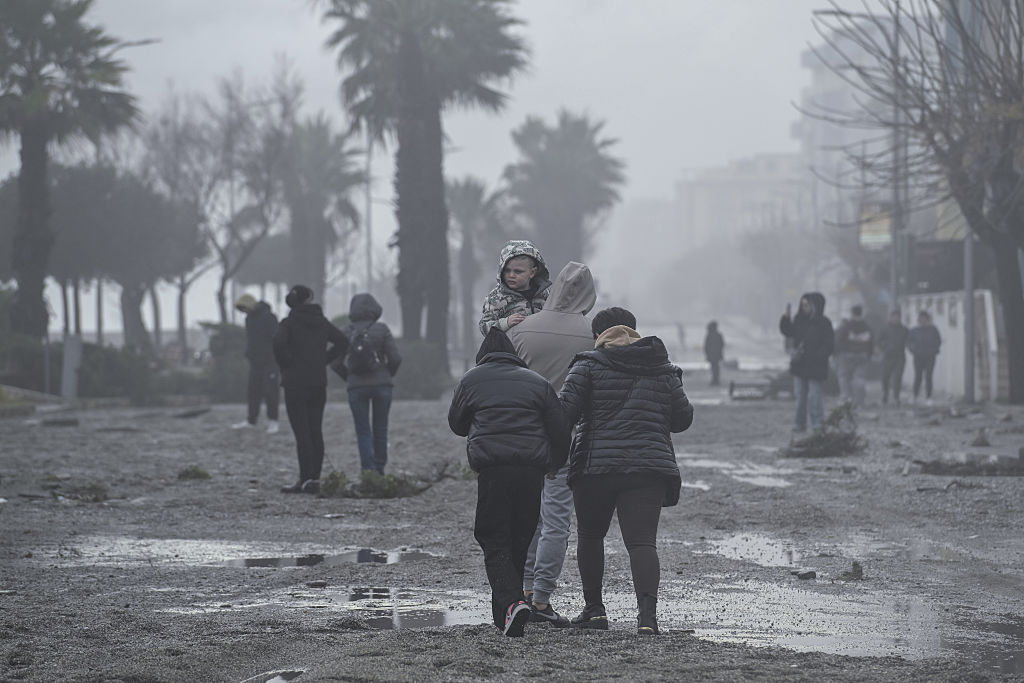
A family seen on the waterfront after the Storm Harry reaches Catanzaro Lido with waves exceeding 5 meters in Catanzaro, Italy, on January 21, 2026. The storm caused severe flooding of houses and local shops. (Valeria Ferraro / Anadolu via Getty Images)
From January 19 to 21, Cyclone Harry moved from the central Mediterranean toward Italy’s coasts, striking southern Italy and Sicily in particular — and devastating infrastructure and roads for hundreds of kilometers. Large sections of the eastern Sicilian coastal road network and the railway system have been fractured at multiple points. Two weeks after the cyclone, estimates of losses still vary, but they now consistently point to figures exceeding billions of euros. The destruction of roads, structures, and water and electricity networks have been concentrated along the seafront, the zone on which the greater part of Southern local economies depend. The consequences are not just material but systemic. In already economically fragile territories, such a concentration of damage raises fears of a prolonged period of economic decline.
Beyond the sheer scale of the damage, another less material but no less unsettling element emerged in the aftermath of the cyclone.
The production and circulation of information about what happened in southern Italy came almost exclusively from people on the ground, local media outlets, and municipal administrators. For many long hours, soon turning into days, the major national print and broadcast media ignored the event. Despite the magnitude of the disaster, national outlets remained silent, to the astonishment of local populations. Only the mobilization of local communities succeeded in briefly, albeit marginally, redirecting media attention toward the unfolding crisis.