Two Brooklyn Socialists Are Hoping to Build the Left’s Bench

Democratic socialists Eon Huntley and Christian Celeste Tate are running for New York State Assembly, hoping to grow the socialist bench in Albany. Jacobin spoke to them about their campaigns.
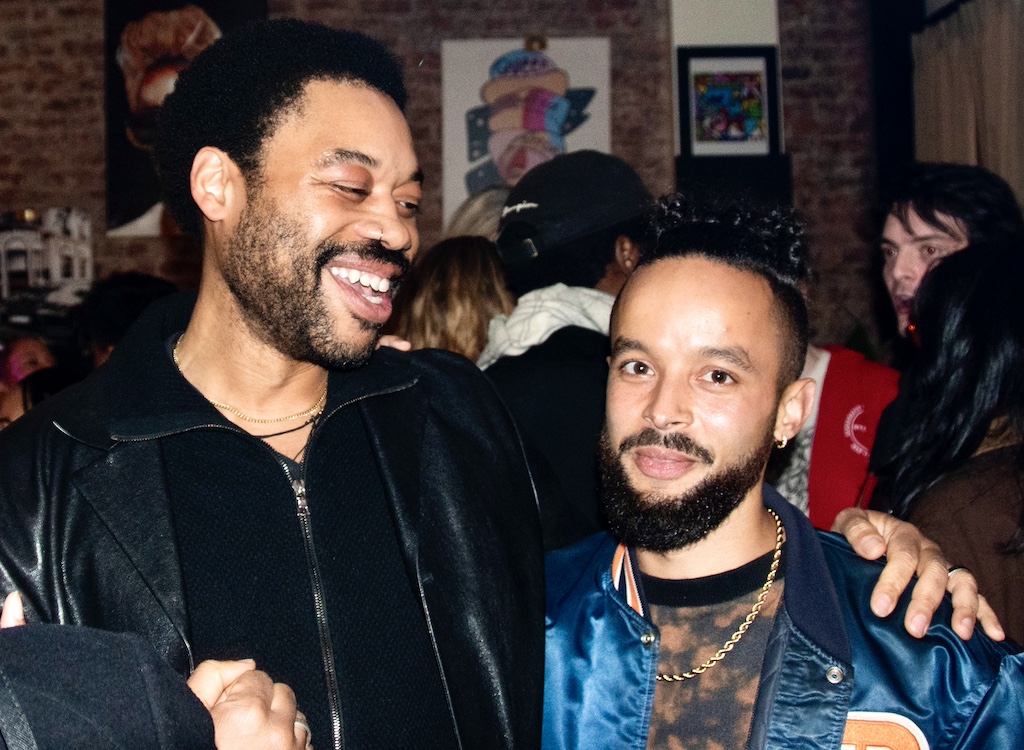
Eon Huntley’s and Christian Celeste Tate’s campaigns represent the most recent attempts to dislodge the current incumbents in the New York State Assembly. (Roman Broszkowski / Jacobin)

Interview by
Roman Broszkowski

Following its success in the mayoral election, the New York City chapter of Democratic Socialists of America (NYC-DSA) is running an expansive slate of candidates across the city. Two endorsees, Eon Huntley and Christian Celeste Tate, are running neighboring campaigns for New York State Assembly in the north and central Brooklyn neighborhoods where DSA has made significant inroads.

After narrowly losing in 2024, Huntley is running for a second time in Assembly District 56, while Tate is running right next door in District 54. Both districts overlap considerably with those of DSA electeds, including areas represented by state senators Jabari Brisport and Julia Salazar, as well as New York City Council Member Chi Ossé (who is a DSA member but did not receive the group’s endorsement when he ran in 2021).

Huntley’s and Tate’s campaigns represent only the most recent attempts to dislodge the current incumbents — state assembly members Stefani Zinerman and Erik Dilan, respectively. Zinerman is seen as a close ally of US House minority leader Hakeem Jeffries, while Dilan is the scion of an influential political family — Dilan’s father, Martin Dilan, was the first state-level incumbent NYC-DSA defeated back in 2018.

Jacobin contributor Roman Broszkowski sat down with Huntley and Tate to discuss how they came to socialism, what they see as the biggest issues for their districts, and how they hope to help Mayor Zohran Mamdani advance his affordability agenda.


Roman Broszkowski

When did you each become socialists, and what brought you to those politics?

Christian Celeste Tate

I was sort of radicalized at an early age, just by the experiences that I grew up with. I came from a working-class family and grew up watching my parents sacrifice and, honestly, struggle at times to make ends meet.

Watching that struggle, watching that sacrifice, taught me a couple of things. First, that if we’re going to have a better world, we have to be the ones to build it. And second, that this system we’re living under is not just broken — it’s rigged.

That early experience then translated into becoming an organizer as an adult. I started organizing during the Black Lives Matter movement, and then, as energy to be out in the streets seemed to die out around me, I started looking for other places to put it — because I still had a lot of energy and a lot of drive and a lot of fire.

But it was clear that just standing in the street screaming was not going to produce the world we deserve. I heard somebody say once that organizers often organize out of love and out of anger. And I think I’ve always had that anger and then developed that love for New York since moving here, and it’s the combination of those two that brought me both to socialism and to DSA.

Eon Tyrell Huntley

The real point in my life that I realized that I was a socialist was living through the financial crisis and Occupy Wall Street. I had gone to college and done all the things that many would say would get you ahead, but I was among the people who found themselves out of work and struggling to make a living for my family, despite doing all the “right” things. And it felt really [oppressive] and felt like somehow these were my own failures.

But watching Bernie Sanders run in 2016 was really illuminating. I had watched him as a Vermont senator and someone whose politics excited me, but I didn’t necessarily expect it to resonate with the country the way it did. It was like everything started to fall in place.

It was a confluence of all these things that made me realize there is really so much arrayed against us, and that it’s not just going to be one individual who can change it but us working together. And I realized that tons of other people felt this way.

Roman Broszkowski

Both of you guys have a lot of experience organizing in different ways. How do you think those experiences have shaped you as candidates?

Eon Tyrell Huntley

Before I found myself in the realm of politics, I was protesting and engaged, but also actively working to negotiate the contract for my union, Workers United, when I worked at Barneys. Following that, I became PTA [parent-teacher association] president after the previous PTA president and school principal left. The school was without any leadership, and then the pandemic hit. This was my opportunity to stand for my community and to not do it alone.

As I speak and run for office, I always center the movements we’re involved in, because that is what has always informed me about how you succeed. It’s not one individual, it’s about us standing together collectively to achieve things, be it negotiating a contract or being able to provide for a community at the height of when people couldn’t get support from the government and others.

Christian Celeste Tate

I think the way that I have shown up as a candidate reflects the way that I’ve shown up as an organizer, which reflects the way that I show up, period. I think that I have spent a lot of time in my life in the space between — whether it’s navigating wealth inequality or biracial identity or divorcing parents — and I think that has led me to listen. To listen with the intent of finding common ground and then building off of that.

That is a really important asset in communities that are as beautifully diverse as Bushwick and East New York. There are many different perspectives, lived experiences, and worldviews that come together here. And it’s really important that we have representatives, leaders, and organizers who are looking for those points of commonality and building on the things we see eye to eye on. Even on our most controversial subjects, I think there’s a lot more that we agree on than we disagree on. But we often let those disagreements prevent us from making progress on the points of agreement.

Roman Broszkowski

Eon, you talk a lot about public education and describe yourself as a child of the public education system. How do you view your role as a candidate in ensuring that public education is still a viable pathway for everyone in New York?

Eon Tyrell Huntley

I am very proud of that. I’ve only attended New York City public schools. My wife is a public school teacher, and my kids attend public school, so it’s very much connected to my experience. And it’s something I think is really important because we’re not going to have a truly equitable society unless we start from the beginning. We need to be funding our elementary schools and making sure that every child is getting the kind of education they deserve.

It is also, conversely, a real dire situation. New York City is one of the most segregated school districts in the country and has such wild imbalances because of how things function in terms of funding.

Parents are doing what they can in a system that’s broken, but that ends up perpetuating the faults of the system even further. People try to do what’s best for their family, but that results in people collecting and hoarding resources in one space and then leaving many other schools without — for example, PTAs that can raise millions of dollars versus some that can only raise hundreds or thousands of dollars in a year in the same district. Or charter schools that get some of the money that comes in with a student [because students receive per-pupil funding], and then [the school] dismisses them and still hold onto that money.

Roman Broszkowski

Eon, the last time you ran, you were the target of attacks claiming you were not representative of this district. I anticipate that happening to you again, and to Christian as well. How do you feel that you are representative of these beautiful places?

Eon Tyrell Huntley

That’s such a funny question. Because I’ve lived here for seventeen years, almost as long as I lived in East New York.

I was engaged here and got married while living here. My kids were born here; they’ve only lived in Bed-Stuy, and they have only attended Bed-Stuy public schools. I’ve been the PTA president of a school in Bed-Stuy and cofounded a food pantry in partnership with Food Bank for New York, which has served this community for three years every third Saturday of the month — serving my neighbors, my elders. On top of that, my stepdad comes from Bed-Stuy. These are long-standing ties.

All that is to say that [those attacks are] using the fact that I’m organizing outside of the establishment power here to further the narrative that, somehow, I am representative of the gentrifiers. From out the gate, off the rip, I said that this campaign is about black political power and the history that came before me.

My political ideology and the policies that I stand for are actually anti-gentrification. They’re about pushing back against the developers, against the real estate lobby, and also against their chosen candidates who carry water for them, recite their talking points, and choose division by painting those who move in here, seeking just to live and maybe also enjoy this community, as the enemies — as opposed to the people who are actually creating the dynamic and keeping us divided so that we can never move forward.

Christian Celeste Tate

Call it what it is — those arguments are distractions. This is about building and continuing to progress a working-class movement that sees through those distractions. This is not about identity politics. This is about platforms that deliver for working-class people.

The same people who will stand there and tell you that a socialist could never represent you have been siphoning money from public systems to private interests for generations. So I think we have to call it what it is and be honest about the fact that those arguments are intended to divide working-class people and pretend like we can’t stand together behind a platform that advocates for all of us.

Roman Broszkowski

Christian, I want to ask you about a quote from an interview you did with the Indypendent where you said, “Part of our assignment is to reintroduce people to democratic socialism because enormous money and political energy have gone to alienating people from it.” Can you explain what reintroducing democratic socialism looks like in your campaign?

Christian Celeste Tate

There has been an enormous amount of money and energy and political strategy that has gone into convincing people that socialism is radical. So, unfortunately, when we are talking to people about socialism, we don’t have the privilege of a first impression. Instead, we have to encourage people to unpack what they have been told about socialism and show them something new.

There’s a Toni Cade Bambara quote that says: “The job of the artist is to make the movement irresistible.” I think that perfectly captures what I see as our assignment here. It’s not about reintroducing people to socialism by giving them a book or telling them the message, but it’s about showing people what it looks like to show up for each other. And to be working toward a world in which we are defined by abundance and not scarcity.

A lot of what made Zohran’s campaign so effective and so far-reaching was that it was fun. It was exciting and beautiful. And that’s what people want to be a part of.

Roman Broszkowski

What are your biggest complaints about the current district representatives, assemblymembers Dilan and Zinerman?

Eon Tyrell Huntley

A lack of vision. And it’s not to say that a broken clock is not right twice a day, that they don’t sometimes do things right; but they lack a vision and lack the will to do more.

Jabari Brisport, Christian Celeste Tate, and Eon Huntley at a rally kicking off New York City Democratic Socialists of America’s “Tax the Rich” campaign. (Roman Broszkowski / Jacobin)

They lack the will to fight for what we deserve, which is a more equitable society. Increasingly, the status quo means that we have to do more with less, and they tell us that’s fine. They tell us that’s okay. They have no vision for what’s beyond that, and that’s the problem here.

When we had a huge opportunity to have more robust tenant protections with the original good cause bill, when the good cause was originally written, [Assemblymember Zinerman] stood against it. She repeated the talking points of the Real Estate Board of New York (REBNY), the real estate lobby, and weaponized black displacement and gentrification — a real problem, and it’s something I have a real issue with — and used it to create a dynamic where people are fighting against each other rather than fighting for what they deserve.

Christian Celeste Tate

It comes down to presence and accountability. Talk to constituents in District 54 and you’ll hear stories of folks who are going through it with their landlords, who are going through it with their employers, who need the support that the job is intended to offer, and they can’t find their assemblymember.

So I think presence is top of mind for everyone. When it comes to accountability, it’s pretty much the same story. Since taking office, over half of Dilan’s money has come from corporations and real estate interests. The sad truth is that can’t be the person to address these problems because that person is funded by the entities and special interests profiting from our problems.

But I also want to be clear that Dilan is not my enemy. Dilan is an appendage of a much larger problem that exists everywhere throughout this city — of special interests and of corporate influence over our politics.

Roman Broszkowski

Eon, in 2024, City and State called your race an existential fight for the political soul of Bed-Stuy. Do you still feel that way? And Christian, do you feel that way about your election?

Eon Tyrell Huntley

I do. My congressman is Hakeem Jeffries, who’s potentially going to be the speaker of the House, and Brooklyn is the home of black political power in New York. Yet we have leaders who don’t offer any vision, any sort of direction, that speaks to the needs not only of what people are saying here but also largely what people are saying across the country.

The reason why Zohran became a nationwide sensation is that the affordability crisis and runaway inequality are felt across every state. Everyone has their own story, and everyone wants their own fighter who’s going to stand up for that.

Christian Celeste Tate

The reality is that if you’re not sitting at the table, you’re on the menu. I think that folks in my community have been organizing tooth and nail to get their seat at the table.

In part because of the lack of representation we don’t have that right now. I see this as a continuation of generations of organizing, political education, and building that folks have done to get this community what it deserves.

Roman Broszkowski

Both of you have really foregrounded housing as part of your campaigns, particularly the plight of renters. I do want to talk about a problem facing both of your districts’ homeowners, though: deed theft. How would socialists address that problem?

Christian Celeste Tate

I want to remove the distinction between the plight of tenants and the plight of homeowners. Because what we are experiencing across this community is housing insecurity. And we will refer to a homeowner as an owner because they pay their monthly rent to a bank instead of a landlord, but even somebody who “owns their home” does not have a guarantee that they can stay in that house. I think there is an enormous amount of commonality and the insecurity that people are forced into when it comes to housing stability.

My goal is to fight for policies that will keep every New Yorker in their home. It does not matter if they’re renting or owning, or at what rate or at what price — everybody deserves a place to live. That is basic.

To the deed theft point specifically, the thing that comes to mind first is the cease-and-desist zone. We need unanimity among elected officials, standing behind the idea that our communities are not for sale. We get sucked into these conversations about gentrification that lose sight of the fact that the cause of that gentrification is landlords and banks that are buying up houses as investments and pushing people around the city.

I think if we are clear about what we are fighting and we are clear about the fact that homeowners and renters alike are suffering because of it, it paves the path toward some of these commonsense solutions. I think that’s true for the cease-and-desist zone; I think that’s true for a flip tax; I think that’s true for tenants’ opportunity to purchase; I think that’s true for the social housing development authority. These are all short-, medium-, and long-term solutions that are rooted in socialist values but are also immediately responsive to the insecurity that people are forced into today.

Eon Tyrell Huntley

I think Christian said it very well. There’s this elevation of homeowners to create division among working people, because the homeowner is maybe just one rung above the precarity that the renter [experiences]. These homeowners face rising property taxes but also people actively [pursuing] predatory behavior to take their homes. It just so happens that these are the same people who are also the enemies of the tenants.

It’s very important that we are making sure that we are communicating to all of our constituents about how we are trying to do right by them and provide the kind of city they deserve. That means especially for the people who invested in a community — who have been pillars of the community when the government and others weren’t interested in being here. You can’t turn your back on them. This is also one of the places with probably the largest number of black homeowners in the country. And that’s really important because people built this in the face of an entire society that did not want to do anything for them.

So [the solution] is very much about making a larger platform about housing, about the insecurity of housing, about the gentrification and displacement that’s going on, and having a robust policy that actually addresses that. Because to protect a homeowner who’s battling deed theft doesn’t mean that you can’t protect the renter who’s also under threat.

Roman Broszkowski

What do you think are the three largest issues facing your districts?

Eon Tyrell Huntley

Housing. This is immediate. We have a lack of real affordable housing.

We have housing that’s not accessible for people with disabilities or places where you can age and have a family. It’s being built like six-person transient-roommate warehouses. It was really hard for my family — I have two daughters and my wife, and we have a dog — to find a place that could accommodate us, where we can grow in the same way that I grew up, where I lived in the same building from the time that I was nine to twenty, twenty-one.

And then, education and the affordability of childcare. I remember what it was like to have my wife and I make a choice between paying for rent and paying for daycare, and the price has only gone up since our kids have exited daycare.

Christian Celeste Tate

Keeping people in their houses, protecting our neighbors from ICE [Immigration and Customs Enforcement] and from fascism, and investing in community safety — whether it’s in the Bushwick side of the district, City Line, or East New York. Those are the three things that I hear people talk about every single day.

 It’s about making the investments in community that prevent crime and harm in the first place. We don’t spend enough time or hardly any time at all talking about the intergenerational cycles of poverty and inequality that push people into corners, that cause conditions in which there is crime. So I think it is things like violence interruption, summer and after-school youth programming, access to mental health support, substance abuse treatments, and homeless services.

These are obvious investments in community that provide for people and allow people to navigate life. The safest communities are those where everyone has enough food to eat, where everyone has a place to sleep, and where everyone has access to health care.

Roman Broszkowski

How do you see your role in pushing Zohran’s agenda at the state level, and how do you understand the role of NYC-DSA in that and in this political moment in general?

Eon Tyrell Huntley

I see my campaign, and all of our DSA campaigns, as the crucial next step in enacting Zohran’s affordability agenda. NYC-DSA is the vanguard of the American left at the moment, and we owe it to everyone, not just New Yorkers, to deliver what the voters mandated when they made him mayor.

Every socialist we put in a legislative seat is a force multiplier in the fight to fulfill that mandate. With my vote in Albany, I’m going to have Zohran’s back and make sure he has the funding he needs to make this city affordable. I’m also going to apply those principles at the state level, where we’re already starting to see the tide turn on things like universal childcare and taxing the rich. It’s time these commonsense, family-focused policies become the norm in this state.

Christian Celeste Tate

I intend to fight tooth and nail to support Zohran’s agenda. As the East Brooklyn field coordinator for the general election, I spent hours knocking on doors in my community (East New York and Cypress Hills especially), talking to folks about that agenda, and I know how hungry people are for it.

But we know that actually getting it requires partners at the state level. Not just partners who jump on the bandwagon when things are good, but partners who actually share Zohran’s commitment to fighting for working people. I see NYC-DSA as being a home for that movement-building. We need to be constantly building political power so that after we win free buses and universal childcare, we’re ready to take on the next fight.