In Defense of the New York City Transit Strike
Roger Toussaint, former president of Transport Workers Union Local 100, challenges the claim that New York’s last great transit strike weakened labor — and explains why its real legacy has been obscured.
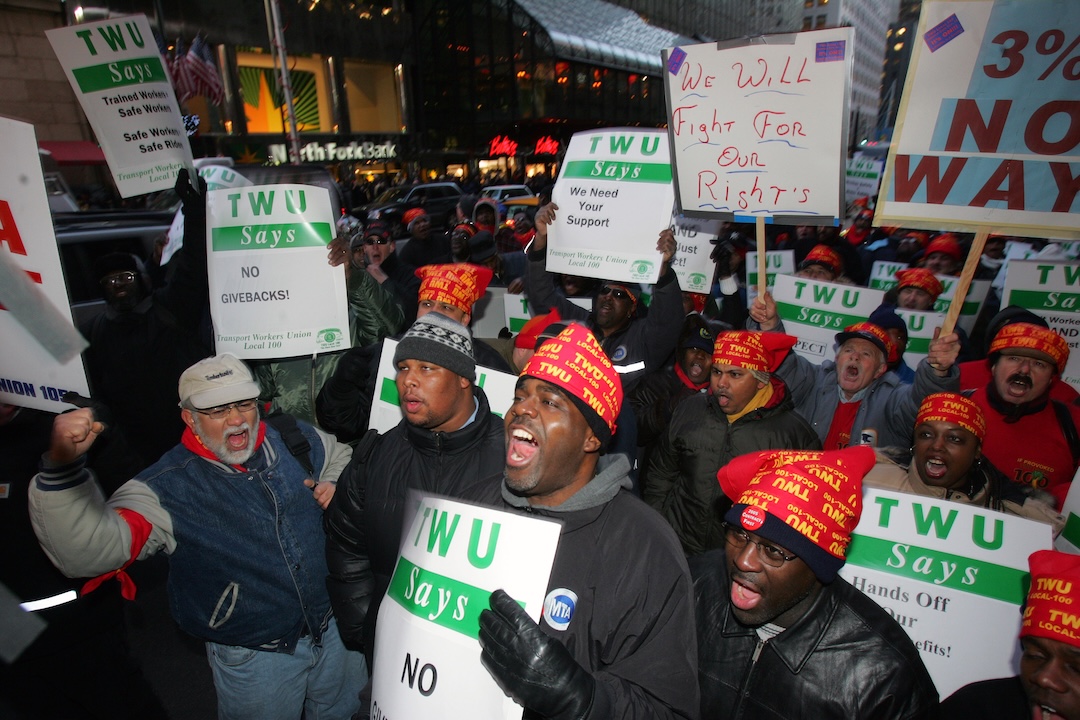
Twenty years after the 2005 New York City transit strike, the legacy of the walkout remains contested. (Michael Nagle / Bloomberg News
I write as the principal leader of the December 2005 New York City transit strike. Twenty years ago, Transport Workers Union (TWU) Local 100 conducted a once-in-a-generation battle against the oligarchs of New York City and state by shutting down all mass transportation in NYC. Twenty years later, the legacy of that strike remains contested — not only by predictable opponents but also by some who present themselves as allies of labor and social justice.
In my view, part of the reason for this is a discomfort with leadership that thinks and operates differently from the inherited habits of an old guard on the Left. Habits that just were not measuring up to the challenges at hand.
The stands we took not only worked on their own terms; they helped shape the terrain for later confrontations, from the public sector uprising in Wisconsin, to Occupy Wall Street, to the Black Lives Matter movement, to the Chicago teachers’ strike, and even Zohran Mamdani’s mayoral victory. So too, navigating the obstacles posed by inherited habits also continues as a serious challenge.
However, Marc Kagan’s recent Jacobin piece argues that the December 2005 NYC transit strike left a “lasting scar” on the labor movement.
A central difficulty in Kagan’s approach is how he assigns responsibility for TWU Local 100’s post-2009 decline. Through a series of interpretive moves, he attributes much of what occurred after my departure in 2009 either to the period following the 2005 strike, or to events predating the strike, including the period after his own dismissal from TWU Local 100 in February 2003. That dismissal followed serious conflicts with the Executive Board and allegations of misconduct — a salient piece of information that does not appear in his account. Whatever one makes of this history, its omission matters, as it bears on the posture of his analysis.
First and foremost, the December 2005 NYC transit strike was a success. We walked out to prevent an arbitrator from imposing a Tier 6 pension. We blocked that outcome decisively enough that the Metropolitan Transportation Authority (MTA) agreed in writing to provide a pension refund to the tune of $131.7 million. Before we ended the strike, we had a signed agreement that also included a 10.5 percent wage increase, Martin Luther King Jr Day as a paid holiday, and first-time-ever nationwide medical coverage for our pre-Medicare retirees, the vast majority of whom live out of state. That coverage was fully funded from the 1.5 percent medical contribution which we agreed to, along with additional gains.
Those achievements followed a series of historic gains in the 2002 contract, which included shifting from a defined contribution medical plan to a guaranteed benefit medical plan, a 140 percent increase in sick time for all bus division members in Manhattan and the Bronx (over five thousand workers), equalizing sick benefits, and strengthening membership unity. This was in addition to other long-sought improvements that had eluded the local for decades. These successes were a product of the first and only successful rank-and-file insurgency in Local 100’s history to overthrow business-style unionism and win leadership.
Kagan offers as evidence Local 100’s “decline” a set of observations and opinions that reflect the state of the union’s later condition. But he retrofits them to before 2009 to support his argument. In this way, any and all damage done by those forces that attempted to undermine strike preparation, sabotage the strike during the walkout, or damage the Save Our Union campaign after the elimination of dues checkoff is reassigned as evidence that the strike itself failed. Even the adversities faced by the strike, such as the call issued by Local 100’s parent organization for members to cross the picket line and attempts by a small group of officers sympathetic to this position to collapse the strike from within, are ignored or sanitized by Kagan. The result is a narrative congenial to assorted right-wing critics of the strike as well as ultraleft denunciation.
However, it is necessary to be concrete about the material conditions Local 100 faced and what it took to survive them. Local 100’s automatic dues deduction was restored by the courts in the fall of 2008, after roughly eighteen months. This interruption was an unprecedented challenge for a US public sector labor organization. It was intended as a death sentence. Surviving which demonstrated strength and was evidence of resilience.
Not only did TWU Local 100 survive the attacks it faced from government and entrenched interests, it also successfully negotiated a successor contract in 2008 following the strike, securing above-inflation wage increases and beginning to mitigate the impact of the 1.5 percent employee medical contribution by capping it at forty hours instead of at gross wages. Most remarkably, this was achieved in the midst of the 2008 nationwide financial crisis, which was the nation’s most severe since the Great Depression of the 1930s. But such critical considerations are largely absent from Kagan’s analysis.
Kagan further claims, without supplying evidence from any of the years immediately following the strike, that the prevailing lesson and narrative (the “scar”) left by the 2005 strike was that strikes are bad and are to be avoided at all cost. He suggests, regretfully, that the strike itself produced this result.
The “evidence” he does bring forward appears to be the union’s performance during the years of MTA chair Jay Walder and Governor Andrew Cuomo beginning in 2010, which included mass layoffs in 2010–11; the imposition of a Tier 6 pension in 2012; an unprecedented five-year contract settled in 2014 (with an 8 percent wage increase) after an equally unprecedented two-year period of expiration and with an increase of employee medical contribution from 1.5 percent to 2 percent; and the return of second-class treatment in wage increases for certain titles, including New York City Transit cleaners (CTA), whose raises were singularly delayed.
Kagan claims his history concludes in 2009, but many of his descriptions and references come from after that period. His argument requires acrobatic backflips in chronology to make the evidence fit his thesis, greased by extensive second-guessing of the decisions taken by the Executive Board and leadership of TWU Local 100.
The real lesson of the 2005 transit strike is that mass direct action worked then and still does, but also that victories are always vulnerable to later reversal. Confusing those reversals for the strike itself lets power off the hook — and deprives labor of one of the clearest demonstrations of what collective action can still achieve.