The 2005 New York City Transit Strike: A Lasting Scar
On this day 20 years ago, New York City transit workers launched an illegal strike. It ended in a bitter defeat that hobbled the union for years and discouraged public sector labor militancy more widely. What lessons can we draw from the strike today?
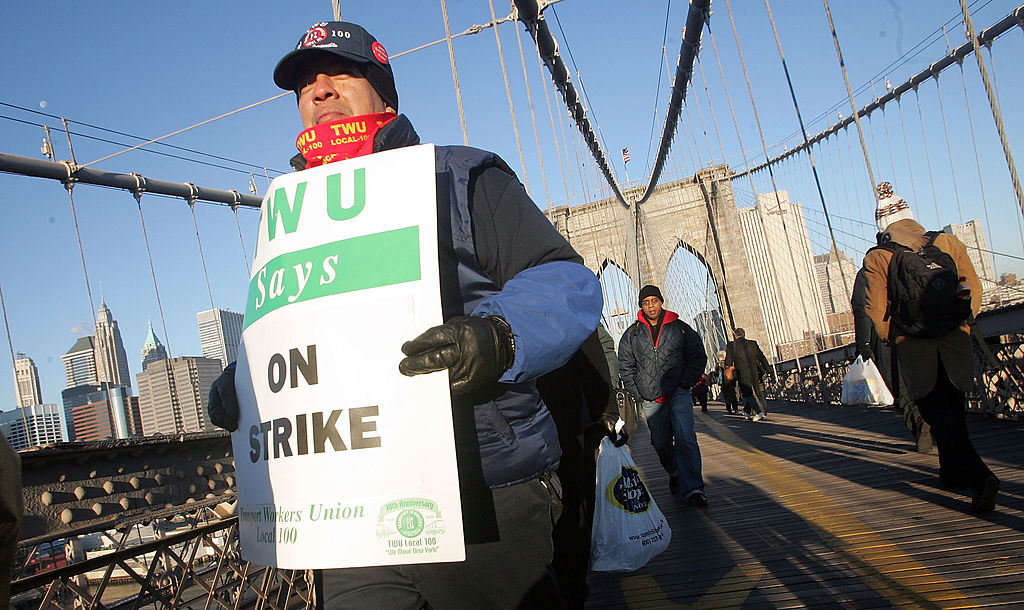
Many public sector workers take the moral of the 2005 New York transit worker strike to be that militancy is too risky and should be avoided. But a sober assessment of what went wrong shows that the union’s defeat was not inevitable. (Mario Tama / Getty Images)
Twenty years ago today, on the second day of a transit strike that had effectively shut down much of New York City, Roger Toussaint, president of the striking Transport Workers Union Local 100, faced the press in a news conference carried live on all the major local television stations. Earlier that day, the New York Post had put him on its cover behind prison bars, while the Daily News wanted to “throw Roger from the train.” Mayor Michael Bloomberg had denounced transit workers — or at least the union leadership — as thugs.
Yet Toussaint not only seemed unfazed but rose to the occasion. Six years before Occupy Wall Street, and ten years before Bernie Sanders ascended the national stage, Toussaint eloquently, if elliptically, spoke a language of class rarely heard in the mass media. “The notion,” he said,
that it is acceptable to hold cops, teachers, firefighters, DC 37, sanitation, and others without contracts for two to three years is repulsive. Housing costs, the cost of gasoline, the cost of food, doesn’t have the patience that Governor Pataki and Mayor Bloomberg apparently insist that labor unions have. . . . Maybe it is difficult for a billionaire to understand what someone who’s making a few tens of thousands of dollars is going through, and meeting those bills and paying for your children to go to school.
Then he gave a stirring defense of his own members:
We believe that working people in New York can better identify with transit workers and know instinctively that the thugs are not on this side of the podium. We are not thugs, we are not selfish, we are not greedy; we are hardworking New Yorkers, dignified men and women, who have put in decades of service to keep this city moving 24/7. We wake up at 3 and 4 in the morning to move trains and buses in this town, and we will continue to do that.
In the full glare of the spotlight, Toussaint articulated an alternative to neoliberalism and austerity. Yet just a day later, Toussaint urged his union’s executive board to end the strike without revealing to them that he had a signed agreement in his pocket, or that it contained two important concessions to management demands. That was because, he explained for the first time just this month, he didn’t want to embarrass the governor, who had disingenuously vowed there would be no negotiations until the strike ended.
Here was the best and worst of Toussaint in twenty-four hours: articulating all that was unjust about New York’s neoliberal agenda in a way no other labor leader did, then lying to his officers and members in order to mollify the supposed class enemies he had just denounced.
A month later, transit workers, upset about those concessions, rejected that contract, setting off a year of turmoil during which Governor George Pataki tried to repudiate the most important union gain in the contract and Toussaint demanded that transit workers revote on the very same contract his members had already turned down. Ultimately, that contract was imposed by an arbitrator.
Years afterward, two of Toussaint’s closest supporters neatly summed up militant workers’ assessment of the strike and its outcome: a mixture of proud, wistful, frustrated, and upset. “We got some respect for going on strike. . . . You win some, you lose some. . . . It was something we had to do,” said one. But, “a lot of members came back looking down to the ground,” observed another.
That demoralization meant that when the union lost its right to dues check-off for eighteen months and workers were able to choose whether to pay their dues, nearly half withheld some or all of those payments. More than fifteen hundred of them remain in bad standing today, unable to vote in union elections. Nor has a demand for more militancy been able to take root among newer workers.
The moral of the 2005 transit strike, then, might well be summed up as: when you take the risk of striking, especially with an illegal strike, try not to play the cards the class enemy has dealt.
The Rise and Decline of New Directions
Roger Toussaint was elected president of Local 100 in 2000 at the head of the New Directions dissident slate that had lambasted lethargic union leaders and vowed to more vigorously fight the employer, the New York City Transit Authority (Transit) and its parent, the Metropolitan Transportation Authority (MTA). In a three-way race, New Directions candidates garnered 60 percent of the vote from transit workers disgusted by nearly two decades of wage and work-rule givebacks and angered by Transit’s abusive treatment.
In the years leading up to that election, Transit routinely put a quarter of its workforce through formal disciplinary hearings every year. Transit sent investigators and even doctors to the homes of workers who called in sick. Thousands of workers were on a “sick abuse list” that required a doctor’s note for any absence. At work, questioning any directive, even on safety grounds — transit workers routinely work around moving trains and next to a live six-hundred-volt third rail — could lead to immediate suspension.
Following the New Directions victory, it seemed great opportunities were at hand to improve economic outcomes, limit management control of operational decisions, and alter methods of union work. The new officers had spent years demanding the union rebuild workplace power, encourage collective self-help and initiative among its members, and allow workers to actively participate in union decision-making. Now they had the chance to challenge Transit’s — and New York City’s — brand of neoliberal austerity and, Toussaint said, help transit workers take “ownership” of their union.
For a time, membership participation increased, concessions were opposed, sabers were rattled and sometimes unsheathed. In early 2003, near the apogee of this “new” Local 100’s efforts, labor historian Kim Phillips-Fein wrote enthusiastically about the far-reaching possibilities of this effort: “That one of the city’s most powerful public unions is controlled by a progressive leadership may help, over time, to transform the whole labor movement in the city and the state.” Then she added, more cautiously, “if the people who run the Local continue striving to build a radical militant Union.”
That conditional phrase was all too prescient; even as Phillips-Fein was writing, efforts to develop shop-floor militancy, new rank-and-file cadre, and greater participatory democracy were flagging. Although the local had prepared to strike in December 2002, buoyed by huge midtown demonstrations, job shutdowns, and two strike authorization meetings at the Javits Convention Center that drew nearly half the membership, Toussaint, meeting alone with the MTA, decided its final offer was adequate and stood Local 100 down.
Whether or not Toussaint’s assessment of that contract was correct, his promise to workers that the local would be even more prepared to strike in three years proved a grave miscalculation. Disagreement about the contract terms helped shatter the New Directions activist core. In the following year’s election, when opposition candidates gained ground, Toussaint disregarded the new officers’ constitutional prerogatives and centralized control of the union.
Three years of internal warfare followed, creating distractions, exhausting resources, limiting shop-floor organization, and hampering efforts to build a powerful local. Transit poured salt on those wounds, inventing new abuses and stonewalling remedies to worker mistreatment the union thought it had won. Its successes encouraged it to press concessionary demands in the 2005 contract negotiations.
Meanwhile, union preparations to “come to the table strong” — its 2005 mantra — sputtered. In the spring, the union’s newspaper had declared, the local would “build strength” with more training, more activists, and more fights around harassment and safety. In the summer, it would develop “main themes, detailed demands, over four thousand members trained to popularize them and a city full of allies.” In late fall, “battle readiness” would be gauged: whether the membership was “informed, organized and united,” and whether “a dozen battles with the MTA” had unfolded.
Little of this ambitious plan was achieved. The internal distractions and infighting meant that planned spring and summer efforts never came to fruition, leaving the union less ready to threaten a strike than it had been three years earlier.
Large battles with management, and the four thousand activists, were nonexistent, while union demands and its definition of success were muddy and strikingly modest. In meetings with members, Toussaint pointed to what “strong unions have fought for and won.” In the context of New York, where Mayor Bloomberg signed a flurry of contracts in the months leading up to his November reelection, that meant the police union’s 10 percent raise over two years, or sanitation’s 17 percent over fifty-one months. What Toussaint didn’t say, but he and the MTA both knew, was that the contracts he praised came with concessions — for police, a steep wage reduction for new workers and, for sanitation, an increased workload.
All this was a problematic message to send to management, which, despite flaunting a $1 billion surplus, demanded that all new hires increase their out-of-pocket payments for health and pension benefits. Even the New York Times wondered, “How . . . can the authority boast of such a surplus while lowballing wage offers and demanding concessions?”
The 2005 Strike
The union’s determination to avoid creating a new tier of second-class workers was enough to send it out on strike, rightly defying New York’s anti-strike Taylor Law — but not before it squandered a key tactical advantage.
For years, the union had touted the value of striking before Christmas, believing retailers would press the MTA to settle. The strike was due to begin on Friday, December 16, but on Toussaint’s advice, the executive board postponed the walkout until Tuesday, December 20, leaving just a few days to create pressure before New York’s school system, and effectively much of its business sector, shut down for the Christmas holidays.
Both Toussaint and the MTA understood that a strike that extended past Thursday was the worst time to be on strike. Due to anti-strike laws and fines, it would inflict more pain on his members and union finances than riders and employers. Yet the union never considered postponing the walkout until January 1, the starting date of its fabled, victorious 1996 strike.
The local faced additional pressures too. The TWU International disavowed the walkout and even told members to return to work; Transit claimed a thousand did so. Toussaint denied this, but three months later, explaining the need to resolve the strike quickly, he cited reports of twenty-five hundred scabs, and said, “These numbers would have gotten worse.” By his own account, only one-third of all members walked a picket line, suggesting that many members were not bought into the strike.
Looking for a way to end the strike, Toussaint secretly made two concessions to get the MTA to drop its demand for pension changes: instead of increased co-pays for new workers, all workers would pay more for health benefits; and the contract term was extended by a month, to expire in January, not before Christmas. Toussaint’s deceitful claim that there was no deal when he briefed the executive board on the afternoon of December 22 meant he avoided any discussion of whether the strike should continue until all concessions were off the table. As to “the secrecy of the term sheet, that was in both parties’ best interest,” observed Richard Curreri, the mediator who brokered the pact. “Roger had no reason to want to disclose the extent of the givebacks to his E-Board unless he absolutely had to. For their part, the Governor and [MTA Chair] Kalikow did not want to appear as if they had negotiated with lawbreakers.”
Later these concessions were key to the contract’s rejection by a mere seven votes. Workers were upset about losing the Christmas expiration and especially the 1.5 percent health care payment, which left all active workers financially worse off than in the MTA’s final offer. It was one thing to strike in solidarity with future members. It was a harder sell to explain to workers that as a result of the strike they took a pay cut to protect those not yet on the job. An anonymous transit worker told Newsday, “The day before the strike, we had a better deal. We had everything we have now and we didn’t have to pay for medical benefits.”
The most avid supporters of the strike had seen it not just as a necessity but as an aspiration far too long in its realization. They wanted to stand up to management, flex their muscles, and show they would not be intimidated by hostile laws and threatened fines. They had longed for an offensive strike to finally right many wrongs, then said, We had to strike. I’m proud we struck. But that’s it? when they saw the contract’s terms.
When Toussaint immediately ruled out another strike after members rejected the contract, he gave up whatever leverage the union had to negotiate minor changes that might have satisfied some workers’ concerns. Instead, the MTA took the opportunity of disarray to put the screws to the local and prolong its distress. Union officers “were tasked with going back out and trying to re-explain everything and re-justifying why it should be voted yes,” recalled one. “It was horrible . . . people were pissed about having a second vote, how do you do that?” They voted yes — a vote the MTA ignored, holding that the initial no vote released them from any legal obligation — because “we went out and said, you couldn’t do any better, what are you going to do?”
Even after the contract was finally imposed by an arbitrator and the union paid fines for violating an injunction barring the strike, there was a last twist of the knife — and another union miscue. The local’s loss of automatic deduction of dues or agency-shop payments from paychecks was supposed to last four months. Instead, Mayor Bloomberg intervened in the restoration hearing, demanding that union leaders must “once and for all time declare unequivocally that they may not, and will not, ever again engage in a strike.” The judge agreed.
However outrageous that ruling was, if circumstances arose that seemed to make a strike imperative, it certainly would not matter that the union had made such a pledge. Instead, Toussaint seemed unwilling to eat this additional slice of humble pie, rejecting advice from his lawyer that an appeal to federal courts based on violation of free speech rights would be lengthy and likely to fail. By the time the local’s claim was finally set aside, the total shortfall over the entire eighteen-month period was around $10 million. Worse, half the members were in “bad standing,” ineligible to vote in the following year’s union elections that ousted Toussaint’s hand-picked successor from office. In the meantime, Toussaint had fled to the International; later he was fired from that post after meddling in the next round of Local 100 elections.
Recovering Militancy
Ellen David Friedman, speaking at a Labor Notes Conference, June 18, 2022
Socialists uphold the right of workers to strike, and the necessity of being able to exercise this strongest form of working-class power. But strikes are not all created equal, nor can their outcomes be foreordained simply by weighing the power to effectively shut down much of New York against laws that penalize unions and workers. The motivations, preparations, and alliances that both the union and the employer can bring to bear must also be assessed. Finally, there is the need to be deft with strategy and tactics.
Socialist labor organizer A. J. Muste once wrote of the “two extremely divergent types of social structure” within a trade union, “that of an army and that of a democratic town meeting.” By 2005, Roger Toussaint ran TWU Local 100 like an army and abjured the democratic town meeting. That demobilized workers. He failed to adequately prepare his members for a strike — after all, he could just order them into battle — or heed their voice. He forgot that for a union, even an army is a volunteer army, or a militia, in which members may not report for duty when called.
Toussaint’s decision to keep the agreement he had reached secret precluded the possibility of a jubilant mass membership meeting to decide that the agreement was a victory and ratify it, or to continue the strike. That determination was taken out of the hands of the membership at the decisive moment before they returned to work. And before and after, there were further blunders that diminished the union’s power.
In 1966, the first citywide transit strike produced a great union victory. When TWU president Mike Quill, jailed and then hospitalized during the strike, died just weeks later — seemingly martyred — it secured a psychological victory to go with the material one, and a spate of other public employee strikes, and victories, followed.
But since the 1970s New York City fiscal crisis, there have been only two more public sector strikes — both by transit workers. In 1980, a bare majority of dissidents on Local 100’s executive board forced the union president to call a strike that effectively ended the harshest phase of the fiscal crisis. Offered a 14 percent raise over two years at a time of double-digit inflation, the union won 22 percent. Still, because the president was able to end the strike precipitously and without winning amnesty from anti-strike fines, many workers were disillusioned: those fines hurt; we could have won more. That let other municipal union leaders off the hook, as they falsely claimed their contracts were better; that it was better to abandon the strike weapon, then and in the decades that followed.
In transit, it took years for a new generation of dissidents to convince workers the fault was not with militant action but with the person who had led the 1980 strike. The next time we strike, they promised, we will not betray you. Instead, the outcome was worse than in 1980 — materially but also psychologically, since in 2005 Toussaint still carried the reputation of a militant. Many workers concluded that a strike simply could not be won. Its legacy has been that for twenty years, every union activist in every New York City municipal union who advocates more militancy is interrogated about the outcome of the 2005 transit strike.
It’s time to close the book on that version of the story. If we analyze the 2005 transit strike seriously and honestly, we can craft a different moral. We can assess where and how the union went wrong, giving up its power, assets, and democracy, and how it allowed management to establish the battleground. Then we can praise workers’ willingness to strike and demonstrate that a bad outcome was not predestined or inevitable.
Workers can win strikes against the neoliberal state, as we have seen recently in Massachusetts (where there are also anti-strike laws) and New Jersey. They can strike, and then do deep and sustained organizing so that those can be followed by contract victories without the need to strike, as in Chicago. Nothing is keeping New York unions from doing the same. What it requires is a mix of belief that victory is possible, and a willingness to mobilize the army and heed the town meeting, combined with the deftness and daring to articulate the stakes of combat and set the terms of engagement.