Israel, From Genocide to Self-Destruction
The genocide in Gaza radicalizes Zionism’s long-standing colonial project. But Israeli leaders’ open rejection of any future possibility of a Palestinian state have undercut their own international legitimacy.
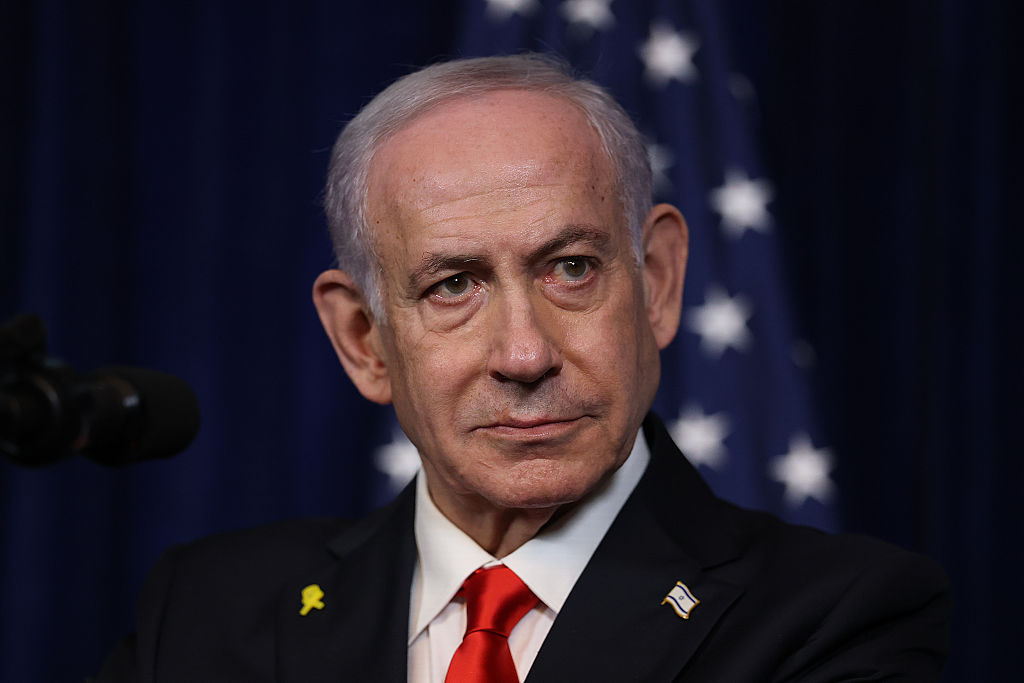
Israeli prime minister Benjamin Netanyahu holds a press conference with President Donald Trump at Mar-a-Lago on December 29, 2025, in Palm Beach, Florida. (Joe Raedle / Getty Images)
- Interview by
- Bafta Sarbo
It has been three months since the ceasefire was announced in Palestine, imposed as a consequence of Donald Trump’s so-called peace plan. In November, the United Nations Security Council ratified this “peace plan,” intended to govern the organization and reconstruction of the Gaza Strip. While it states that there should be “a credible path to Palestinian self-determination and statehood,” it contains hardly any concrete political measures to guarantee this process.
Meanwhile, the destruction of Gaza continues: According to the BBC, Israeli forces have demolished thousands more buildings since the ceasefire began. Experts estimate that over 80 percent of buildings in Gaza are destroyed or at least severely damaged. Over 10 percent of the population is dead, injured, or missing.
Due to the brutality of Israel’s war conduct, the first observers raised the accusation of genocide as early as October 7, 2023, although this accusation was and remains controversial, especially in Germany. One of the first to speak openly of genocide was Avi Shlaim, an Israeli British historian of Iraqi Jewish origin. An emeritus professor of international relations at Oxford University, he is one of Israel’s new generation of historians who advocate a historiography beyond the official Zionist national myth.
His latest book, Genocide in Gaza: Israel’s Long War on Palestine, received an especially controversial reception in Germany last fall, around the time of the ceasefire. In an interview originally conducted for the German-language edition of Jacobin, Shlaim explains how far the recent war and genocide in Gaza represented a continuation of Israel’s historical policy.
For your newly published book, you wrote a special foreword for the German edition. At the press conference in Berlin, your publisher Abi Melzer talked about how the title has caused quite a stir among some journalists in Germany. Could you explain why you chose this title?
None of my previous books have been translated into German, so I was especially keen to reach a German audience. Westend Verlag were interested in publishing the German edition, but eventually they got cold feet, and they suggested adding a question mark, so the title would be “Genocide in Gaza?” I didn’t agree to add a question mark, because in my mind, there is no longer any question as to whether Israel is guilty of genocide. Abi Melzer, a German Jew and an anti-Zionist, then decided to publish it with the original title, without a question mark.
In the preface to the German edition, I said that it didn’t come easily for me to accuse Israel of genocide. It seemed almost perverse to accuse the Jewish state of committing genocide when the Jews were the main victims of the Nazi genocide in World War II. Moreover, a couple of years ago, I published an autobiography under the heading Three Worlds: Memoirs of an Arab Jew. I’m an Arab Jew because I was born in Baghdad, and I grew up in Israel. This book is a searing critique of Zionism and especially of its treatment of the Jews of the Arab lands. But I added that, for all its sins, Israel has never committed genocide.
That was my position before the outbreak of the war in Gaza. Even at the beginning of the war, it did not look to me as if Israel was committing genocide. The turning point for me was when Israel used starvation as a weapon of war on a massive scale. When Israel suspended all international aid to Gaza, deprived the people of Gaza of water and food and fuel and medical supplies, that convinced me that this is genocide.
Then, there is the legal definition of genocide. In 1948, the “Convention for the Prevention and Punishment of the Crime of Genocide” was concluded in order to prevent a repeat of what happened to the Jews under Nazi Germany. The message of the Holocaust was never again — never again for everybody, not just for Jews.
The convention defines genocide as acts committed with the intent of destroying, in whole or in part, an ethnic, religious, or racial group. What Israel has been doing in Gaza is an attempt to destroy a whole ethnic group. The convention lists five criteria, five acts, that constitute genocide, and Israel is guilty of all of them.
One is killing members of the group. Israel has killed about 69,000 people in Gaza and injured nearly 200,000. Second is inflicting mental and physical suffering on the people. Third, creating conditions for the group that make it very difficult to sustain life. Israel has made Gaza unlivable. Fourth, preventing birth in the group. Israel has done that by attacking the entire health system, including maternity wards in hospitals. The fifth act is transferring children of the group to another group. Israel is not guilty of that. But what Israel has done is much, much worse. Israel has killed over 20,000 children in Gaza and made 40,000 children orphans. So, in a very real sense, this is a war on children.
I therefore conclude that Israel is indisputably guilty of genocide in Gaza. This is not just my opinion; many leading Israeli experts on the Holocaust, like Omer Bartov, Amos Goldberg, and Raz Segal, have concluded that this is a classic case of genocide.
Could you elaborate on how this genocide especially affects Palestinian children? You write hospitals in Gaza had to introduce a new acronym, WCNSF (wounded child, no surviving family). You also have drawings and pictures of wounded children in Gaza printed in your book.
The attack on children is particularly distressing, and the attack on civilians is very deplorable, and Israel has done both. Killing civilians is wrong if it’s committed by Hamas or if it’s committed by Israel; it’s a terrorist act. I regard this war and the previous seven Israeli military assaults on Gaza as acts of state terrorism. The principal distinction made in international humanitarian law is between combatants and noncombatants. Israel has blurred this distinction. For example, Israel said that, if it gives civilians the order to evacuate and they refuse the order, they become legitimate military targets. Wrong. The forcible displacement of civilians is a war crime in itself, and Israel has been committing this war crime on an almost daily basis for the last two years.
Some civilians have been displaced ten times and even more. In many cases, when civilians obey the Israel Defense Forces (IDF) orders to evacuate, they then get bombed and killed from the air. So, there are no safe zones in Gaza. There is nowhere where civilians can feel safe.
Over 70 percent of the casualties in this war have been women and children. The deliberate assault on, the killing and maiming of children, is particularly deplorable because they are totally defenseless. President Isaac Herzog, at the beginning of the crisis, said there are no innocent people in Gaza. The 20,000 children who were murdered in Gaza are therefore not innocent by his definition. The attack on children was accompanied by genocidal statements by Israeli leaders saying, kill the snakes, because if children grow up, they will become terrorists. That is the perverse Israeli moral justification for killing children in Gaza.
Therefore, in my book, there is a particular emphasis on the war on children. And as you pointed out, there is a whole section of photographs about children during the war in Gaza and very distressing images of real cruelty, even sadism. But the photographs also convey the resilience and the courage of the children in Gaza.
For these war crimes, there has been an arrest warrant against Benjamin Netanyahu. In your book, you describe how Netanyahu’s actions throughout his whole political career have been aimed at preventing a Palestinian state. To what extent would you say the current course is the logical endgame to his whole political career?
Benjamin Netanyahu grew up in a very nationalistic Zionist home, and he’s always been on the right wing of the Zionist movement. He personifies some of the most negative aspects of Zionism, like racism, militarism, and Jewish supremacy, but, above all, the territorial ambition of the Israeli right, which is Greater Israel. His political career has been dedicated to preventing the emergence of a Palestinian state alongside Israel.
But he is not alone: the Likud party has never accepted the case for a two-state solution. The policy guidelines of Netanyahu’s current government say that Jews have an exclusive right to sovereignty over the whole Land of Israel, which for nationalists includes the West Bank or, as they prefer to call it, Judea and Samaria. This is a stark denial of any Palestinian national rights anywhere in historic Palestine. This position of the Netanyahu government is more extreme than the July 2018 Jewish Nation-State law, which said the Jews have a unique right to self-determination in the State of Israel. This was a claim to exclusive Jewish rights to statehood within the pre-1967 borders of Israel, but it didn’t lay the claim to Jewish sovereignty over the West Bank.
Netanyahu, before the Hamas attack on October 7, 2023, used to boast that Israel has won, that the Palestinians are defeated, and that without conceding anything to the Palestinians, Israel can have peace treaties with Arab states. He was referring to the Abraham Accords, the peace accords between Israel, the United Arab Emirates, Bahrain, Morocco, and Sudan, which were brokered by Donald Trump in his first term as US president in 2020. For Netanyahu, this was a major diplomatic victory: peace with Sunni Arab states without making any concessions on the Palestinian issue.
There used to be a collective Arab position on peace with Israel embodied in the Arab Peace Initiative, which was adopted at the Arab League summit in Beirut in 2002. It says Israel can have peace and normalization with all twenty-two members of the Arab League in return for an end of occupation and an independent Palestinian state on the West Bank and Gaza, with a capital city in East Jerusalem. Netanyahu has always rejected this offer and laid a claim to exclusive Jewish sovereignty over the entire area, from the river to the sea. The premise of this policy was that Hamas would be able to govern Gaza. Hamas would be contained within Gaza as an open-air prison without threatening Israel’s security.
But on October 7, Hamas launched the most devastating attack on Israelis since 1948, so Netanyahu’s position was undermined. The Hamas attack sent the powerful message that the Palestinians will not be sidelined; the Palestinian issue will remain on the international agenda; and resistance will continue to the Israeli occupation under the leadership of Hamas. Netanyahu then changed his tune and reversed his policy. Now he said that Hamas is completely unacceptable in any form. His new war aim was the total eradication of Hamas. But this is impossible because as long as there are people in Gaza, there will be resistance. The proof is that after two years of relentless bombardment, Hamas is still standing and still fighting.
Netanyahu’s other war aim is permanent Israeli military control over Gaza. The undeclared war aim is to make Gaza uninhabitable. Netanyahu has gone a long way toward achieving this aim by destroying over 80 percent of the housing and civilian infrastructure of Gaza; by destroying the health care system; by the systematic destruction of the educational system; and by drastically reducing the ability of the Gazans to grow their own food. So far, he has succeeded in preventing the birth of a Palestinian state.
You asked about whether this is the logical endgame of Netanyahu’s career. In a sense, it is, although he’s gone too far and engaged in genocide, which was never part of any previous Israeli plan. This is really damaging in the long run because he’s destroyed any claim by Israel to hold the moral high ground. This is encapsulated in the International Criminal Court arrest warrant for him, because now the prime minister of Israel is a war criminal, which means that Israel is a criminal state. He has inflicted permanent damage to Israel’s international reputation. He’s on trial for serious corruption charges inside Israel, and he’s also a fugitive from international justice. And he knows that if there is an election, his party would lose, he would lose his immunity, and he’ll probably end up in jail. The war in Gaza has been a strategic disaster for Israel, and a major reason for pursuing it was Netanyahu’s desire to stay out of jail.
Could you elaborate on how, even before Netanyahu, there was never a path toward Palestinian statehood?
There is a very broad international consensus behind the two-state solution. What that means in practical terms is an independent Palestinian state in Gaza and the West Bank, with a capital city in East Jerusalem; a state alongside, not in place of Israel. In rhetoric, some [Israeli] Labor leaders accepted the two-state solution, but in reality they have done nothing to bring it about. And the proof is that under both Labor and Likud governments since 1967, there has been a steady expansion of settlements, which means that they’re not prepared to concede the whole of the West Bank to a Palestinian state.
It has become fashionable to say the two-state solution is dead. Israel killed it by building settlements, by annexing East Jerusalem back in June 1967, and by building the security barrier on the West Bank, which effectively annexes about 10 percent of the territory and separates Jerusalem from the rest of the West Bank. What is left is isolated Palestinian enclaves on the West Bank, surrounded by Israeli military bases and settlements. That’s not a basis for a viable, territorially contiguous Palestinian state.
I would argue that the two-state solution is not just dead. It was never born, because no Israeli government of any color since 1967 has offered a concrete formula for a two-state solution that is acceptable even to the most moderate Palestinian leaders. That’s [reason] number one. Number two is that no American administration has pushed Israel into a settlement, so the status quo persisted. Until now, all American presidents, except Trump, supported a two-state solution.
It’s convenient for Western politicians like Joe Biden and Sir Keir Starmer to say that they support a two-state solution. This sounds reasonable. But they have done nothing to realize it. I am tired of repeating that the two-state solution is dead. I have a German research assistant, a former graduate student, and I asked her, “How do you say it in German?” And she said, “Die Zwei-Staaten-Lösung ist tot.”
After Hamas won elections in Gaza in 2006, Israel, the United States, and the European Union responded not with recognition but with economic warfare against Gaza. Could you describe the aftermath of the 2006 election — how Gaza was systematically economically and politically underdeveloped?
Israel and its friends maintain that the Hamas attack on October 7 was a bolt from the blue and that history begins on that day. But the conflict started at least as far back as June 1967. It’s not really a conflict but a colonial occupation of Palestinian land. The real issue is Israel’s military occupation. It’s the most prolonged and brutal military occupation of modern times. That’s the real background; the October 7 Hamas attack is an expression of Palestinian resistance to the Israeli occupation. People don’t know the history of this conflict between Israel and Hamas. The past is crucial for understanding how we got here. It’s my job as a historian to put Hamas’s behavior in its proper historical context.
I would like to single out a few key turning points in this conflict and to start with the Hamas victory in the all-Palestine elections in January 2006. It was a fair and free election throughout the occupied territories, and Hamas won it. Israel refused to recognize the democratically elected government and resorted to economic warfare. Israel collects taxes on behalf of the Palestinian Authority, and it can always withhold them in an arbitrary manner.
Israel did everything to make it impossible for the elected government to govern. The United States and the European Union, to their eternal discredit, sided with Israel in refusing to recognize this government. The Western powers say that their aim is to promote democracy in the Middle East. Here there was a shining example of democracy in action under the most difficult conditions of military occupation, but the Western powers completely disregarded the results of the election. What in effect they were saying is that democracy is a good idea in theory, but here the people voted for the wrong bunch of politicians so that we cannot accept them as a legitimate government.
They implemented a series of economic and political measures designed to undermine the Hamas government. In March 2007, Hamas formed a national unity government with Fatah and offered Israel negotiations on a long-term ceasefire of ten, twenty, or thirty years. Hamas’s aim previously had been a unitary Islamic state from the river to the sea, but once it was in power, it became more pragmatic, and it was prepared to settle for a Palestinian state in the occupied territories. Israel refused to negotiate, and the national unity government collapsed in June 2007.
We now know from the Palestine Papers, a collection of 1,600 documents of the peace process that were leaked to Al Jazeera, that there was a plot against Hamas when it was in government. The participants in this plot were Fatah, Israel, the United States, and Egyptian intelligence. They formed a secret committee called the Gaza Committee. The aim was to isolate, weaken and ultimately drive Hamas out of power. Israel and America armed and encouraged Fatah to stage a coup against Hamas. In June 2007, Hamas preempted a Fatah coup by seizing power in Gaza.
Since then, Gaza and the West Bank were kept firmly separate by Israel to prevent a unified resistance movement. Once Hamas seized power, Israel imposed the blockade on Gaza. A blockade is an act of collective punishment that is proscribed by international law, and the blockade of Gaza had been in place since 2007. This history is very important for understanding the context for the Hamas attack on Israel on October 7.
The leading expert on Gaza, Sara Roy, is a Jewish academic at Harvard. The first of her five books about Gaza was called The Gaza Strip: The Political Economy of De-Development. Her thesis was that Israel since 1967 pursued a systematic policy of preventing Gaza from developing trade with the outside world, agriculture, and fishing industries. Gaza was exploited as a source of cheap labor and a market for Israeli goods. Gaza is not poor and underdeveloped because the people are lazy or incompetent. It’s poor and underdeveloped because of the systematic Israeli policy of de-development. And the last and most crucial stage in this consistent policy is the physical destruction of Gaza that has happened in the last two years.
Coming back to the systematic separation between the West Bank and Gaza: While the world’s eyes are obviously on Gaza, what is the situation like in the West Bank?
The present government, headed by Netanyahu, has some extremist coalition partners, in particular Bezalel Smotrich, the leader of Religious Zionism, and Itamar Ben-Gvir, the leader of Jewish Power. These are overtly racist, far-right, extreme, messianic, religious Zionist parties. They are, above all, Jewish supremacist. The explicit agenda is the eventual and formal annexation of the West Bank as part of the Land of Israel, and they’ve been pursuing it since they came into power in 2022.
In the last two years, the war in Gaza attracted most international attention and diverted attention from the West Bank. This was exploited by the right-wingers in this government in order to expand settlements and to intensify the ethnic cleansing of the West Bank that has been going on steadily for years. In the last two years, we have seen a massive escalation of settler violence against the Palestinians. And this is done with the encouragement of the government and the protection of the army. You have to look at what Israel has been doing in Gaza and on the West Bank in parallel. In Gaza, it began with the aim of ethnic cleansing and degenerated into genocide, and on the West Bank there has been a massive intensification of violence against the population, with the aim of the ethnic cleansing of the whole of Palestine.
You finished writing your book in October 2024. But at the press conference in Berlin, you talked about your assessment of how Trump’s peace plan came about. Can you explain why this so-called peace plan came then and not earlier, when Israel attacked several sovereign states?
America gives Israel $3.8 billion a year in military aid and diplomatic protection by wielding the veto in the Security Council to defeat any resolution that isn’t to Israel’s liking. The problem with American support for Israel is that it is not conditional on Israel respecting international law or Palestinian human rights. Joe Biden was a proponent of this policy of unconditional support for Israel. During the war in Gaza, his administration, America gave Israel $21.7 billion in military aid.
Trump continued this policy until Israel attacked Doha, the capital of Qatar. When Israel had attacked Iran, America eventually weighed in and also illegally attacked Iran. Iran is an enemy, but Qatar is a close ally of the United States. Qatar had been playing a constructive role in trying to broker a ceasefire between Israel and Hamas. The Hamas political leaders were based in Doha, and Israel tried to assassinate the people who were negotiating a ceasefire. America’s biggest military base in the Middle East is in Qatar. This attack frightened not just the Qataris but all the Gulf rulers because America failed to protect them. Trump forced Netanyahu to call the Qatari prime minister and apologize for this attack and then gave assurances that this wouldn’t happen again.
It was only in the aftermath of this attack on Doha that Trump put effective pressure on Israel to have a ceasefire. But Trump’s so-called peace plan for the Middle East is not a peace plan.
I don’t want to belittle the importance of this development. It involved an end of fighting, the resumption of humanitarian aid to Gaza, and an exchange of the Israeli hostages for Palestinian prisoners, so three very positive developments came out of it. The plan is very thin on details, but the details that are there envisage an international board headed by Trump, and below it there would be an executive committee of “nonpolitical” Palestinians — in other words, not Hamas people, but handpicked people who are acceptable to Israel, and they would have to run Gaza. The Palestinians will have no agency and no say in running their own affairs. Nor is there any plan for elections. The obvious thing at the end of a war is to allow the people who live there to run their own affairs. But this is a colonial project, with America and Israel imposing it on the Palestinians. It doesn’t begin to deal with the underlying problem, which is the Israeli occupation of the West Bank and Gaza.
There’s another dimension to this. Israel is completely devastated Gaza, and it will take years to just clear the rubble before you start reconstruction. Trump’s plan doesn’t require Israel to pay any reparations to the people of Gaza, nor does America plan to put any money into the reconstruction. The idea is to get the rich Gulf states to pay. And the question arises, why should any Arab government agree to put money into the rebuilding of Gaza when the next Israeli assault could happen any time, and we’ll be back to square one? So, there are many unanswered questions.
If this is not a viable peace plan, how could a lasting peace be reached? The far-right Israeli government is often criticized domestically. Still, the actions in Gaza enjoy broad support among the political opposition and the population in Israel. In fact, there’s a big demand for a much tougher approach to Gaza. Do you see any prospects for Israel to initiate positive changes from within?
This is exactly the paradox today. Netanyahu is very unpopular in Israel, but the war in Gaza is not. One public opinion poll showed that more than 50 percent of Israelis think that the IDF did not use enough force, that it should use more force. There is an Israeli saying, “If force doesn’t work, use more force.” This is a completely idiotic notion, because force doesn’t touch the underlying political problem. The problem is colonial occupation by Israel. Israel has launched eight military assaults on Gaza, starting with Operation Cast Lead in December 2008. Israeli generals call these assaults “mowing the lawn.” Mowing the lawn is something that you do mechanically every now and again, but it doesn’t stop the grass from growing, so you just have to keep going back and inflicting more death and devastation on Gaza.
This government reflects the shift in Israeli society over the last twenty-five years, since the Second Intifada — a shift to the right. It represents the Israeli public and their views. So, I don’t see any prospect of reform from within. I cannot envisage that one day the Israeli public will wake up and come back to its senses and say we were wrong to use force. It doesn’t give us security. It only leads to more violence and bloodshed. If there is going to be any change in Israel’s position, it would have to be as a result of external pressure. And external pressure on Israel is building up; it’s reflected in the growing number of countries that recognize Palestine. Most significant were the British and French recognition. This means that today on the Security Council, four permanent members — Russia, China, and now Britain and France — have recognized Palestine. America is the odd one out, still offering Israel diplomatic protection. But this cannot last forever.
I believe that eventually Israel will go down the same way as South Africa. America and Israel were the last supporters of the apartheid regime in South Africa, and America will be the last supporter of the Israeli apartheid regime. This is a long-term process, with Israel losing international support and losing legitimacy.
In the meantime, the question arises, what is the solution to this conflict? I used to support a two-state solution until Israel killed it with settlements. So, now I advocate one state from the river to the sea, with equal rights — with freedom, dignity, and equal rights for all the people who live in this space. You may say that this is pie in the sky — and I don’t care, because the real choice today is not between a two-state solution and a one-state solution. The real choice is between the status quo, colonialism, apartheid, Jewish supremacy, brute force, which is totally unacceptable to me — and another solution, which is the one-state solution, which is what I believe in. What matters to me is not whether it’s one state or two states but equality. You can’t have democracy if you have two classes of citizens. And from the river to the sea, the Palestinians, including the Palestinian citizens of the State of Israel, are second-class citizens.
Therefore, what I want to see is equal rights for all the people who live in this space. This involves the liberation not only of the occupied Palestinian territories but of pre-1967 Israel as well.