ICE Won’t Stop Shoving Guns in People’s Faces
Renee Good’s murder was the deadly culmination of the past year in which ICE and other federal agents pointed their guns and even shot at US citizens in dozens of cases around the country.
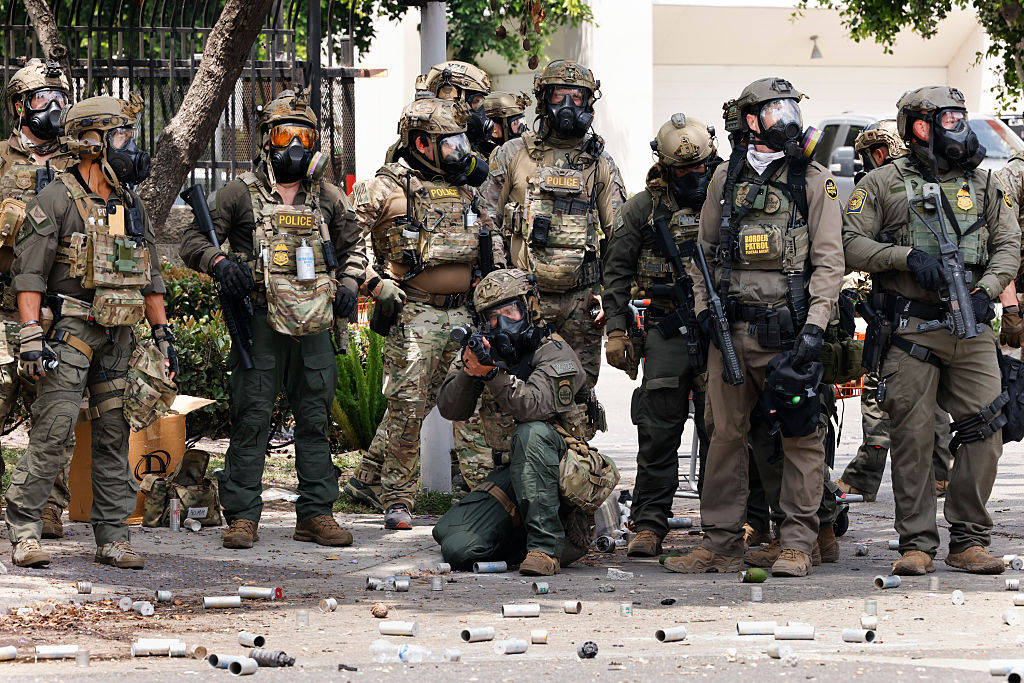
An ICE officer points a weapon at protesters on E Alondra Blvd. in Los Angeles, June 7, 2025. (Carlin Stiehl / Los Angeles Times via Getty Images)
Last Wednesday’s murder of Minneapolis mother Renee Good at the hands of federal deportation agents has shocked the nation. Many have expressed horror and outrage that an officer of Immigration and Customs Enforcement (ICE), which has almost no legal authority over Americans, would point a gun at and threaten a US citizen, let alone pull the trigger and kill her. Since then, federal agents have continued a spree of violence in the city, last night shooting a man and sending six children to the hospital.
But Good’s murder was not the first incident in which ICE and other deportation agents have aimed firearms at or threatened lethal force against US citizens and other unarmed people. In fact, it is not even the tenth or twentieth.
Jacobin has identified more than two dozen instances over the past year in which ICE agents have drawn or pointed their guns at people, almost all of them US citizens. This count doesn’t include the more than half-dozen shootings of noncitizens that have happened over the past few months, including the fatal September shooting of an undocumented immigrant in Chicago, which experts told the Washington Post was the result of agents serially violating their own training and guidelines to put themselves in danger.
In most of these cases, those threatened by agents with deadly force were following, filming, or otherwise protesting deportation actions. Sometimes, they were just unlucky, ending up in the wrong place or the wrong time. In no case is there evidence that agents’ lives were in the kind of danger that would warrant drawing a gun. In fact, video footage often definitively shows there was none.
It’s an alarming series of incidents, as the machinery of Donald Trump’s turbocharged deportation plans is more and more turned against not only immigrants of all kinds but also US citizens. And it suggests Good may not be the last American to lose their life at its hands.
Trigger-Happy Agents
As we covered yesterday, agents have repeatedly threatened to shoot people numerous times in the days that followed Good’s killing becoming a national firestorm. But we have also seen it happen many, many times before her murder last week, in cities all across the country.
Most recently, there was the December 3 incident in Kenner, Louisiana, where agents repeatedly pointed their guns at a team of roofers, before aiming sniper rifles at them, scaring local residents. Not only were the roofers unarmed and posing no physical threat, but they had work visas, according to their employer and an immigration lawyer who came to the site. ICE ended up detaining only two people.
Or take this November 9 incident, in which a police officer in Orange County intervened when he saw a man in a green shirt and glasses get out of his car and point a gun at a woman at an intersection. It turned out the man was an ICE agent, who was irate the woman had been filming and following him, at which point the officer had to inform him that was perfectly legal to do.
It’s far from the first time in the past year California police have had to respond to a federal agent behaving in an erratic and threatening manner toward someone.
Two days after the Orange County incident, a seventeen-year-old Mexican American US citizen who had just dropped his friend off at home was held at gunpoint by an off-duty ICE agent, Gerardo Rodriguez, who proceeded to interrogate him for twenty minutes and charge him with a crime, even though ICE has no authority to carry out traffic enforcement.
His conduct was so blatantly improper that local police in Southern California arrested and hit him with several charges, including child endangerment. The ICE agent, Rodriguez, who can be seen in security footage inexplicably walking in the middle of the road, falsely accused the teenager of nearly running him over as he held him at gunpoint.
During an ICE raid five months earlier, Pasadena police investigated a masked man who got out of his car and pointed his gun at demonstrators on the sidewalk. When they later ran a search on the man’s license plate, all the information had been blocked, suggesting that he was likely someone working for the federal agents carrying out the raid.
The Pasadena mayor, who lived on the street where the raid happened, expressed anger at the incident, noting that the man could have accidentally fired the gun — not out of the question, given that an ICE agent in Minnesota just a few days ago discharged his gun after he slipped and fell on the ice. That Pasadena incident had happened a day after a different federal agent in the city got out of his car and pointed a gun at a man for trying to photograph his license plate.
Meanwhile, in June last year, federal agents who refused to identify themselves detained a man on church property in Downey, Los Angeles County. When the pastors came out to ask them who they were and what they were doing, agents told them they didn’t have the right to confront them, and one pointed a gun at one of the religious leaders.
Outside of California, there was this instance from North Carolina in July last year, caught on tape, of an agent shoving and pointing his gun at an unarmed US citizen woman who ran out when she saw her partner being arrested, as their son watched from inside the house. A month before that, in June, this video from Memphis shows a federal agent casually pulling out his gun and pointing it at the daughter of the man he’s arresting as she screams that he’s not a criminal.
Maybe most shocking was this October raid on a privately owned horse racetrack in Idaho, in which federal agents from a variety of agencies, including ICE and Customs and Border Protection (CBP) detained four-hundred people for hours, many of them parents with young children, who were zip-tied and separated. Multiple US citizens caught up in the raid reported seeing agents pointing guns at people as they stormed the track.
The Chicago Way
These kinds of incidents were rife during “Operation Midway Blitz,” ICE’s name for its deportation operation in Chicago last year, many of which were documented in US District Court judge Sara Ellis’s November 2025 ruling barring federal agents from use of force against protesters. That 233-page ruling, which used a copious amount of body-camera footage, eyewitness testimony, and news reporting, meticulously detailed a breathtaking variety of abuse by federal agents.
Ellis’s ruling cited more than half a dozen separate instances of federal agents drawing or pointing their guns at protesters or being prepared to use deadly force against them. That count doesn’t include Marimar Martinez, the US citizen who survived being shot five times by a Border Patrol agent last October in Chicago’s Brighton Park. The federal government initially accused her of ramming the agents’ car, but the case fell apart when body-camera footage and texts revealed agents bragging about shooting her and muttering “Do something, bitch” before deciding to shoot her, leading the government to drop it.
One of the instances in Ellis’s ruling came in the aftermath of Martinez’s shooting, when agents at the scene escalated an already tense situation with a variety of aggressive behavior toward the crowd that had gathered, including indiscriminate use of chemical weapons, assaulting protesters, and grabbing a young man, a US citizen, out of a truck. Having inflamed the situation and led the crowd of protesters to balloon, the agents were then directed to “use all means necessary to ensure their safe exit,” including “deadly force.”
Other instances vary in their level of egregiousness:
- At a standoff with protesters near a school in Evanston, Illinois, at the end of October, an agent who had already been observed pointing his gun at protesters earlier is recorded drawing his gun on a resident and telling him, “Step back or I’m going to shoot you.”
- A Border Patrol agent pulls up beside a woman recording agents arresting day laborers and aims a gun at her.
- An agent responds to a military veteran yelling that he had served his country and that agents were doing the opposite by pointing a handgun at him, and saying, “Bang, bang” and “You’re dead, liberal.”
- A journalist covering protests at the Broadview, Illinois, facility observed agents unholster and draw their firearms several times.
Ellis made clear that these and other instances were often the outcomes of “escalatory force” by federal agents, who one former Border Patrol commissioner quoted in the opinion said were “deploying force that exceeds a legitimate law enforcement purpose.” She also wrote that agents going all the way up to Border Patrol leader Greg Bovino had a habit of serially misrepresenting the facts of every situation that was examined, making it “difficult, if not impossible, to believe almost anything that [they] represent.”
In other words, these and other agents were creating the situations they were using to justify the use of force, reacting to them too aggressively, and then lying about it to cover up that it was their fault.
But even these cases are just a sampling of many more reported instances of agents pulling their guns on Chicago residents. The time an ICE agent pulled a gun on an Illinois state representative alerting locals to federal agents’ presence, for instance. Or the time they pointed guns at bystanders during a raid in Northbrook. Or the time an agent rolled down his window and pointed a handgun at people filming him in Little Village. Or the sniper rifles posted at Broadview as protesters and Democratic politicians gathered.
Or, maybe most shocking, a federal agent filmed pointing his handgun at a pregnant woman in Berwyn, Illinois, in October.
Aiming at Children
This, too, is part of a pattern, with federal agents around the country repeatedly endangering young children by drawing guns on them.
In Oregon this past November, ICE agents burst into a room without a warrant, breaking open the door and aiming guns at the people inside, which included a mother holding her three-month-old child, in an embarrassing incident that saw the agency wrongfully arrest two men it had to later release. One of the men was shipped around to three different states before being dumped in Mississippi, from which he was forced to find a way home with no cell phone.

The same month, a similar scenario played out in Queens, when federal agents, looking for a man who had not lived in the house for years, busted into an apartment and pointed guns at a mother, who was holding her two-year-old when they entered. The agents, who did not identify themselves or show a warrant, proceeded to drag the woman by her hair and point an assault rifle at her thirteen-year-old, too, before leaving without making any arrests.
In southern Colorado one month earlier, federal agents followed a young couple driving home with their one-month-old, before pulling them over, smashing one of their windows, and ordering them out of the car, holding them at gunpoint throughout. The driver was eventually deported to Mexico, while his girlfriend and their child are both US citizens.
Then there was the incident in June, when agents detained a family at a Los Angeles court going through the asylum process, including a six-year-old with leukemia. One of the agents lifted his shirt to show the gun he was carrying, causing the boy to urinate on himself in fear. Agents left the boy to sit there for hours without a change of clothing.
Meanwhile, in April last year in Oklahoma City, a family of US citizens that had just moved to town had twenty armed federal agents smash into their rental home and point guns in their face, “traumatizing” the mother and her three daughters “for life,” apparently in search of the house’s previous occupants. The fact that they had the wrong people didn’t stop the agents from effectively robbing the family, seizing their phones, laptops, and life savings in cash, and telling them it would take months for them to get them back.
Last week, as protests in Minnesota erupted, the official Department of Homeland Security X account retweeted a claim that protesters were using their own infant children as human shields, commenting, “Do not bring your baby to a violent riot.” Those are particularly chilling words given not just ICE’s murder of Good earlier that week but agents’ alarming propensity for pointing firearms at infants and young children over the past year.
Prone to Panic?
In a number of instances, agents appear to have pointed firearms or threatened to shoot people out of a tendency to panic on the job.
A viral video from September shows an agent threatening bystanders who were filming his arrest, in a moment of entirely self-manufactured peril. As agents try to handcuff a man in Maryland’s Prince George’s County, one of them reaches for his gun, appears to not know where it is, sees it drop to the ground, then lunges and scrambles to pick it up, immediately pointing it at bystanders and keeping it aimed even once he’s able to get up on his knees. His partner likewise draws his own firearm.
A month later, in nearby Portland, a federal agent threatened to shoot an ambulance driver trying to take an injured protester from an ICE facility to a hospital. According to reports written by the ambulance crew immediately after the incident, and backed up by audio recordings and dispatch reports obtained by the local Willamette Week, the incident happened because federal agents blocked the path of the ambulance for ten minutes by standing in front of it. One of the agents responsible was apparently frightened when the driver put the ambulance into park, causing the vehicle to roll forward slightly.
In several cases, federal agents have shot at US citizens and claimed, as they did with Good’s murder, that they feared being run over.
In late October, agents shot a food bank worker, Carlos Jimenez, in Ontario, California, after he asked them to move away from a bus stop where school kids would soon be gathering. His lawyer says that an agent immediately drew a gun and pointed it at his face, ordering him to leave, but that when he reversed his car to avoid hitting the federal vehicle in front of him, an agent shot him through the back window, confirmed by photos of the gunshot. ICE claimed that Jimenez reversed his car toward ICE agents, and that “an ICE officer, fearing for his life, fired defensive shots at the vehicle.” They later arrested him at the hospital, preventing him from getting medical treatment.
The case mirrored an incident two months earlier in San Bernardino, when CBP agents who shot at two US citizens, one of them eighteen years old, likewise claimed that they had fired in self-defense because the car they were in had hit two of their agents. But in that case, two separate videos existed of the incident, revealing that the agents were lying. A video taken inside the car shows masked agents immediately approaching the car with their guns drawn, refusing to identify themselves, then smashing the windows and reaching inside the car, prompting the driver to flee and the agents to shoot the car three times. Neither that footage nor a video from outside the truck show agents being hit by the car.
The incident suggests that in at least some cases, agents actively feign cowardice in order to justify trying to kill people.
Only the Beginning
Looking over these cases, the most surprising thing about Good’s death is that something like it had not happened earlier.
Her murder appears to have been the deadly culmination of what has, over the past year, become alarmingly common behavior from ICE and other federal agents, who have displayed — repeatedly, over months, and all over the country — a volatile combination of characteristics: being highly aggressive, at times incompetent, and prone to panicking, often in situations created by their decision to escalate or ignore their own best practices.
The fact that this has often been aimed at citizens in seeming retaliation for protesting or objecting to their operations is especially disturbing. As the Department of Homeland Security and the federal government now explicitly treat activists and other opponents as criminals and targets of investigation and prosecution — and as Trump officials explicitly vow to grant agents total immunity over anything they do on American streets — it is only a matter of time before federal agents kill another US citizen exercising her First Amendment rights.