Elizabeth Gurley Flynn’s Life of Class Struggle
From free speech fights to picket lines to defending political prisoners, Elizabeth Gurley Flynn lived a life on the front lines for the working class.
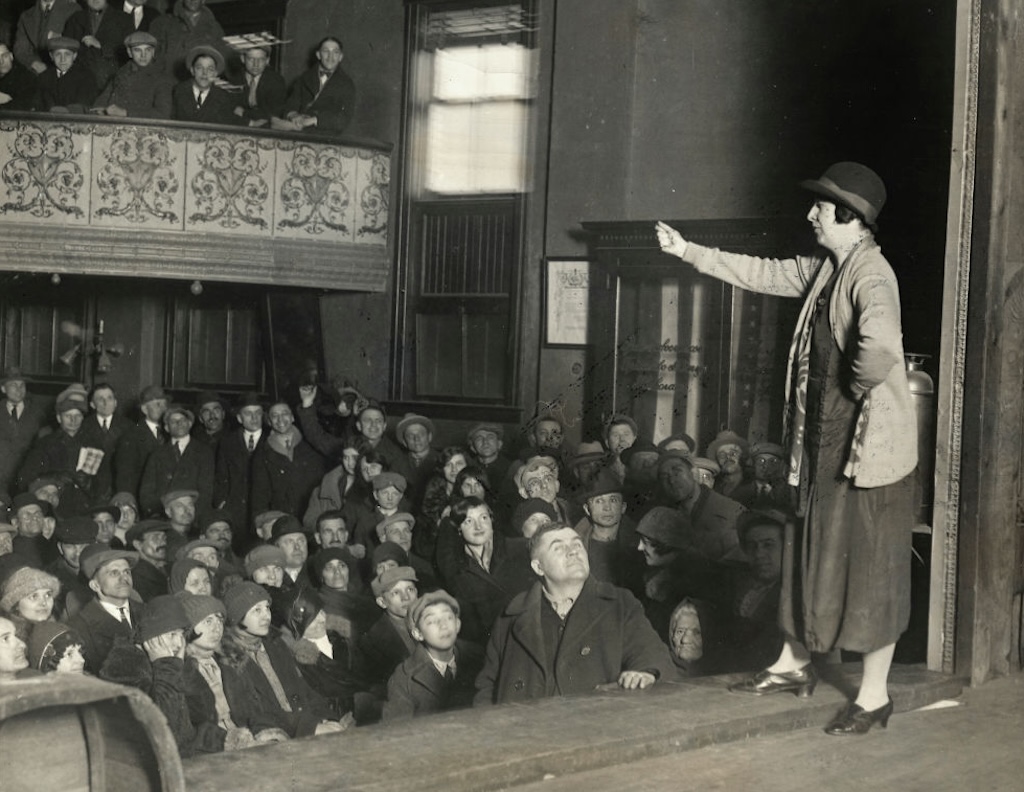
Elizabeth Gurley Flynn speaks to striking mill workers in Passaic, New Jersey, on May 3, 1926. (Underwood / Corbis / VCG via Getty Images)
Elizabeth Gurley Flynn ought to be a household name, given the decades she spent challenging an assortment of powerful forces, including big business, the police, politicians, and judges in her devotion to fighting for a better society. Sadly, she is not. Mary Anne Trasciatti’s new, meticulously researched book about this political radical, Elizabeth Gurley Flynn: The Rebel Girl, Democracy, and Revolution, may help change that.
Flynn’s significance, after all, is beyond question. She was a type of leftist that, sadly, no longer exists. She crisscrossed the nation and was active in numerous leftist organizations throughout her rich life, including the Industrial Workers of the World (IWW), the Workers Defense League, the International Labor Defense, the American Civil Liberties Union, the Anti-Fascist Alliance of North America, the American Communist Party (CPUSA), and the Women’s International Democratic Federation. She marched on picket lines, championed the rights of political prisoners, hobnobbed with a host of leftist luminaries, and was featured in prominent magazines like the Nation.
For much of her life, she saw the fundamental agent for social change as the working class. But she also believed in America’s core political institutions.
In Trasciatti’s interpretation, Flynn engaged in class struggles with the US constitution — which Flynn believed protected basic civil liberties — on her mind. Foundational to Flynn’s worldview, according to Trasciatti, were the Bill of Rights and the Declaration of Independence. As Trasciatti explains, Flynn was an advocate of “the American civil liberties movement, an ardent and active defender of the right to hold and express one’s own political views and to associate with like-minded people in peaceful pursuit of economic, social, and political change.” She tested these rights throughout her long life.
Flynn, whether speaking on picket lines or defending herself or others in courtrooms, believed that the Constitution was intended to protect civil liberties. As Trasciatti explains, “She believed that freedom of speech, press, assembly, and the right to a fair trial by jury are necessary for democracy.” In Flynn’s mind, according to Trasciatti, “the best way to defend free speech was to occupy a terrain, claim your right to do so — with justification from the Declaration of Independence or the Constitution articulated with the language of Americanism — and speak.” Trasciatti seeks to show, through her analysis of Flynn, that working-class radicalism and patriotism were, in fact, compatible.
Resistance and Repression in the Early 20th Century
Flynn’s commitments were frequently put to the test in the early twentieth century, when the IWW, the radical syndicalist organization founded in 1905, staged numerous “free speech fights” against dictatorial authorities, those responsible for imposing restrictions on left-wing public speakers. During strikes and union organizing campaigns, Wobblies, including Flynn, spoke on city streets, ranting against bosses and the politicians who served their interests. Flynn threw herself into the movement.
It did not take long for authorities to, as Trasciatti put it, recognize “Flynn as the unquestioned leader of the free speech movement.” From western cities like Missoula, Montana, and Spokane, Washington, to Lawrence, Massachusetts, and Paterson, New Jersey, on the east coast, Flynn and her comrades faced state and vigilante violence as they denounced capitalism’s horrors and the bosses responsible for making ordinary people’s lives miserable.
In these years, Flynn conducted herself with skill and creativity. During struggles in Paterson in 1913, for example, she once disguised herself with elegant clothing she borrowed from an affluent suffragette to avoid detection. Trasciatti emphasizes the class-based reasons for free speech restrictions, explaining that city leaders saw “anything that threatened the profits of business interests [as] harmful to the city [of Paterson].”

The repression, backed and sometimes directed by businessmen, continued well into the World War I years, undoubtedly one of the low points for the organized left. The era’s infamous Espionage and Sedition Acts, as Trasciatti puts it, “provided legitimacy for the federal government to silence critics of the war and capitalism.” Federal repressive activities were complemented by the actions of vigilantes, including the American Protective League and the Ku Klux Klan. The question for historians is, was the bourgeois-generated vigilantism directed at organizations like the IWW during the World War I period distinct from earlier eras of repression? Building on Michael Mark Cohen’s scholarship, Trasciatti appears to accept that the World War I years were, in fact, distinctive. This was especially true given that the federal government was directly involved in efforts to crush the IWW.
Yet Flynn continued to challenge the forces of exploitation and oppression in the 1920s. She was an active member of the American Civil Liberties Union (ACLU), which, according to Trasciatti, aided “the class struggle by protecting workers’ rights of free expression and assembly.” In this decade, she became a fierce critic of the far right, including the Ku Klux Klan at home and fascist organizations overseas. In the face of rising fascist threats, she joined with others to form the Anti-Fascist Alliance of North America, an organization consisting of anarchists, communists, socialists, and labor unions.
As Trasciatti explains, “When she spoke, she often drew parallels between the Fascisti’s persecution of labor activists in Italy and the American Legion’s hyperpatriotism and xenophobia or the Ku Klux Klan’s reign of terror over African Americans.” Flynn believed the class struggle had to be fought globally.
Communists and Opponents
One of the most consequential decisions Flynn made was to join the American Communist Party in 1937, when the organization was in its Popular Front phase and reconciled “itself to U.S. liberalism.” Most famously, Earl Browder, CPUSA head, proudly exclaimed that “Communism is Twentieth Century Americanism” — in other words, nothing for the average American to be afraid of.
Trasciatti appears to believe that this period represented a step forward for the party, because Communist Party members played “a key role in the economic, political, and cultural upheavals that transformed U.S. society in the 1930s.” The achievements, especially the Congress of Industrial Organizations’ (CIO) massive membership gains and combative presence in workplaces around much of the nation, were impressive (though many of labor’s breakthroughs, including the victorious strikes in 1934, predate the CIO’s formation).

Flynn’s membership in the Communist Party put her at odds with both the federal government and the ACLU, an organization that had become increasingly intolerant of the period’s labor radicalism. A split emerged within the ACLU that pitted liberal New Deal liberals against leftist Popular Fronters. As Trasciatti explains, the leftists, including Flynn, faced opposition from anti-communist liberals like John Haynes Holmes, Morris Ernst, and Roger William Riis: “The latter group held to the ACLU’s original commitment to free speech as a necessary tool for working-class organizing and activism in the struggle for economic justice in a hostile political environment, while the former was nudging the ACLU in a new direction toward free speech as a value-neutral right that could be invoked by capital as well as labor.”
The more conservative members, who identified as “value-neutral” advocates despite their anti-communist views, believed that management deserved speech rights and expressed discomfort by the outbreak of a series of sit-down strikes. The rightist faction emerged strongest. Trasciatti revisits some of the compelling material that she also discussed in Jacobin. In February 1940, the leadership announced its opposition to what it called “organizations in the United States supporting the totalitarian governments of the Soviet Union and of the Fascist and Nazi Countries (such as the Communist Party, the German-American Bund and others); as well as native organizations with obvious anti-democratic objectives or practices.” This was a response partially to the work of the House Committee on Un-American Activities, which labeled the ACLU a front for the Communist Party.
Seeking to rid itself of what it considered a stigma, ACLU director Roger Baldwin appointed journalist Dorothy Dunbar Bromley to oversee the expulsion process. The Board of Directors ousted Flynn for holding CPUSA membership in May 1940, even though they had reelected Flynn to her leadership position in 1939.
In this context, Flynn expressed disappointment that the organization had drifted sharply from defending underdogs in class struggles to embracing the anti-communist ideas shared by members of both political parties. By the time Flynn left the organization, it had “become,” as she put it, “an ‘open shop’ organization.” It was no longer a friend of labor or the Left at a time when anti-union and red-baiting activities were picking up steam.
The federal government was a far more malevolent, powerful, and unyielding foe. Trasciatti deserves praise for her treatment of official politics during the 1930s. She does not glorify Franklin D. Roosevelt, noting his involvement in undermining large sections of the Left. She reminds us that Roosevelt gave the FBI the green light to monitor suspected subversives and signed the 1940 Smith Act, which criminalized them for holding membership in leftist organizations. Roosevelt and his successors did not care that Communist Party had shifted to the right.
The Smith Act, which authorities first used against Trotskyists before prosecuting members of the CPUSA, including Flynn, put the Left squarely on the defensive. Yet it was not until authorities went after the Communist Party that Flynn mounted a series of strong fights that paralleled her involvement in defending the free speech rights of her Wobbly comrades more than two decades earlier. She noted, “We contend that Americans have a right to speak their minds out on any subject. We Communists have a right to defend socialism or the evolution of the capitalist system and economy and of the private ownership of the means of life of all the people.” Yet she showed no inclination to speak out in favor of the first victims of the Act, the Trotskyist Teamsters from Minnesota.
Nevertheless, one of the great strengths of Trasciatti’s book is its excellent, blow-by-blow accounts of the Smith Act trials, including one involving Flynn herself. Her incarceration at Anderson Federal Industrial Institute for Women in West Virginia did not shatter her spirit: “My body can be incarcerated, but my thoughts will be free.”
Flynn’s Limitations
Flynn lived a selfless life of struggle. Yet her record was far from flawless. First, as a leading member of the CPUSA, she was part of a top-down Stalinist organization, which, despite the organization’s noble and heroic participation in a wide range of struggles from early racial justice fights to the labor movement, also made policy decisions that constantly zigzagged based on the dictates of the Communist leadership in the Soviet Union.
Trasciatti mentions that Flynn shifted to the right in the 1940s and ’50s, noting that the “days when Flynn and other Wobblies climbed atop street corner soapboxes in Missoula, Montana, and exercised their right to speak for the abolition of wage labor in defiance of the law were long gone.” I would make the point stronger: Flynn had essentially abandoned radicalism and rejected her IWW heritage during the heyday of the New Deal years.
The shift happened at a time when Stalinism was dominant on the Left, and the dominant left-liberal coalitions prioritized electoral politics while deprioritizing more confrontational actions like promoting factory occupations and other expressions of working-class militancy. During this period, as Bryan D. Palmer put it, “socialism stalled in the ruts of bureaucratic ossification.”

This was a time when labor-liberal coalitions, led partially by pro-FDR union heads like Sidney Hillman, helped to cement organized labor’s ties to the Democratic Party, the start of a coalition that continues to bedevil the labor movement to this day. Of course, these relationships were rooted in the structural limitations of our electoral system. The party, under FDR’s leadership, oversaw US entry into World War II, a war that Flynn supported as part of a broad anti-fascist campaign.
Flynn and her comrades were undoubtedly sincere that they wanted to defeat fascism, but one must ask: Was supporting war the only way to achieve this end? Flynn must have known that the war planners entered the conflict not out of any deeply felt commitments to anti-fascism but out of a desire to achieve global power. Moreover, many US wartime policies, both foreign and domestic, needed leftist critique. Dropping nuclear weapons on Japan, the no-strike pledge, internment of Japanese people within the United States, and an exceptionally exploitative Bracero Program, were hardly signs of working-class progress or expressions of anti-fascism. As the late Howard Zinn, who served in World War II, put it, “When I examined the best of wars [like World War II], I found it so ridden through with immorality and atrocity, not just on the Nazi side, but on our side.”
And what did Flynn make of her old comrade, James P. Cannon, the Trotskyist who had closely collaborated with the “rebel girl” during the great IWW struggles and as part of the International Labor Defense organization? Trasciatti notes that Flynn refused to defend Cannon against the Smith Act. Given the importance of this trial, the first time the US government used the Smith Act against “subversives,” she could have explored this shortcoming more fully. Neither Flynn nor Trasciatti addressed several thorny questions.
And why was Flynn so committed to the idea that it was best for activists to champion the United States and its revered documents like the Constitution? Was an embrace of the American Flag the best way to organize? Did working-class people benefit from rituals like waving American flags at demonstrations? Certainly, Flynn must have recognized the tensions between class struggle unionism and a full embrace of patriotism, which was pushed most aggressively by an assortment of reactionary organizations like the National Association of Manufacturers, the American Legion, and the Ku Klux Klan. If she was as committed to the United States’ sacrosanct documents, as Trasciatti notes, we must ask how Flynn reconciled her early IWW membership with her professed Americanism.
Moreover, critical scholars of the Constitution, including Daniel Lazare and Robert Ovetz have pointed out that the founders developed the Constitution not out of any high-minded enlightened commitment to helping “the people,” but rather to serve their own narrow class and racial interests. Flynn’s own life showed that the legal system, far from serving any emancipatory role, repeatedly punished leftists. Did a steady stream of government-generated punishments ever convince Flynn to abandon her belief in the Constitution?
Despite Flynn’s meaningful shortcomings, her exceptional life is worth celebrating, as Trasciatti’s terrific book does. This was especially clear during her early years of activism, when she traveled to the nation’s class-conflict hot spots, built solidarity with activists, and engaged in direct struggles. The days of the roaming activist, sustained by tight networks of socialists and Wobblies around the nation, seem distant today. But the need for spreading a message of class struggle far and wide with enormous courage, undaunted by state and vigilante repression, is timeless.