The Cuba Embargo Is a Cold War Grudge That Won’t Die
For over six decades, Cuba has withstood US sanctions and pressure. Noam Chomsky and Vijay Prashad's latest work shows how the embargo is less a response to Cuba’s policies than a long-term effort to undermine its sovereignty and revolutionary ideals.
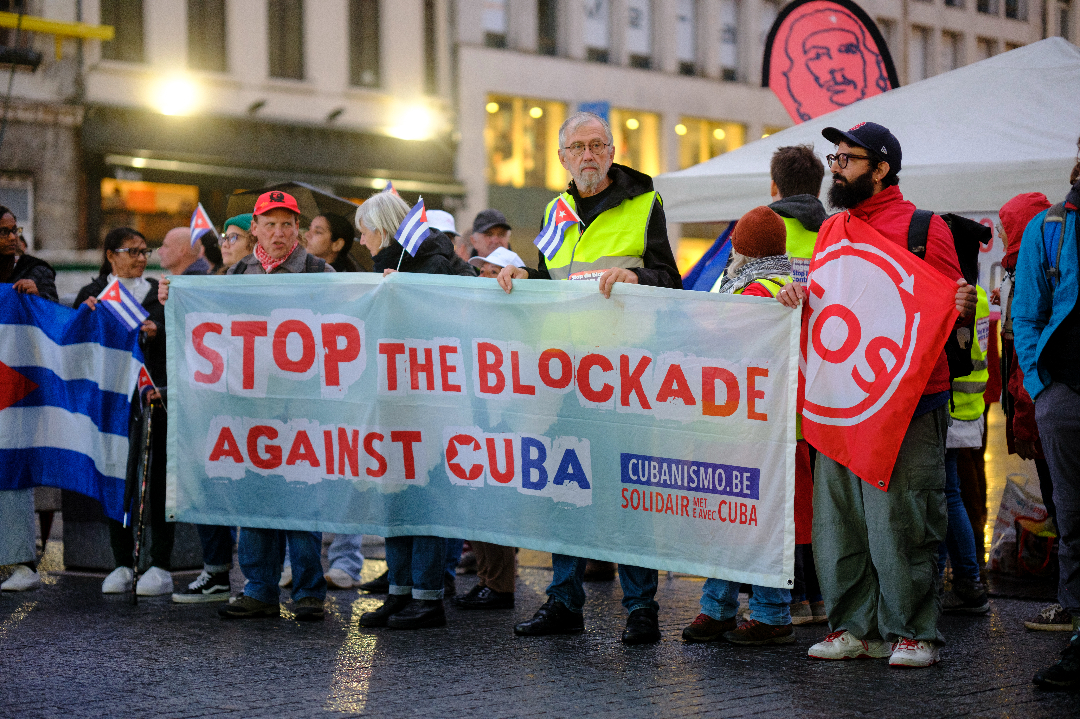
A demonstration for the lifting of the blockade against Cuba on October 29, 2024, in Brussels, Belgium. (Thierry Monasse / Getty Images)
At the United Nations General Assembly on October 30, 187 countries voted for a nonbinding resolution to end “the economic, commercial and financial embargo imposed by the United States of America against Cuba.” This resolution has passed with near-unanimous support every year (except 2020) since the fall of the Soviet Union, which deprived Cuba of a major trading partner and plunged the nation of ten million into an economic depression known as the “Special Period.” Rocked by natural disasters, migration crises, sabotage efforts, and a global pandemic, the Cuban Revolution has weathered its challenges, relying on both public policies as well as market solutions, alongside international support.
The UN resolution seeks to normalize US-Cuba trade relations, which have been frozen since John F. Kennedy’s administration imposed the embargo after the 1962 Missile Crisis. In 1982, the Reagan administration labeled Cuba a “state sponsor of terrorism” (SSOT), a designation reinstated by the Trump and Biden administrations after Barack Obama briefly lifted it in 2015. In their recent book, On Cuba: Reflections on 70 Years of Revolution and Struggle, Noam Chomsky and Vijay Prashad trace US hostility toward Cuban sovereignty back even further to the 1823 Monroe Doctrine, contrasting Cuban and Haitian histories to shine a light on the United States’ long-standing sense of entitlement over nearby islands.
In a recent interview with Jacobin, Prashad lays out the history behind Washington’s enmity toward Cuba, arguing that US policymakers have long perceived Cuban independence as a threat to their vision of a compliant Western Hemisphere. Prashad explains how this hostility reflects a broader pattern of undermining self-determination across Latin America and how the United States has viewed regional sovereignty as incompatible with its own strategic and economic interests.