Don’t Overlook Coretta Scott King

Matthew Delmont

Throughout her life, Coretta Scott King condemned the waste of war, opposing the brutality of Vietnam and criticizing how it drained money from housing, health care, and jobs.
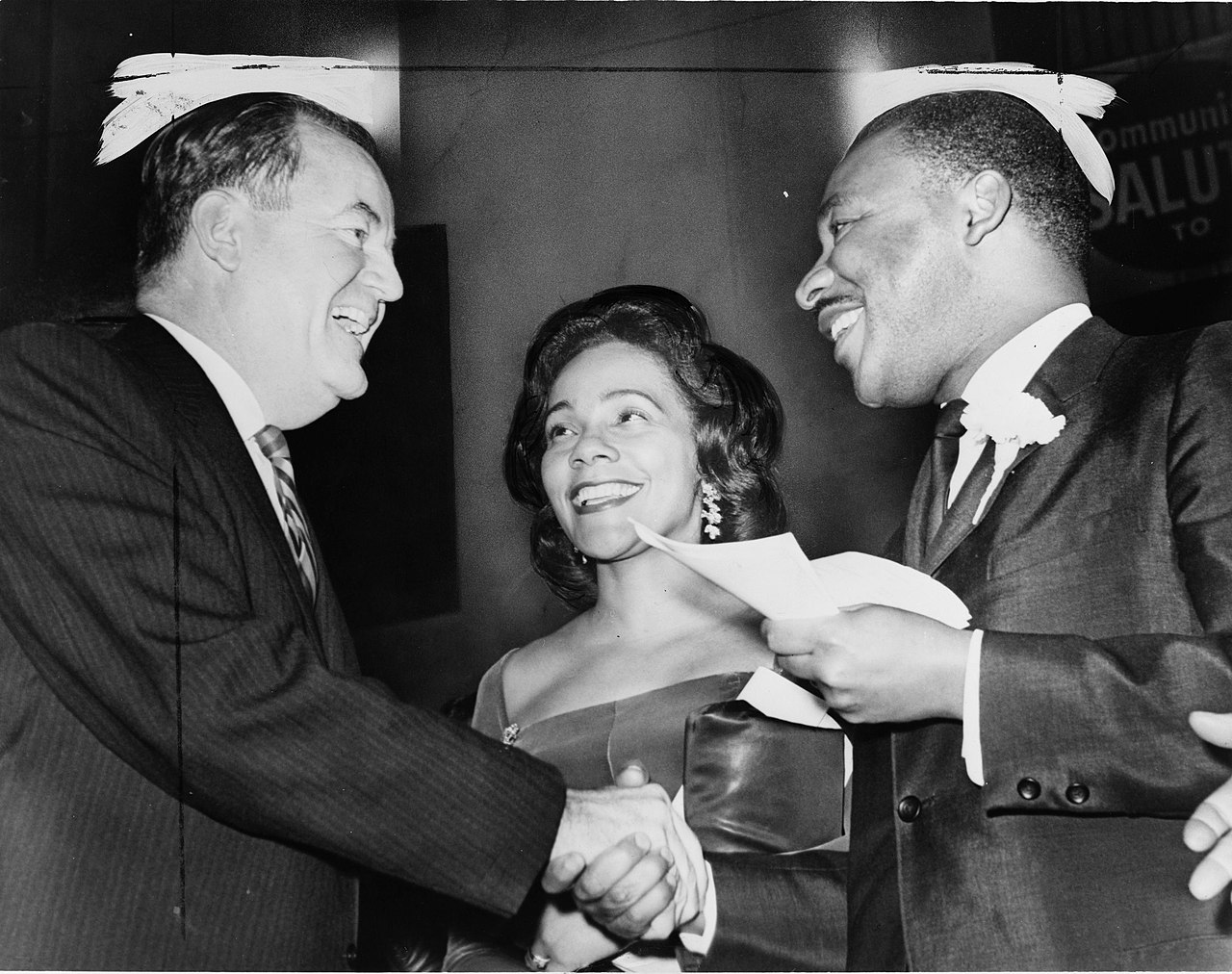
Vice President-elect Hubert H. Humphrey (left), alongside Coretta Scott King (center), and Dr Martin Luther King, Jr (right), at a rally at Harlem's 369th Regiment Armory on December 17, 1964. (Library of Congress)

Interview by
Nick Hilden

On June 8, 1965, Coretta Scott King spoke at the Emergency Rally on Vietnam, which drew 18,000 people at Madison Square Garden.

“Ultimately, there can be no peace without justice, and no justice without peace,” she declared, deeming peace and human rights the “two great moral issues of our time.”

This is the opening scene of historian Matthew F. Delmont’s Until the Last Gun Is Silent — a fitting way to set the stage before the book delves into the inseparable histories of the civil rights and antiwar movements of the 1960s.

Following the Vietnam War–era activism of Scott King in parallel to the life of Dwight “Skip” Johnson — a black Vietnam veteran who received the Medal of Honor during the conflict, only to come to a tragic end after returning to the United States — the book feels disturbingly pertinent to our current moment. Today, as American interventionism continues to persist alongside grievous attacks against civil rights, Until the Last Gun Is Silent comes off less as an exploration of the past than a warning about the present.

A professor of history at Dartmouth, Delmont has penned several historical texts tied to civil rights, most recently Half American, which looked at the contributions of black Americans during World War II. Now with his latest, Delmont presents a stirring portrait of a young black man laid waste by inequity and violence, and the renowned activist who fought on behalf of not only men like him, but for the very soul of her country and the security of the world.

Jacobin spoke with Delmont about the book, the struggles of Coretta Scott King and Skip Johnson, and their relevance today. In 2026, when American imperialism and racism are raging like wildfire, there is much to be learned from those who preceded us in confronting them.


Nick Hilden

What role did Coretta Scott King have in pushing her husband, Martin Luther King, toward peace activism?

Matthew Delmont

Even in doing the research myself, I was surprised by how early she was out on the anti‑nuclear position and then on the Vietnam War, and how much Martin recognized her important role there.

Part of it was gendered — there was more space for women activists in the antiwar movement in the early sixties. Part of it was strategic: Martin, as a civil rights leader, felt the risk of losing civil rights support if he spoke out against the war was greater than Coretta. So within their household, she became the spokesperson on the war while he kept focus on civil rights longer. Part of it was what they brought to the relationship: her politics were more invested in global antiwar questions earlier than his, by virtue of her engagement with Bayard Rustin, Paul Robeson, and the Progressive Party. After his Riverside speech, they became coleaders, often speaking on different coasts. Then after he was assassinated, Coretta took on both roles, speaking for herself and taking on invitations that would have gone to Martin.

One interesting thing as a historian: if you search historical newspaper databases for “Coretta Scott King,” you get relatively few results. If you search “Mrs Martin Luther King Jr,” you get many more. Part of the reason that she hasn’t gotten as much attention as she should have is just because you have to get creative in how you look for it.

Jean Theoharis’s work has been really pathbreaking here, so I’m certainly not the first historian to talk about her role. But I hope what my book does is trace a longer and fuller trajectory of Coretta’s antiwar voice. She was at almost every major mainstream anti‑war protest in the sixties and early seventies, and that’s an important thing not to lose.

Nick Hilden

How do you think the stories of Coretta Scott King and Skip Johnson are relevant today?

Matthew Delmont

On the Coretta Scott King side, I think one thing that’s so powerful about her story is how clear and early she was about the dangers posed by US military intervention in Vietnam, and how she understood the broader contours of colonialism and what it meant for the United States to be engaged not just in Vietnam, but in the Dominican Republic and elsewhere. And then the broader resonances with the possibilities of nuclear war, and how she was unafraid to challenge politicians about it, and how she worked to rally Americans across many different demographic lines to fight against the war and to activate for peace.

When I think about the present — obviously Coretta and Martin Luther King and their allies were adamantly opposed to the kind of gunboat diplomacy we’re seeing in Venezuela, and to the broader sense that the United States can impose its will wherever it chooses in other countries, and that it can do that without thinking through the long‑term consequences.

I think for Coretta, she always thought about it in economic terms, so she was opposed to Vietnam both in terms of the moral aspect of it, but also because she was always making the case that the money being spent fighting the Vietnam War would be much better spent here in the United States taking care of the needs of American citizens — housing, health care. Those issues obviously have not gone away, and they remain front and center for most average Americans. People are concerned across party lines about day‑to‑day economics, and that’s something Coretta Scott King was always on the forefront of thinking about. As the Vietnam War was winding down, she was really interested in what it meant to have a peacetime economy that could serve the needs of average Americans.

On the Dwight Johnson side, I think Dwight Johnson looked like what the American military looks like today — not just a young black man, but someone from a lower socioeconomic status for whom the military offered some opportunities but also dangers. Dwight was drafted, as many men were in Vietnam. We have an all‑volunteer military today, but the racial and socioeconomic demographics of the military resonate strongly with Dwight Johnson’s profile and experiences.

One part of that story that’s important to think about is the human costs and consequences of American military deployments. It’s easy for presidents, politicians, policymakers, and average citizens to talk about whether the United States should be in Venezuela or Nigeria or wherever as if moving pieces around on a board, but there are real lives at stake. If the country moves into a situation where we are actively engaged in another war, it’s going to be men and women with profiles like Skip Johnson who bear the brunt.

Nick Hilden

You mentioned that these issues transcend party lines, and today you see people across the political spectrum arguing against spending tax dollars on war, which is a big change from not that long ago.

Matthew Delmont

Yeah, I think that’s right. It’s one of the things history can help us think through — what different people were able to think about and say, and how they tried to reach different constituencies with different arguments at different points in time. We talk a lot about divides and polarization, but this might be a case where people can find some common ground across party lines by asking basic questions: What is this costing us? Yes, geopolitical situations are complex and dynamic, but what is it costing our nation to be engaged in new potential conflicts every week? Some of these consequences can be anticipated, some are unknown. But if we look back to Iraq and Afghanistan, it’s not hard to imagine where some of these things might lead. And I keep coming back to the question of costs — economic costs and the potential lives at stake.

Nick Hilden

You write that Coretta’s antiwar activism and the wave of solidarity she inspired had a real impact in ending the Vietnam War. What was that impact?

Matthew Delmont

A big part of the impact was getting what I would call more middle‑of‑the‑road people to come out and protest publicly. When we think about the Vietnam War, we sometimes think about the most radical voices. Those were extremely important voices; they pushed the envelope in terms of what could be said and what actions could take place. But Coretta’s big contribution was getting average people across race, gender, income, region, and religion to take a big step — many had never publicly protested anything before — and to get out in the streets with their church and neighborhood groups and speak out against the war.

That was important, because Presidents [Lyndon] Johnson and later [Richard] Nixon were always paying close attention to public sentiment. They felt their ability to move in different ways in the war was either enabled or constrained by public support. Coretta Scott King’s contribution was helping move the center of the country on the antiwar question. And being consistent, speaking earlier and more vocally and more often than many others, including her husband.

Nick Hilden

You wrote about March on Washington organizer Sanford Gottlieb trying to silo off more radical messaging at protests. Why did they want to do that?

Matthew Delmont

There are historically — and today — important debates about the best way to approach these things. There’s never a single best political approach to making change. But for Gottlieb and Coretta Scott King, their thinking was that there was a bigger middle of the country that they wanted to engage and get more proactive on the war question, and their worry was that allowing the media and the White House to frame radical voices as the only perspectives on the war would risk turning off that middle part of the country.

Speaking more in terms of Coretta’s history than Gottlieb’s, I think she was aware of the give‑and‑take between mainstream oppositional politics and more radical oppositional politics. She never saw it as an either‑or. She was strongly influenced by Paul Robeson, and many of her views were radical in some ways, but for her it was about strategies that would lead to more people being engaged. She thought her biggest success was getting people who wouldn’t have previously thought of themselves as politicized on an issue like the Vietnam War to be comfortable speaking in their communities and participating in public protests.

Nick Hilden

You wrote that she recognized “the legislative gains of the Civil Rights era were incomplete and could be rolled back by determined politicians and ambivalent voters.” Do you feel that fear has come true today?

Matthew Delmont

Absolutely. One of the classes I teach is on the history of civil rights. I haven’t taught it since Trump was reelected, and the next time I teach it, it’s going to be an entirely different class, because a lot of the key legislative gains of the Civil Rights era have been rolled back.

Obviously not just in the last year — it’s been a long, slow slide, and fast at times. One of the things we can learn from the history is that, even while people were celebrating gains, they recognized the foundation was shaky and required ongoing political work — both to make sure legislation translated into real change, and to build coalitions and keep voting blocks in place that would keep supporting key policies, or at least not allow backlash voices to undermine and rollback those policies.

A truism in American history is that each time we’ve had a key moment of movement toward racial equality, there’s been an equal and sometimes larger movement of backlash. For Coretta and Martin, the so‑called “Golden Age of Civil Rights” was followed by the Nixon‑era backlash. Today we’re experiencing similar movements against the perceived gains of the 2010s and 2020. There’s a story that Americans like to tell ourselves about Martin Luther King Jr. and the iconic movements of Civil Rights Movement as if to say, “job well done, it’s safely in the past.” But looking back at the messiness of the time, you can see that Martin and Coretta were worried about how quickly these things could be undone. And sadly, we’re living through a time period where a lot of the work that they and thousands of other activists had pushed for is being undone.

Nick Hilden

You write about how black Americans were affected by the war, how their service rates were higher and so on. How did the war affect black Americans specifically?

Matthew Delmont

I’m really interested in military history from the black American perspective, because it’s been such a fraught story. There’s long been a hope that serving in the military would improve life conditions and opportunities for black people in the United States, and Vietnam is when a lot of that came to a head. The military, in some ways rightly, patted itself on the back by the Vietnam era for being one of the most racially integrated organizations in American society. They had made intentional efforts between World War II and Vietnam to desegregate the military and create more viable pathways for black Americans to serve and take on leadership roles. So that was one thing that a number of black Americans were looking to, including political leaders, saying the military is a space where we’ve got some footholds.

At the same time, much of that was segmented by class. For young working‑class men like Dwight Johnson, that wasn’t what Vietnam meant for them. Vietnam meant being drafted, almost always being sent into infantry roles, not having the opportunity for a college deferment because college was almost entirely out of the question for them. And it meant, certainly early in the war, that they were at a higher risk of becoming casualties. That galvanized many black Americans, particularly groups like SNCC and other more radical black and student organizations.

As I was writing the book, I realized that Skip Johnson’s experience isn’t just a black American experience — it speaks to a working‑class experience more broadly. The military increasingly looked like Skip Johnson: a lot of working‑class guys from the Rust Belt, from farming communities. A white guy from Kentucky or Arizona or California had a more similar pathway into the military and similar experience in the military than a college‑educated white person. That’s why his story speaks to a broader experience of the war.

Nick Hilden

You wrote that Dr Benjamin Spock asserted during one of his testimonials that “the war will blacken the reputation of my country for decades, if not centuries to come.”  Do you think it’s legacy is still felt today?

Matthew Delmont

I think the legacy is felt, but I think it depends a lot on generation and where one falls on the political spectrum. I’m forty-eight, so I didn’t live through this myself, but I think for the generation older than us who lived through the Vietnam era, absolutely it’s still there.

The reason I’m not sure it resonates more broadly is because the lessons I would think the country’s political leadership would have learned from the Vietnam era don’t seem to have stuck. Politicians from both parties have led us into military engagements that seem optional rather than urgently necessary — which I would have taken to be one of the lessons from Vietnam: to think very seriously about when to deploy military forces, and to think downstream about the consequences. It’s hard to look at the last twenty-five years and not think that we didn’t learn those lessons.

Nick Hilden

In the end, what do you hope people take away from Until the Last Gun Is Silent?

Matthew Delmont

Two things. The big one for me is that I want people to understand that dissent and patriotism can be intertwined — and they are intertwined. One can and should ask serious questions about the direction our country is going, and that doesn’t mean one doesn’t care about one’s country. One can still have aspirations for the kind of country America can be while asking serious, pointed, protesting questions about it.

And the second is taking seriously what the military looks like today. The military is part of the labor market, as I understand it, and at the enlisted ranks it draws on folks for whom military service is often the best economic pathway that they see among relatively limited options in the private sector.

That’s something all Americans need to care about. We can’t say, “Oh, this is only a conservative issue,” or “only a Republican issue,” even if a larger percentage of service members might vote a certain way. The military is part of American society, and an important component that all Americans — regardless of political party — need to be mindful of, both in terms of the service people are taking on and the obligations we have to care for veterans when they return.