The Flawed Memory of Brazil’s Dictatorship
Kleber Mendonça Filho’s Oscar-nominated The Secret Agent examines how authoritarianism corrupts and distorts memory. Forty years since the end of Brazil’s military dictatorship, the rise of Jair Bolsonaro’s far right is proof.
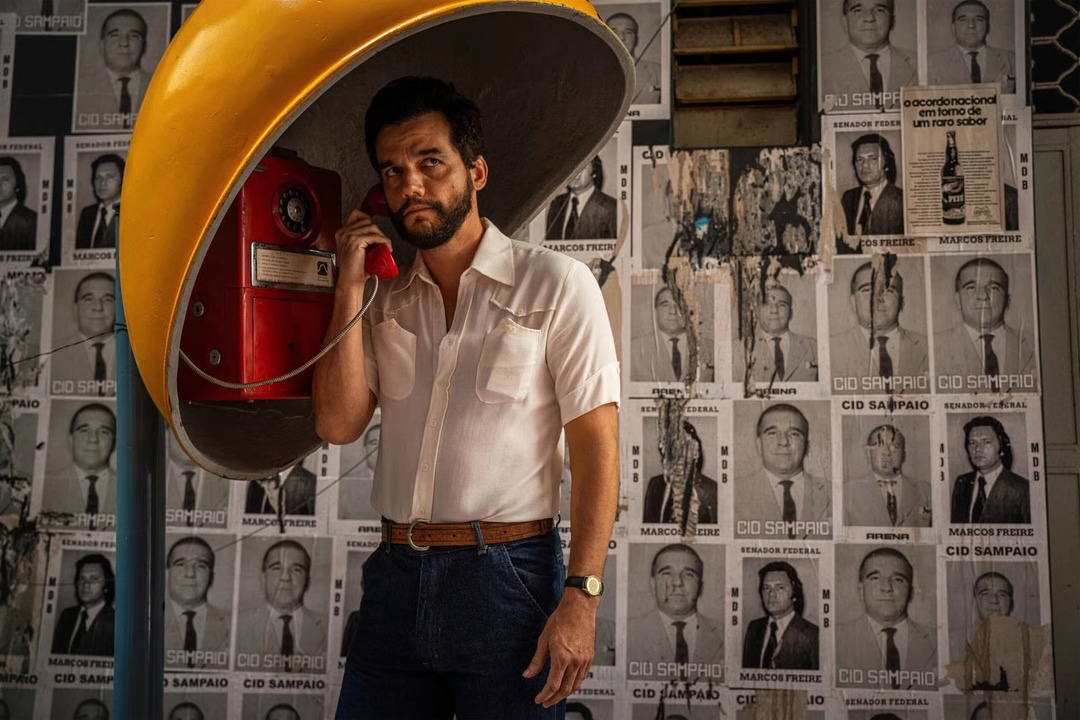
Forty years since the end of Brazil’s military dictatorship, and seven since the election of a president who praised its torturers, the memory of Brazil’s dictatorship remains contested. (Vitrine Filmes)
Forty years since the end of Brazil’s military dictatorship, seven since the election of a president who praised its torturers, and three since said ex-president attempted a coup of his own, it can be tempting to diagnose the whole country with a sort of national amnesia. This is, after all, the most optimistic explanation for the rise of Jair Bolsonaro and the modern far right. The least optimistic — that his supporters recognize his authoritarianism, in full knowledge of what that means — is more frightening. And the true explanation no doubt lies somewhere in between — somewhere in the mess of inherited memories and manufactured consent, of official archives and the archives stored in our flesh.
It is this mosaic of collective memory that animates The Secret Agent, director Kleber Mendonça Filho’s latest feature. Set in Recife in the midst of Brazil’s dictatorship — the title card reads simply “Our story is set in the Brazil of 1977, a period of great mischief” — the thriller follows Marcelo Alves (Wagner Moura), a widowed scientist on the run. At the start of the film, he’s driven three days straight to reach a safe house run by the elderly Dona Sebastiana (Tânia Maria); he’s left his young son (Enzo Nunes) in the care of his in-laws (Carlos Francisco and Aline Marta Maia); he is exhausted and has nightmares. Marcelo is not his real name. But though the title suggests otherwise, he is an ordinary guy who stood up to an ally of the regime — not a secret agent at all.
That anyone even hears Marcelo’s story is thanks to a dissident fixer named Elza (Maria Fernanda Cândido) who might actually fit the “secret agent” bill. She is the one who warns that Marcelo is under a death threat; who arranges for him to work, until his false passport is ready, at an ID card office in Recife; and who, in the face of planted news stories and rampant censorship, begins to conduct interviews of her own. It is Elza who challenges the official archives of the era, archives that comprise the film’s central motif and object of inquiry. For Mendonça, official records serve as physical manifestations of public memory, as crucial to the historical setting as they are to the plot and powerful enough, in their erasures and fabrications, to shape the story as it unfolds.