Sortition Can Help Cure What Ails Our Democracy

Americans are frustrated with our increasingly oligarchic political system. Selecting an assortment of lawmaking deliberative bodies through random lotteries could help fix it, by empowering ordinary people rather than unaccountable politicians.
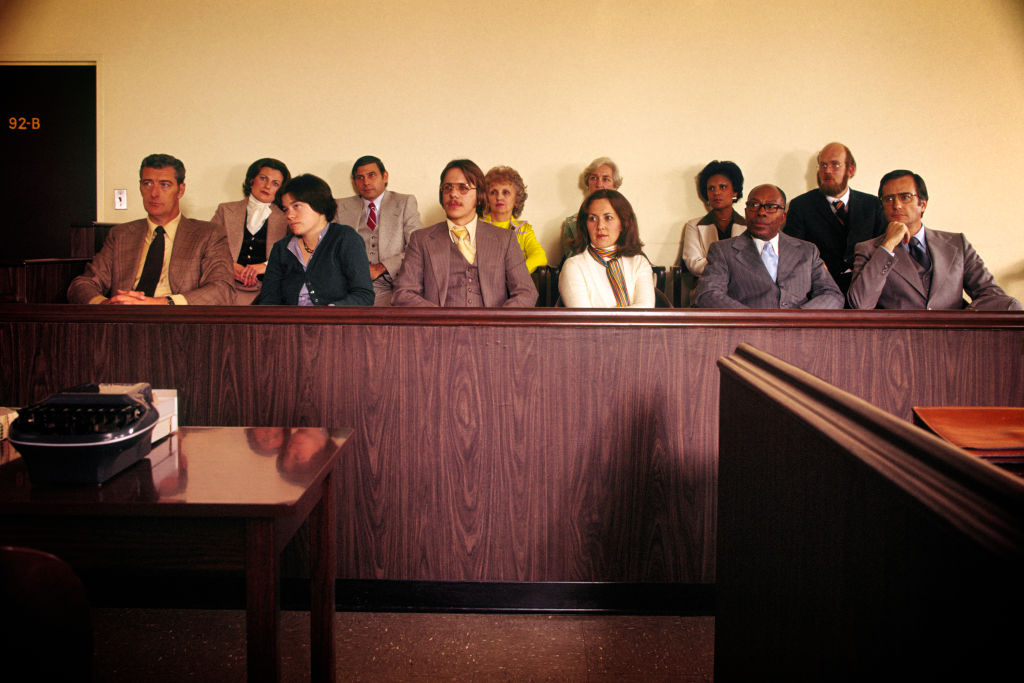
Trial juries, in which ordinary citizens are randomly selected to serve, offer a model of democracy that could be extended much more widely. (Stormi Greener / Star Tribune via Getty Images)

Less than a year into the Trump administration’s blitz on America, many are wondering how we can rebuild our moribund republic. One thing I can tell them: electing different politicians isn’t the answer. I should know: I spent twenty years as a politician in Vermont, beginning with the Burlington City Council alongside my ally Mayor Bernie Sanders and continuing in the House of Representatives, where I served five terms as a founding member of the Progressive Party. Through this experience, I saw up close what most merely observe at a distance. And my conclusion was that electing an unrepresentative political elite is actually undemocratic — the root of all political evils.

Abraham Lincoln defined democracy as government of, by, and for the people. But across the country, politicians are completely unlike the citizens they purport to represent. Congress, even in 2025, remains disproportionately white, male, and old. In terms of class, a majority of its members are millionaires; working people are woefully underrepresented. Is it any wonder, then, that the body’s decisions favor the rich? A legislature, John Adams wrote in 1776, “should be, in miniature, an exact portrait of the people at large. It should think, feel, reason, and act like them.” By this measure, Congress — and all state legislatures in America today — fail utterly.

I saw this imbalance firsthand in the Vermont Legislature while dealing with a housing bill affecting tenants and landlords. As our hearings proceeded, I noticed that the committee members relied more on anecdotal information from their social networks than statistical reports or witness testimony — especially testimony on behalf of renters. Curious, I surveyed the committee to find out how many of us were tenants, as opposed to homeowners. The answer? Zero (including me). I expanded my query to the entire House. The result was startling: of 150 representatives, I could find only one renter. Meanwhile, a third of Vermonters rented their homes. It was clear their interests were at a disadvantage in the chamber, and the resulting statutes reflected it. If fifty legislators had been renters, they could’ve challenged their colleagues’ bias with their own very different experience.

Poor representation is one problem. Another is tribalism. Henry Adams, historian and great-grandson of John, wrote that politics “has always been the systematic organization of hatreds.” But parties don’t just organize hatreds — they create new ones. The first question my leadership asked whenever a bill was introduced wasn’t, “Can we find common ground here?” Rather, “What can we use in this bill to make the other side look stupid or evil?” Too many politicians are agents of polarization, stoking acrimony and insisting their enemies are a mortal threat — because that’s how you win elections.

Such partisanship, though, doesn’t promote quality deliberation. In my experience, politicians don’t deliberate at all on most issues, if by that we mean persuading others through reason and empathy. Legislative “debates” are political theater, intended to vilify and grandstand. Most members vote without reading or understanding bills, loyally toeing the party line. Instead, politicians negotiate: they leverage power to extract concessions, cutting deals behind doors that are closed to the public but open to lobbyists.

And far from choosing the best among us, elections favor the worst: those who score high for the “dark triad” of personality traits. Not all politicians are narcissists, and we each have our favorites. But selfless ones are rare — exceptions that prove the rule. The rate of psychopaths among politicians is anywhere from four to twenty-five times that of the general population. Deficient in policy knowledge, they’re mostly adept at campaigns, public relations, and lusting after power. That’s why Americans name “politicians” — in their greed, dishonesty, and egotism — as the biggest problem in government. Vast majorities believe members of Congress from both parties don’t listen to the people in their districts or even care what they think. They also feel that Democrats and Republicans are more interested in fighting with each other than solving problems.

Faced with this corruption, 85 percent of Americans say our system needs major changes or complete reform. And change it they’ve tried, with the only tool at their disposal: elections. Nine out of the past ten federal contests have been “change” elections, with either the Senate, the House, or the presidency flipping to the other party. Both Barack Obama and Donald Trump were elected as outsiders whom voters hoped would fix Washington. Neither did.

The truth is, elections are a trap. Far from a democratic process, they concentrate power in the hands of elites. This was widely understood in past eras; classical and modern political philosophers observed that elections are tools of oligarchy. The liberal theory of consent of the governed, which elections claim to achieve, is about elevating a “special” caste of rulers. That’s the opposite of self-government. And when you consider the cost of campaigns in time and money, the idea that most working people can run for office — let alone win — is a joke.

Fed up with this state of affairs, many Americans have bowed out. Some ninety million eligible US citizens didn’t cast a ballot in last year’s presidential election. When asked why, two-thirds of nonvoters state that elections have little to do with the way decisions get made in government. Sad to say, they’re right.

Legislating by Lot

So if elections won’t change politics, what will? After my experience in the legislature, I began commenting that any 150 Vermonters picked at random would be more representative than the elected membership. Then I had an epiphany. In 2004, while working as an election reform policy analyst, I testified to a citizen assembly in British Columbia. The delegates were everyday people from all walks of life, and I watched as they deliberated in a way I never saw among politicians: with dignity, integrity, and mutual respect. When I found out they were picked by lottery, one man and one woman from each district, the light bulb went off. This was democracy.

Later I learned that random selection, known as “sortition,” was practiced in many regimes for centuries — Ancient Greece most prominently. The Athenians used lotteries to fill almost all of their governing institutions. These included the Council of Five Hundred; the courts; the legislative commissions that adopted laws (after 403 BCE); and panels of magistrates who implemented them. Aristotle, watching the citizens rule and be ruled in turn, considered sortition the essential tool of democracy. Scholar Josiah Ober even suggests it was responsible for the city-state’s extraordinary flourishing.

Sortition has made a stunning comeback the past two decades through hundreds of assemblies around the world, at the municipal, provincial, and national levels. And while still rare in the United States, they’re popping up here too, most notably in Oregon and Colorado.

The American left should be eager to embrace sortition. In the collection Legislature by Lot (to which I contributed), the late Marxist sociologist Erik Olin Wright makes the anti-capitalist case for democracy by lottery. “Ordinary citizens wielding legislative power,” he says, “will be more open to reform and more skeptical about self-serving arguments for inequality preferred by rich and powerful elites.” In fact, socialist parties in other countries have already adopted sortition to pick their own leaders and candidates. Spain’s Podemos has used lotteries to pick 17.5 percent of the members of its standing committee in several provinces. La France Insoumise did the same to select the twelve-hundred delegates to its 2017 national convention. The MORENA party in Mexico practices a combination of elections and lottery to field candidates for the national legislature.

Jury Democracy

Actually, the United States is familiar with democracy by lottery already: through jury service. It turns out the cure for our political ills is right under our noses. Our most truly democratic institution, juries have retained the public’s trust in this cynical age. That’s because jurors aren’t easily bought off or corrupted. It’s also because juries give agency to everyday citizens in a way elections never can. As Jeffrey Abramson writes in We, the Jury, “the jury version of democracy stands almost alone today in entrusting the people at large with the power of government.” Elections enable rule by the people “of a sort,” he says, “but this is a far cry from empowering the people themselves with the daily responsibility for governing.” By randomly selecting jurors on the other hand, “the noble principle remains that every citizen is equally competent to do justice.”

To integrate sortition into the rest of our government, then, would merely be to expand on this democratic foundation. Imagine an Article V constitutional convention in which amendments are proposed by citizen juries, similar to what’s been done in Ireland and Mongolia. Lawrence Lessig of Harvard argues that such a process is not only possible but necessary. A number of scholars (myself included) have also developed designs for making lottery-selected juries the basis of our whole government. While it wouldn’t be perfect, the bar politicians have set — as actor Riz Ahmed said recently in a viral video — is so low it’s in hell.

The key is to have many distinct bodies, each selected for a specific task. An agenda council could hear from a wide range of witnesses, select a set of priority issues to be tackled for the coming period, and put out a general call for proposals. Multiple review panels dealing with specific policy domains, and serving longer terms, could evaluate all the proposals to draft a final piece of legislation. To avoid “pride of authorship” distortions, separate, very large and accurately representative juries would be convened, listen to both pro and con arguments, and then vote on whether to adopt the new law. Other randomly selected bodies would monitor procedures and staff to assure neutrality and seek steady improvement of the system.

Such a comprehensive system will not spring forth fully formed, so a transition strategy is essential. In brief, the transition strategy I have proposed, I call “peeling.” After people become somewhat familiar with sortition dealing with policy in one-off citizens’ assemblies (as has already happened in much of Europe), the strategy is to transfer one policy domain at a time away from politicians and vest full authority in randomly selected juries.

This might initially cover domains where politicians have been caught in a recent scandal or concerning issues they are happy to be rid of, because they are politically “no-win” issues. On the municipal level, this might start by removing all authority to change zoning law from a city council (after a city councilor is caught taking a bribe to spot-zone, say) and having citizen juries take that responsibility. Eventually, on a national or state level, the whole topics of health care, AI regulation, or taxation, might be moved from politicians to large, diverse, randomly selected panels. Just as kings and queens still exist in Europe (but with no real power), I imagine a day when Congress might be reduced to just naming post offices, with real authority entrusted to democratic sortition bodies.

It’s worth recalling, in such times, our first president’s warning about how autocrats rise. “The alternate domination of one faction over another, sharpened by the spirit of revenge,” Washington said in his Farewell Address, “is itself a frightful despotism.” To escape it, people come to desire a strongman, and “sooner or later the chief of some prevailing faction, more able or more fortunate than his competitors, turns this disposition to the purposes of his own elevation, on the ruins of public liberty.” The road to unfreedom runs through politicians. As the United States falls deeper into tyranny, jury democracy may be our only road out.

Share this article

Contributors

Terry Bouricius was a third-party candidate for the Vermont Liberty Union Party, then the Citizens' Party, and was elected to the Burlington City Council along with Bernie Sanders in 1981. He later served a decade as a Progressive Party member of the Vermont House of Representatives and has written extensively about democracy reform, with a focus on sortition as an alternative to elections.

Filed Under