The Quiet American Captured the Hubris of American Empire
It’s been 70 years since Graham Greene’s novel The Quiet American was published. Greene’s scathing picture of US foreign policy and the men who carry it out enraged American critics, but the history of the last seven decades has vindicated his perspective.
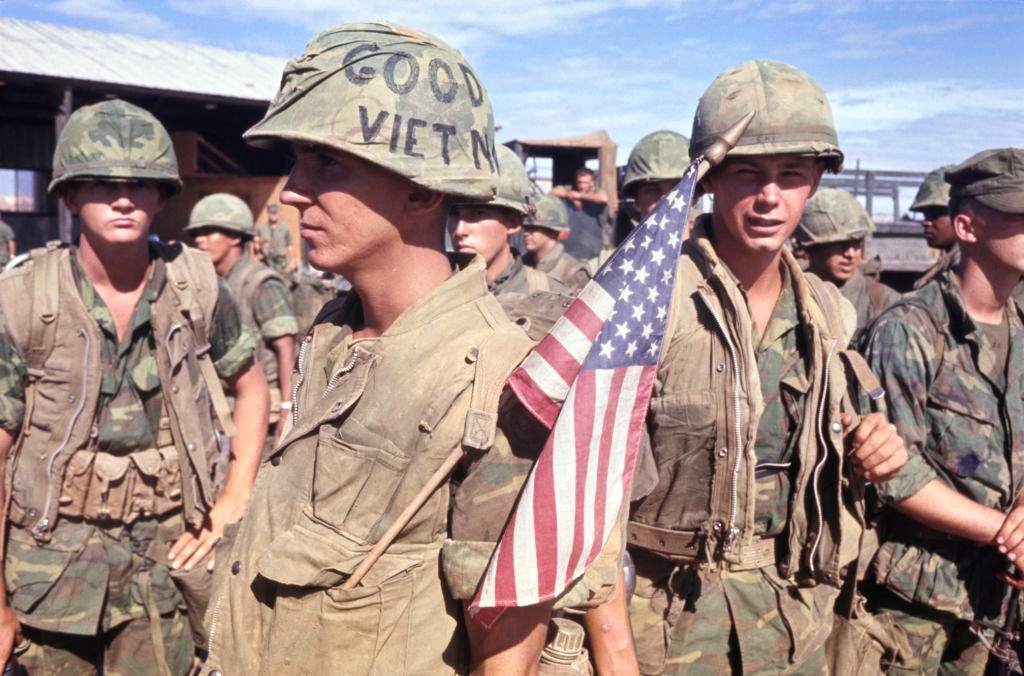
As the American war intensified, the antiwar protest movement adopted The Quiet American as a flagship work. (UPI Color / Bettmann Archive via Getty Images)
In June 1951, British novelist Graham Greene was cruising round the Mediterranean in a luxury yacht, the guest of movie producer Alexander Korda. By mid-month they had reached Greek waters.
“Last night we spent in Epidaurus Bay & went up to the Greek theatre for a concert,” Greene wrote to his American lover Catherine Walston. “First, Mozart’s Jupiter Symphony (which I liked perhaps because a faint idea for an Indochina novel stirred).”
Earlier that year, Greene had visited Indochina — the French colonial fusion of Vietnam, Laos, and Cambodia — to observe the war between France and Ho Chi Minh’s communist-led Vietminh nationalists, then in its fifth year. In Vietnam, the cockpit of the conflict, something unexpected happened to him: “I fell in love,” he later confessed, not with a person but a country.
Three more visits followed before The Quiet American, his Mozart-stirred, Vietnam-set novel, was published in Britain in December 1955 and in the United States early in 1956. Seventy years on, The Quiet American remains one of the most profound literary renderings of the politics of war ever written.
The novel not only provides a searing critique of US policy in Asia in the early Cold War but a pointer (prophetic at the time, uncanny in retrospect) to how the French war threatened to make a successor American war inevitable. Linking fiction and fact was the naivety and arrogance of US policymakers, first detected by Greene in the French period before being amplified to even greater tragic effect when America claimed Vietnam as its own battlefield.
Twig in the Spokes
A decade before President Lyndon B. Johnson (LBJ) began bombing North Vietnam and dispatching hundreds of thousands of troops to South Vietnam, Greene could be found speaking truth to superpower. Within the parameters of his fictional tale, he warned of the dangers and consequences of America’s real-life bulldozing anti-communism in Asia and condemned US historical and cultural ignorance of Indochina.
Greene challenged what he saw as a guiding assumption of Washington’s foreign policy: the idea that given a free choice, all the developing world would buy into democracy and liberal capitalism, US-style, and where that freedom did not exist, or was denied, it could be created.
The Quiet American is set in Vietnam in the early 1950s, when the tide of war had turned against France, and draws heavily on Greene’s own experience of the country. The first of his four visits was in January 1951 shortly after the start of a US military assistance program for France. Along with arms and ammunition came a flood of military and economic advisors to ensure that the French employed America’s largesse effectively.
The novel’s main political theme emerges from the interaction between its two principal characters. The first is Thomas Fowler, a middle-aged and world-weary British reporter based in Saigon, an experienced Asia-hand who narrates the novel from his personal perspective. The second is Alden Pyle, a young, idealistic, and committed Cold Warrior, the quiet American of the novel’s title, who is involved in humanitarian work as part of the wider US aid effort.
Although Greene regularly parried suggestions that Fowler was a mouthpiece for his own views, he conceded in later life that “I would go to almost any length to put my feeble twig in the spokes of American foreign policy.” Greene was a contrarian by nature and his public statements are not wholly reliable as a guide to the man within (to invoke the title of his first novel from 1929). Still, there is no question that The Quiet American flays US Vietnam policy, as personified by Pyle, and that the lash is administered by Fowler.
York Harding Thought
Upon encountering Pyle in Saigon, Fowler is quickly enraged by his complacent insistence that his preparatory reading back home has given him a full insight into Vietnam. Pyle is a devoted disciple of (fictitious) political scientist York Harding, who provides a template for how America can save the developing and postcolonial world from communism.
When Fowler explains that the complexity of Vietnam’s politics defies simplistic book-based solutions, Pyle “didn’t even hear what I said. He was absorbed already in the dilemmas of Democracy and the responsibilities of the West; he was determined . . . to do good, not to any individual person but to a country, continent, a world.”
Hearing Pyle utter Cold War clichés, Fowler bridles: “I know the record. Siam goes. Malaya goes. Indonesia goes. What does ‘go’ mean?” Before long he is “tired of the whole pack of them,” all the Pyles pouring into Indochina “with their private stores of Coca-Cola and their portable hospitals and their too wide cars and their not quite latest guns.” In Vietnam, Greene, a Francophile, mostly associated with local French colonialists and soldiers, and he clearly shared their resentment of the creeping Americanization of the war.
The Quiet American reaches its climax when Fowler discovers that Pyle is really a CIA agent secretly arming a so-called Third Force independent of both the French and the Vietminh. While in Vietnam in 1951–52, Greene learned that the CIA was covertly cultivating local anti-communist movements as insurance against the moment when a war-weary France withdrew and left Vietnam dangerously exposed. With that revelation, he had his storyline.
After some local reconnaissance, Pyle decides that General Thé is made of the right Third Force stuff. A murky figure dwelling in the jungle near the Cambodian border, Thé heads a politico-military organization that is equally anti-French and anti-communist. Greene admitted to modeling Thé on a real person, the Cao-Dai warlord Trình Minh Thé, whom the CIA championed “in one of its manic moments.” But whereas Pyle sees Thé as the future, Fowler (like Greene) sees only “a shoddy little bandit with two thousand men and a couple of tame tigers.”
When a devastating car bomb in downtown Saigon kills and maims many innocent bystanders, Fowler recognizes the handiwork of General Thé and, beyond him, Pyle: “I should have seen that fanatic gleam, the quick response to a phrase, the magic sound of figures: Fifth Column, Third Force, Seventh Day,” he reproaches himself. “I might have saved all of us a lot of trouble, even Pyle, if I had realised the direction of that indefatigable young brain.”
Fowler determines to end Pyle’s meddling before more people are hurt. Bitter, too, because the younger man has stolen his Vietnamese mistress, he betrays him to the Vietminh. Until almost the very end, Fowler is proud of his professional detachment as a neutral pressman. But as the body count from Pyle’s interference mounts, he recalls the words of a communist contact: “Sooner or later . . . one has to take sides. If one is to remain human.” Belatedly, Fowler agrees. And so Pyle dies, quietly bayoneted by a Vietminh assassin and dumped in the Saigon River.
“A Nasty Little Plastic Bomb”
When The Quiet American was published in 1955, Greene, then fifty-one, was a major literary figure whose previous novel, The End of the Affair (1951), was garlanded with praise on both sides of the Atlantic. However, while his latest effort earned admiring reviews in Britain, in America critics rounded on him for denigrating US foreign policy.
In the New Yorker, A. J. Liebling blasted it as a “nasty little plastic bomb” of a book. Christian Century denounced its “malice” toward the United States, while Newsweek complained about the “dreary stereotyping” of the American characters. “Nobody liked it in America when it came out,” Greene later conceded.
Oscar-winning US film director Joseph L. Mankiewicz was as incensed as anyone. Describing the novel as “insulting to America and Americans,” in 1958 he turned Greene’s story into a celluloid paean of praise for US policy. Along the way, Pyle (played by Audie Murphy) was transformed into the hero and Fowler (Michael Redgrave) made the naive tool of the communists. The picture was “a travesty,” complained Greene, “a complete betrayal.”
From the start of the 1960s, as the United States became ever more deeply embroiled in Indochina, Greene’s novel regained relevancy and won new readers. The Franco-Vietminh war ended in 1954 in the partition of Vietnam: in the north, Ho Chi Minh established communist rule; in the south, once the French departed, American nation-building produced an anti-communist state.
A prepresidential John F. Kennedy called South Vietnam “our offspring” and insisted that “we cannot abandon it.” As president from 1961, he duly ramped up US military support to the South Vietnamese government as it battled a communist-Vietcong insurgency. Eventually, in 1965, to save America’s offspring, Kennedy’s successor, LBJ, fully Americanized the war.
Second Life
US war correspondents played their part in the revival of interest in The Quiet American. Often sent to South Vietnam with minimal briefing, they puzzled over how the French war gave way so quickly to an American war before finding the answer in Greene’s novel. “Many passages some of us can quote to this day,” recalled Pulitzer-winning reporter David Halberstam. “It was our Bible.”
Another Pulitzer winner, Neil Sheehan, called The Quiet American “the best book written about Vietnam” because it identified so early “the arrogance of power” animating US policymakers. By a curious process of literary-journalistic osmosis, Greene’s thesis thus came to subtly permeate a surprising amount of battlefront copy.
As the American war intensified and US society became riven over its rights and wrongs, the antiwar protest movement adopted The Quiet American as a flagship work and feted its author as a geopolitical Cassandra whose warnings about US policy had gone unheeded. Uncomfortable with the attention, Greene maintained that a book from 1955 “couldn’t attack a hypothetical future.”
However, by opting to write in the first person (Fowler) and include in his novel large amounts of reportage from his time in Vietnam, he underestimated the extent to which later readers, particularly in America, would embrace his words as contemporary history or else read them as a reality-fiction hybrid.
The Best Intentions
Greene died in 1991 at age eighty-six. By then, what he called America’s “senseless and cruel war” was long over. Meanwhile, The Quiet American’s title attained an independent life. Just as the phrase “catch-22” may be used to describe a no-win situation by people unfamiliar with Joseph Heller’s 1961 novel of that name, “quiet American” is routinely applied to any US foreign policymaker “impregnably armoured by his good intentions and his ignorance” (as Fowler says of Pyle) in dealing with the developing world/Global South.
Rereading Greene’s novel in the buildup to the 2003 Iraq war, Zadie Smith found it “reinforced my fear of all the Pyles around the world. They do not mean to hurt us, but they do.” Arguably that hurt had already hit home for Americans with the 9/11 terrorist attacks. A new film of The Quiet American, directed by Australian Phillip Noyce and loyal to Greene’s storyline, had been due for release in fall 2001 but the producers pulled it from the schedule.
American audiences might not be ready, they felt, for a picture that prompted them to ask if 9/11 was in part a reaping on US soil of what America had sown over many decades in the rest of the world. When it was finally released in 2002, the movie, starring Michael Caine as Fowler and Brendan Fraser as Pyle, was generally well received.
As for Greene’s novel, its message transcended Vietnam and has therefore endured. In the aftermath of 9/11, David Greenway, whose reporting career spanned Vietnam and the “war on terror,” realized that “Greene was right.” In Vietnam, “the Americans were naive in their idealism, and their good intentions were destructive. I have since seen the ghost of Alden Pyle in the Green Zone in Baghdad and I ran into him in the corridors of the American embassy in Kabul.”
Gloria Emerson, another correspondent, recalled giving away her beloved and battered copy of The Quiet American to a Vietnam veteran. In accepting it, he asked her what could be learned from a novel about a dead war? She replied with two words: “Almost everything.”
Back in 1955, Greene chose a quote from Lord Byron’s Don Juan for The Quiet American’s epigram. As the novel celebrates it seventieth anniversary, Byron’s words, like Greene’s, are no less resonant today with a distinctly un-quiet American in the White House.
This is the patent age of new inventions
For killing bodies, and for saving souls,
All propagated with the best intentions.