Zohran Mamdani Is Listening — and Taking Notes
At an unusual event in Queens on Sunday, everyday New Yorkers lined up to offer their expertise and experience to democratic socialist mayor-elect Zohran Mamdani.
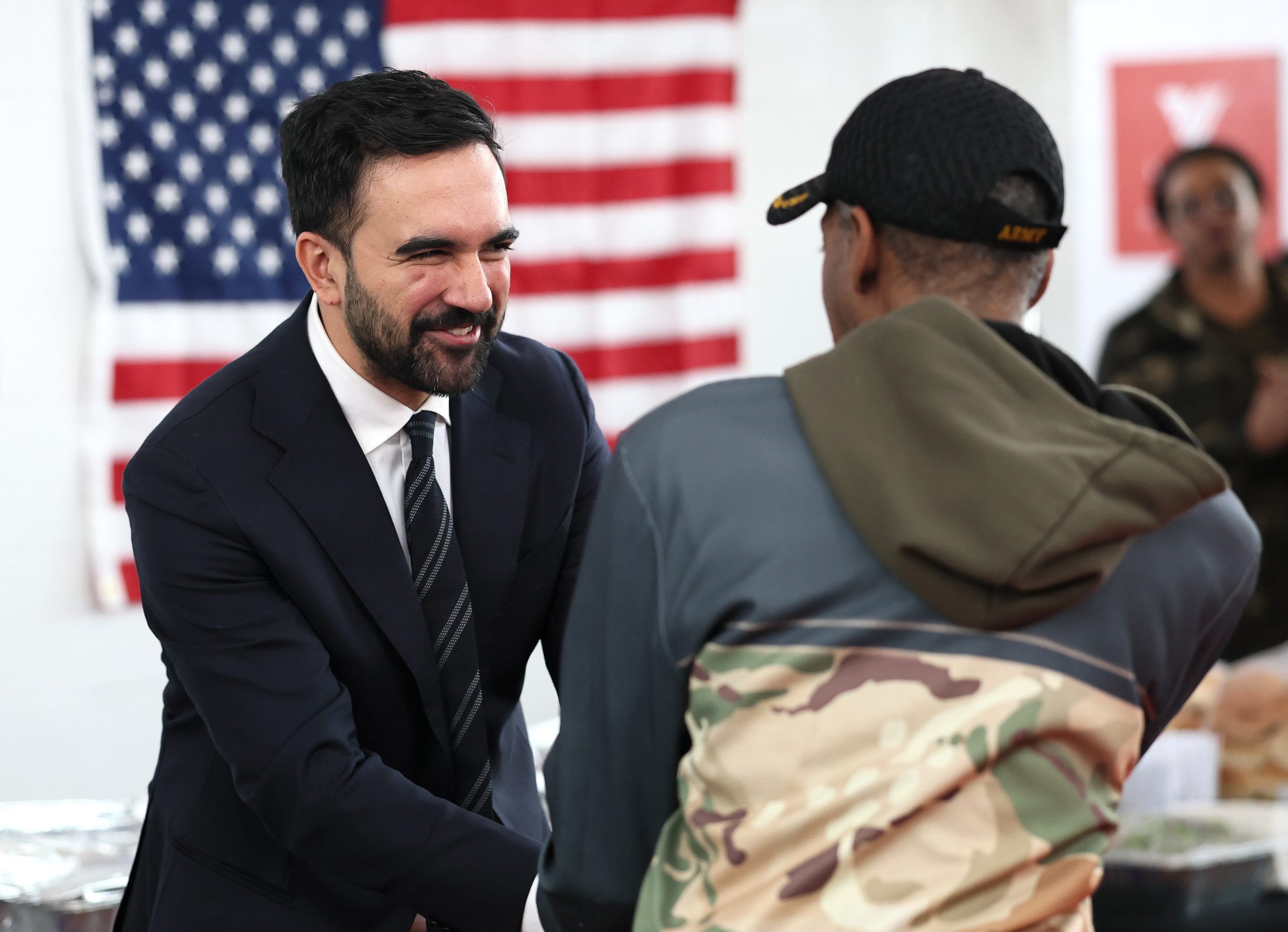
For a mayor-elect who came to power through working-class and grassroots organizing, the act of listening to members of the public lands differently. (Michael M. Santiago / Getty Images)
Jocsan Rojas, sixteen, had traveled to Astoria from Staten Island with his mom, and the two were waiting excitedly to speak to mayor-elect Zohran Mamdani. A junior at New York’s Harbor School, located on Governors Island, Rojas had written an extensive research paper on the proposed closure of New York’s notorious Rikers Island jail and wanted to share his insights with Mamdani and his policy team. Rojas argued for remaking Rikers as a school, much like the school he attends, only a rehabilitative one for the incarcerated.
Indeed, he said, the island itself should be rehabilitated to be more like Governors Island, with bike lanes and pedestrian walkways. “Rikers Island is something you don’t want to think about,” he said. “Make it into a place people want to go, maybe a tourist attraction. Get rid of the stigma.”
Rojas told me what he had learned about the island in the course of his project — during the Civil War, it was a training facility for Union soldiers — and mused about punishment, noting that a prisoner had died there just last week. “They put [prisoners] in a dark room with no furniture for days,” he emphasized, explaining why it was important to end the isolation of the island and its inmates. “How do you expect these people to rehabilitate into society?”
Also waiting to speak with Mamdani was Tom Geiser, thirty-three — almost the same age as the mayor-elect, who turned thirty-four in October — who lives in Astoria, just a few blocks away. He wanted to talk about bike lanes and pedestrian safety in the area and reigniting faith in government by doing things more efficiently.
“Government can be so much, right?” he said. “It’s the thing we do together and that’s beautiful. But it’s hard to make the case when things take so long.”
Rojas and Geiser were there to participate in an all-day event called “The Mayor is Listening.” For twelve hours on Sunday — 8 a.m. to 8 p.m. — mayor-elect Mamdani and his top aides spoke with 142 ordinary New Yorkers in one-on-one sessions at the Museum of the Moving Image, which is in Astoria (where the mayor-elect still lives for now, though he will move into Gracie Mansion next month).
People came prepared, knowledgeable, nervous. They spoke privately with one of the top members of Mamdani’s team, including Lina Khan, Patrick Gaspard, Elle Bisgaard-Church, and Dean Fuleihan, followed by Mamdani himself. Even longtime politically active New Yorkers at the event agreed they’d never experienced anything like this before. Mamdani won the election through mass participation, but to invite the masses to help govern the city is even more novel.
Each New Yorker who lined up to speak with the newly elected mayor had urgent concerns. I spoke with Alicia Waller, an emergency room doctor who lives and works in the Bronx, when she was at the front of the line. As she waited, she applied a fresh coat of light-colored lipstick and reviewed her extensive notes.
She wanted to talk to Mamdani about how the federal cuts to Medicaid and Medicare were going to affect the patients she serves and ask him what the city could do about it. She told me that she sees so many patients who are sick simply because they are too poor to receive adequate preventive health care. A thirty-nine-year-old man came in recently with a stroke, for example, simply because he suffered from high blood pressure that had gone untreated for too long.
Behind Waller was Christina Chaise, thirty-six, who lives nearby in the Ravenswood Houses. She came to talk about public housing, which she didn’t feel the mayor-elect had been talking about enough. She wanted to see him oppose “any form of privatization” as well as any plans to demolish existing projects. Chaise thought the mayor has been placing too much emphasis on privately owned housing. But housing is a right, she said, which means “public housing should be the model, not something to turn our backs on.”
As well as those waiting, I also spoke with New Yorkers as they exited their conversations with the mayor. Pat Jewett and her daughter, Ahjaah, a young woman on the autism spectrum, had traveled from the Bronx that day to talk with Mamdani about housing. Jewett told him that as a part-time census worker, she had observed that it was not unusual to find two or three families sharing a two-bedroom unit to be able to afford the rent. Ahjaah lives in supportive housing for the disabled, but, she says, many of the educational and enrichment activities have been eliminated due to funding cuts. “He was very receptively taking notes on everything,” said Jewett of Mamdani. Her daughter concurred.
Also fresh from his session with Mamdani was Thadeaus Umpster, a mutual aid organizer in Bedford-Stuyvesant who was concerned about a food pantry closing in the neighborhood and a shrinking supply of community fridges. Part of the problem is landlords’ unwillingness to have visibly poor people near their buildings, and, dispiritingly, Umpster said, even churches have become less willing to house these vital resources. The mayor and his team, he said, agreed this is a problem they urgently need to help address.
Shabir Ahmad, from Brooklyn’s Ditmas Park, a founder and volunteer with the Muslim Vote Project, exited his conversation glowing. He’d come to propose what he called a “community safety” concept: a “culturally competent youth resource center.” He reported, smiling, “The mayor loved my idea.”
The title of the event could have invited skepticism. After all, “listening “is just what elites do when they want to give an illusion of participation. Even Hillary Clinton held “listening tours” as a US senator. “Listening” can be an empty buzzword in an elitist political culture that hollowly “consults” ordinary people while passing policies that substantively disempower them.
Over the last half century, as unions and other working-class institutions declined and big money increasingly dominated politics, focus groups, visioning sessions, and endless customer services satisfaction surveys proliferated, in a culture of consultation that functioned as a kind of consolation prize for the loss of popular power, as I wrote in Divining Desire. There’s nothing progressive about listening in itself — it’s what politicians need to do to get votes, and what companies need to do to sell us stuff.
But for a mayor-elect who came to power through working-class and grassroots organizing, who put the struggles of the city’s working class at the forefront of his platform and whose transition team is made up of socialists, trade unionists, and others with a proven track record as tribunes of the working class, the act of listening lands differently. He often emphasizes how his platform itself grew out of listening to New Yorkers, as an organizer and an assemblyman. Mamdani’s session at the Museum of the Moving Image on Sunday reminded New Yorkers that his mayoralty should belong to them. It felt like an invitation to an experiment in working-class co-governance.
For their part, the participants gave it their all. They weren’t looking simply to be heard or to blow off steam; each came to help the mayor make policy. Not many politicians, said Ahmad, are sincere about listening to people. He said he had expected the mayor-elect to be charismatic and to speak well. What surprised him was that Mamdani asked so many questions.
“And the reason he asked so many questions,” Ahmad said, “is that he really wanted to understand my idea. He took notes, he asked me more questions, he remembered things. It was great, actually.”