Mamdani’s Halal Cart Plan Is Part of a Bigger Agenda
As strange as it may sound, Zohran Mamdani’s new policy on halal cart licenses would lay the groundwork to democratize ownership through cooperatives — an approach that could finally help make New York City affordable again.
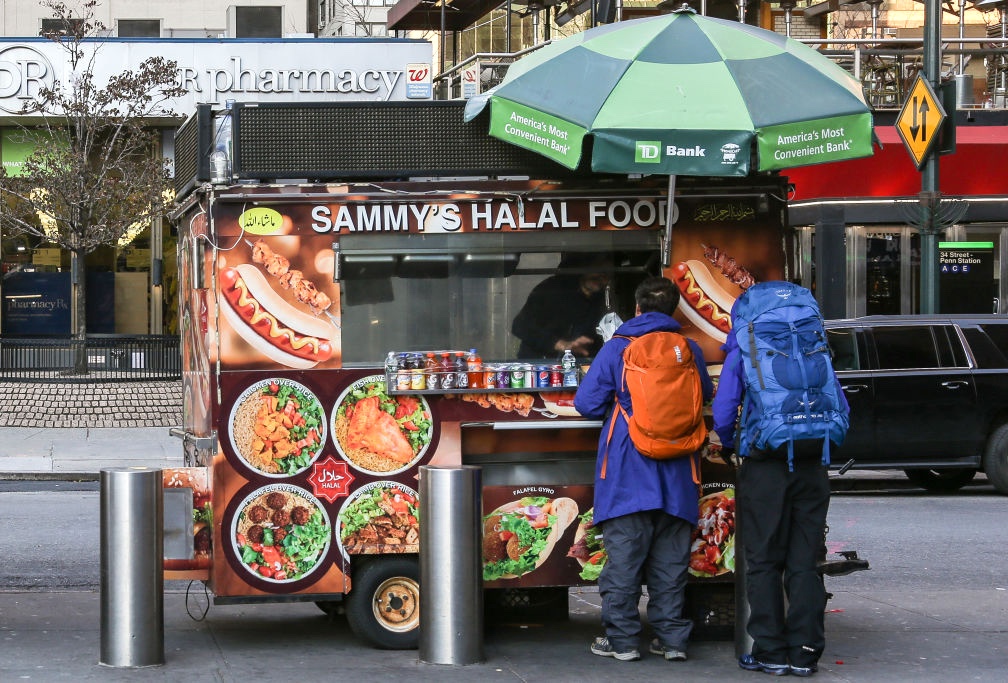
One way Zohran Mamdani wants to improve the well-being of New Yorkers is to keep the price down on halal cart licenses. (Nicolas Economou / NurPhoto)
Zohran Mamdani, the newly elected future mayor of New York City, is a much-needed breath of fresh air. For decades now, Democrats have focused increasingly on identitarian appeals while offering few real solutions to an economy that puts basic needs like housing out of reach for millions. At best, this has left established power structures unchallenged — at worst, it has even reinforced them.
By focusing on affordability, Mamdani has broken out of this trap. While he certainly does not shy away from asking how municipal policies can help marginalized groups, he is primarily focused on improving well-being for the majority of New Yorkers. But to ensure that life is easier for the current and future generations of New Yorkers, his policies should go beyond mitigating the symptoms of a broken system.
For a particularly illustrative example, take halal carts — a staple of New York City dining. Halal cart licenses are expensive because they have been put on the market, leaving their price subject to the speculative behavior of rentiers. One way to keep the price down on both halal cart licenses and their menu items is to cut out the middleman, decommodify them, and bring them into the hands of those who actually run the halal carts.
Encouragingly, Mamdani has promised exactly this. But it shouldn’t stop there. As strange as it may sound, by focusing on ownership, Mamdani’s new policy on halal cart licenses could lay the groundwork for a bigger framework that could finally help make New York City affordable again.
Who Owns What?
In principle, there are two ways of organizing ownership in the market economy.
Ownership can be treated as a commodity that is freely traded on the market, which makes some degree of speculation on its price a legitimate part of the game. In such scenario, an asset can be bought by anyone seeking a financial return.
The stock market as an organized market for business ownership is perhaps the most glaring example of such a system for the allocation of ownership rights. People invest their money in ownership of different companies with the hope of receiving dividends and seeing the value of their assets — in this case, shares — grow. It doesn’t matter whether shareholders are involved in the company, so long as they follow market valuation graphs and cash out when profitable.
Over the past decades, as neoliberal thought seeped into policy circles, housing, too, has become increasingly viewed and treated by politicians as just another type of investment asset. This is especially true in cities like New York, where investing in the real estate market can be a great way to make a lot of money — of course, only if you either already have a lot of it in the first place or have access to debt. And as a matter of fact, many parts of the public infrastructure, including essential goods and services, have turned into an investment asset after the neoliberal turn, from water to public transport.
But there is another vision of ownership — one that treats it as a personal right.
Imagine a private company where the benefits of ownership, that is, having a say in how the business is run and benefiting from the financial success of the business, are permanently attached to the group of people working in that business. Or think of a scenario where being a tenant allows you to co-govern the housing unit with other tenants, and where rent — instead of profiting an investor landlord — is only used to cover depreciation costs, maintenance costs, and management costs.
This somewhat resembles the way we manage the right to access public transportation and other public services, where such right is, like the right to vote for a mayor, granted by virtue of being a citizen in a municipality. If we define the right to housing, to commute, to clean water, electricity, and childcare, etc. as fundamental, then accessibility should be universalized through public provision. And that’s where democratic ownership comes in.
Democratic Ownership Works
In the United States alone, there are hundreds of worker, housing, and grocery cooperatives with a whopping 6,500 businesses using an employee stock ownership plan (ESOP) to bring 14.9 million workers into ownership. The ESOP model partly decommodifies business ownership by creating an indirect ownership structure in which company stock is held in a trust on behalf of employees collectively.
One common critique of the US ESOP — and, for that matter, its UK and Canadian variants — is that these models do not democratize governance. But this limitation stems from legislative design, not from anything inherent to the transformative, leveraged-buyout mechanism at the core of the ESOP model. In Europe, the Institute for Economic Democracy has addressed this by democratizing the ESOP structure, replacing a trust with a cooperative. And in October this year, Slovenia became the fourth country in the world to adopt dedicated ESOP legislation.
Hundreds of empirical studies show that ESOP firms tend to build workers’ wealth, offer higher wages, and provide greater job stability — all of which positively affects affordability. ESOPs have, on average, twice the retirement savings of employees in conventional firms. A recent report in the Harvard Business Review shows that if all American businesses became 30 percent employee-owned, economic inequalities would plummet; 90 percent of the population would see substantial gains, and only at the expense — a very slight expense — of the top 1 percent earners. Interestingly, employee ownership often enjoys bipartisan support at both federal and state levels, a rare feature of a progressive policy. Similar principles applied to housing could also be highly beneficial. In housing co-ops, residents collectively own and manage their buildings, stabilizing costs while fostering long-term community accountability.
Vienna, often ranked the world’s most livable city, has led this approach for a decade: roughly 23 percent of rental housing is municipal, and another 21 percent is cooperatively owned, ensuring both affordability and quality of life. Zurich has also pursued similar policies, with cooperative housing now making up 27 percent of the total housing stock, achieving long-term affordability in one of the world’s most expensive cities.
In employee-owned companies and housing cooperatives, ownership is removed from the market — it’s not something to speculate with. In the case of private companies, profit rights for employees increase the disposable income of working people. In the case of housing cooperatives, the nonprofit nature of ownership decreases the cost of accommodation. Both increase affordability and do so in a structural, sustainable way by changing ownership patterns.
Many states in the United States promote employee ownership with tax incentives, subsidizing technical support, and adopting other types of targeted legislation. But even at the municipal level much can be done. A recent report from the Institute for Economic Democracy shows how local governments are promoting employee ownership through direct subsidies and cooperative-friendly procurement policies.
The potential for a radical shift in business ownership across the United States — especially in major cities like New York — is enormous. The Institute for the Study of Employee Ownership and Profit Sharing estimates that over one million businesses, employing nearly sixty million Americans, are viable candidates for employee ownership or cooperative conversion.
Likewise, the success of housing cooperatives depends largely on sustained municipal policies — something Mamdani is more than capable of delivering. By adopting innovative approaches to create cooperative housing, such as leveraged buyouts of housing units by housing cooperatives, financed through long-term municipal bonds, the Mamdani administration could reach its housing affordability goals without incurring unsustainable costs.
The benefits of a policy agenda centered on ownership extend beyond direct and immediate economic effects. We should also consider what Carole Pateman described as the spillover effects of worker ownership: the idea that workplace democracy embeds democratic practice in the everyday lives of citizens, thereby strengthening democracy by giving people greater control over their working lives. Cooperatives serve as spaces where people learn to participate in democratic processes and act in solidarity, witnessing firsthand the material benefits of cooperation and building the social power of the Left.
Fostering employee ownership is also a way to anchor businesses within the city’s economy and align the interests of firms with those of the broader community. In doing so, the Left can help create a business environment that integrates more harmoniously with society and does not work against progressive policy agendas — making the lives of socialist municipalities impossible — but is instead more likely to act as a constructive interlocutor in promoting the well-being of local citizens. As Daniel Wortel-London brilliantly illustrates, an affordable city cannot be built atop a regressive economy.
Back to Halal Carts
The reason prices are so high at your local halal cart isn’t the greediness of the vendor serving you up a chicken-and-lamb combo. It’s the commodification of halal card licenses — the asset that allows New Yorkers to sell falafel and shawarma. Under the current system, these licenses have been turned into an investment — one bought up by people who hoard them and rent them out to individual halal cart operators, who are then left with thin or nonexistent profit margins even though they’re doing all the work. It’s capitalism at its finest.
But things don’t have to be this way. And Mamdani is giving us hope that they might start changing. If the Left wants to deliver on affordability, it must put forward policies that aim to redefine the nature of ownership for certain strategic assets. To be effective, these policies must allow workers, tenants, and commuters to partake in ownership — not as investors but as people that actually use that asset.
In business, that means supporting employee ownership. In housing, that means cooperative ownership. And when it comes to halal carts, it means limiting license ownership to people that actually make the falafel.
In the end, keeping a halal platter not only delicious but affordable feels quintessentially New York. It’s an everyday expression of the sunny, egalitarian vision that carried Mamdani to victory.