Heathrow Cleaners Deserve More Than the Bare Minimum

Cleaners at London Heathrow have begun a strike that could last until the end of the year. While subcontractors pay them only the legal minimum, they’re demanding that the airport live up to its proclaimed standards as a Living Wage employer.
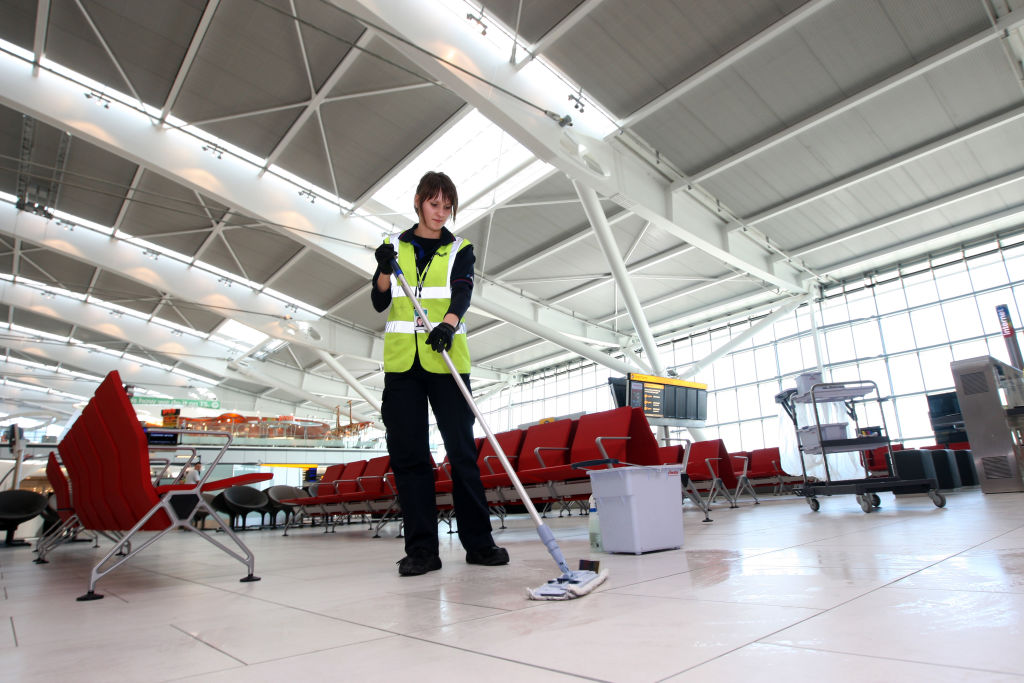
London’s biggest airport boasts that it’s a Living Wage employer paying above the legal minimum. The use of subcontractors makes this a fiction, using a nice-sounding label to mask the reality. (Steve Parsons / PA Images via Getty Images)

Antoneta works as a cleaner in London Heathrow’s airport’s newest and shiniest wing, Terminal 5. Despite working the night shift, she doesn’t receive any extra allowance for these tiring hours. The airport boasts of its environmental, social, and governance (ESG) and reducing CO2 emissions, and it even claims to be a Living Wage employer. And yet Antoneta is not paid the stipulated £13.85/hour rate but only the legal minimum of £12.21. Meanwhile, Sean Doyle, CEO of British Airways, whose headquarters she cleans, took home a £2 million bonus in 2024. To make matters worse, there is no company sick pay scheme to fall back on. She’s only eligible for government Statutory Sick Pay — a meager £118.75 per week.

This is because client companies such as Heathrow and British Airways award public contracts to the lowest bidder — usually highly financialized yet penny-pinching conglomerates. Thus, Antoneta is neither employed by the airport where she works nor by British Airways but by a contractor, facilities management giant OCS. Such an arrangement results in low pay for the overwhelmingly black and ethnic minority workers — but is whitewashed by official certifications and accreditations that unduly praise employers while taking bargaining out of unions’ hands.

These findings are confirmed by Stephen Mustchin and his fellow British industrial relations scholars in their recent PROCURFAIR report. It finds that low pay, discrimination, irregular and long working hours, and health and safety issues are routine problems for cleaners and security guards on public contracts in Britain. Women and migrant workers especially bear the brunt.

Immigrant Workers at Capitalism’s Choke Points

Every day, Antoneta travels eighty minutes on two buses to reach the airport to clock in for her shift at 6 p.m. She works twelve hours overnight cleaning brightly lit offices, kitchens, and toilets, then gets two buses home again at 6 a.m., feeling bone tired.

Antoneta is not alone in this. A migrant to Britain, she is one of the workers from black and Asian backgrounds who make up 90 percent of OCS’s 125-strong cleaning workforce. She is part of an ever-growing fraction of the working class that is not directly employed by the company she works for. As deindustrialization continues with worrying speed, this fraction of the working class is growing.

Whether airport cleaners, security workers, or caterers, these workers are often forced to sleep in break rooms or their cars due to their shift schedules. A UNI Global Union study, Working Against the Clock, surveying over three thousand cleaners across Europe, found that half of them worked atypical shifts, thus facing worse working conditions than cleaners working days. Seven out of ten of them reported that they had no other choice than to accept these unsocial hours.

Almost all political parties in Britain have adopted anti-immigrant stances. On the one hand, policies aim to deter migrants from entering Britain. On the other hand, they aim to time-bind them to one employer, so they are less likely to join a union or speak up about exploitation. Consequently, immigrant workers such as Antoneta are viewed as expendable — able to be discarded whenever it suits the employer. Yet British capitalism needs migrants as the population ages, labor shortages hit economic growth, and the promise of robots replacing cleaners fails to materialize. The inevitable consequence: ever more immigrant workers are located at central nodes within capitalism.

The centrality of Heathrow Airport for British capitalism couldn’t be clearer. An estimated 83.8 million passengers used it in 2024, and its 2025 revenue is expected to rise to £3.61 billion. Unsurprisingly, it is being touted as a “growth engine” and “jobs creator.” However, Antoneta’s case underlines that the jobs on offer are not of the kind to sustain families or give workers a better life. It appears that sky-high profits and grounded workers go hand in hand. But why so?

In Immanuel Ness’s and Jake Alimahomed-Wilson’s edited volume Choke Points, the authors distinguish between workers “upstream” and “downstream.” The latter are more often self-employed, in informal employment, or on temporary and precarious contracts. In other words, workers like Antoneta are viewed differently than pilots or air traffic controllers who are in structurally stronger positions to shut down air traffic. Ness and his coauthors explain that companies often buy peace with structurally and institutionally strong unions. However, this is not the case for unions representing cleaners, security guards, and other service workers at airports.

Cleaners in London demand better wages from airline British Airways. (Rebekka R.)

Unfulfilled Promises of the Living Wage

Heathrow and the client company British Airways have sought to buy peace with private accreditations and certifications that promise workers the Living Wage. Yet as Antoneta’s case illustrates, gaps in private regulation have a huge public cost.

Studies have shown that public cleaning contracts in Europe and the UK are often awarded to the lowest bidder. In labor-intensive industries, this results in a race to the bottom on workers’ terms and conditions. Such awarding practices also disincentivize companies to invest in their staff, as it raises the price of labor. Even the smallest increase cuts into the margins that they promise shareholders. In countries like Britain where sectoral collective agreements don’t exist, workers have very few safeguards and rights. Having a company certified as a living wage employer is one such safeguard — and has been touted as a solution to the decline of union density.

Like Heathrow Airport and British Airways, Antoneta’s employer, OCS, also claims to be a Living Wage employer, featuring the Living Wage Foundation’s logo on its website. The fine print, however, tells a different story. For this label only requires OCS to put in a living wage bid alongside every “market rate” bid it submits, as well as paying its head-office staff at least a living wage.

Mustchin points out how tensions arise for unions when employers adopt the Living Wage label. In the cases researched, the companies didn’t bargain with the union but waited for the Living Wage Foundation to set its new rate. As one interviewee puts it, this “actually takes wage bargaining out of the hands of workers. . . It doesn’t mean you have a respectful relationship with your employer.”

In Antoneta’s case, the chain of companies, all accredited by the Living Wage Foundation in one way or another, offload their responsibility to the next in line. It feeds more insecure work and poorer pay and terms and conditions for these — mostly black and ethnic minority — workers. It is in this context that a growing number of trade unions, including the National Union of Rail, Maritime and Transport Workers (RMT) and United Voices of the World, have described outsourcing as a form of systemic racism.

You Gotta Fight for Your Rights

The unfulfilled promises of the Living Wage have fueled new unionization. For more than two years, Antoneta and her colleagues have been raising alarm bells about their daily struggle to survive in London. After polite letters and requests for meetings led nowhere, workers from Terminal 5 joined Unite the Union in summer 2024.

During initial meetings with union staff, some workers spoke in whispers and kept darting glances over their shoulders, scared of being seen by their managers. Yet by this spring, nearly forty union members were on strike and chanting “Low Pay — No Way!” outside British Airways’ head office.

Rather than negotiating, OCS brought in cleaners from other areas of the contract to cover the strikes. Cleaners often do not hold the same leverage as pilots or air traffic controllers. To their frustration, British Airways refused to meet, simply blaming OCS for the treatment of the workers despite itself setting the terms and conditions through its procurement process.

Undeterred, Antoneta and her colleagues decided to continue their fight. In summer and fall this year, union membership nearly doubled. Workers that had previously provided cover during strikes were now inspired to join their colleagues in pushing for dignity and a living wage.

You Never Work Alone

These workers are not an isolated case but part of a growing movement of airport workers building their power. Across Europe’s airports, discontent is growing, and workers are ratcheting up action in the post-COVID-19 world.

For example, security workers organized with Germany’s ver.di services union at Frankfurt Airport, Europe’s fourth-busiest, have repeatedly been on strike. The predominantly migrant workforce celebrates its strikes by playing a techno version of the Italian partisan anthem “Bella Ciao.” There employers provoked strike action by trying to play different groups of security staff off against one another through chains of subcontractors, employing them under different firms. Such workers are not usually seen as critical to capital accumulation. Yet their strike forced all outgoing flights to be canceled, and incoming planes were diverted, also affecting air travel elsewhere.

In 2024, when a coalition of thirteen trade unions from across Europe called for demonstrations under the banner “Stop the race to the bottom,” Belgian unions took strike action at both Brussels and Charleroi airports. They pointed out how cleaning, security, and other services were being bought at the lowest possible price, placing immense pressure on workers. Belgian and other unions were supported by more than a hundred economists, including Isabella Weber and Thomas Piketty, calling for a public procurement reform that enshrines collective bargaining rights for workers on public contracts.

Strike for the Common Good

After a recent successful ballot, Antoneta and her colleagues went on strike on December 18 — and will continue striking until December 29, if no resolution is found. They are showing that they are neither victims nor helpless but determined to take matters into their own hands.

In doing so, they are joining the growing ranks of workers who denounce procurement practices that are driving a race to the bottom. These cleaners’ courage and determination stands in stark contrast to the cowardly blame game played between corporate clients and contractors across Europe.