Guest Worker Schemes Are a Machine for Labor Exploitation

European governments that have pledged to clamp down on immigration are still expanding schemes for workers to come on short-term visas. Their goal is to maximize predatory exploitation of migrant workers without giving them any rights or security.
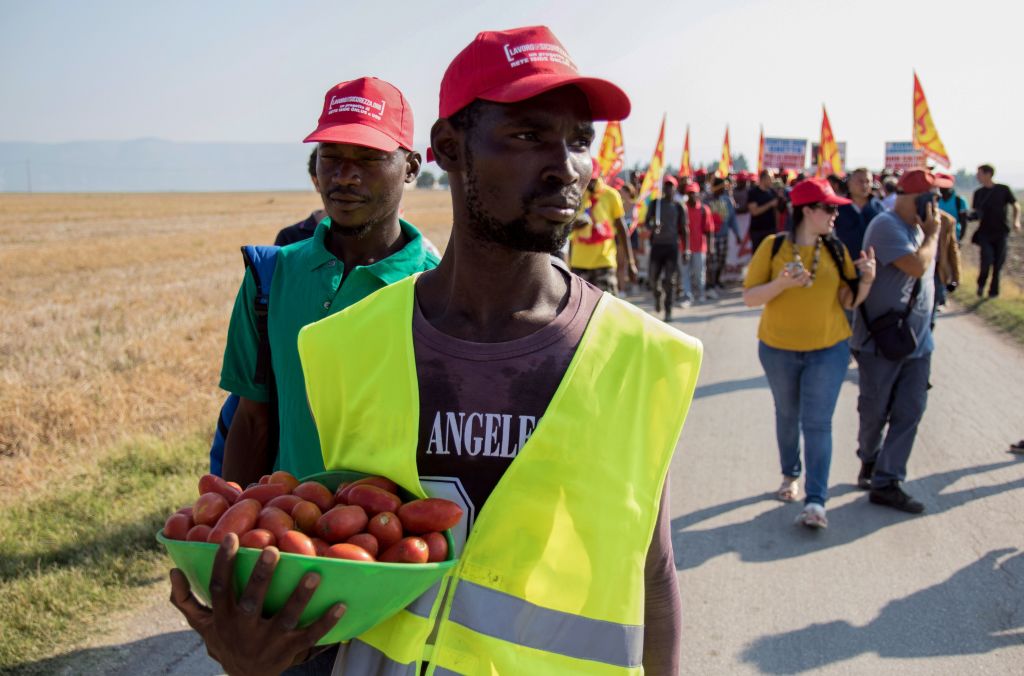
A migrant worker from Africa participating in a march near Foggia, Italy, calling attention to the plight of foreign seasonal tomato pickers during harvest season. (Roberto d'Agostino / AFP via Getty Images)

A curious development is playing out in Europe today. At the same time as anti-migrant rhetoric and a politics of European nativism is on the rise across the continent, government schemes for the recruitment of foreign workers, often through short-term visas, are being expanded in a number of European states.

There is a further apparent paradox: some of the governments at the forefront of this trend are led by far-right parties that promote narratives of migrant “invasion,” traffic in moral panics of racial replacement, and implement ever more restrictive and cruel border policies targeting asylum seekers and so-called “illegal” migrants.

In Italy, for instance, the far-right government of Giorgia Meloni has approved quotas for the recruitment of 500,000 non-EU workers between 2026 and 2028, of which 267,000 will be in the form of seasonal work visas for sectors such as agriculture and tourism. Greece, under the center-right New Democracy government, signed a labor mobility agreement with Egypt in 2023, with the aim of bringing in Egyptian workers for seasonal jobs in agriculture and, soon, also in construction and tourism.

Even Hungary, which under Prime Minister Viktor Orbán has enacted some of the harshest measures against migrants, has in recent years introduced a new legal framework for the temporary recruitment of foreign workers, with a quota set at 65,000 in 2024. These schemes are part of a broader trend. In 2023 alone, more than 2.4 million temporary work permits were issued across countries in the Organisation for Economic Co-operation and Development (OECD), up from 1.5 million a decade before.

The rise in guest worker schemes testifies to a growing political alignment on the management of migration between the far right and mainstream European politics. A recent article in the Economist, for instance, hailed temporary migration as a “pretty good alternative to the permanent sort” — a way to address labor shortages while sidestepping the fraught politics of integration.

Temporary migration schemes also appear to a growing number of European policymakers to provide an answer to long-term patterns of demographic decline. Last year, the then–European commissioner for home affairs, Ylva Johansson, commented that “for demographic reasons, the population of working age in the EU will decrease by one million per year. It is decreasing by one million per year . . . that means that legal migration should grow by more or less one million per year.”

Greek prime minister Kyriakos Mitsotakis put it more bluntly: “Who is going to pick our olives? We are a continent that is shrinking, and we all recognize that in order to maintain our productivity, we will need labor, unskilled or skilled.”

Precedents

While novel in appearance, the idea of putting in place schemes for the temporary recruitment of foreign workers is far from new. In the post–World War II era, guest worker programs such as the West German and Swiss Gastarbeiter systems facilitated the arrival of millions of migrant workers from Yugoslavia, Turkey, Italy, Spain, Portugal, Tunisia, and Morocco to work in the booming industries of Western Europe.

Migrant workers, whose numbers in West Germany alone reached a peak of 2.6 million in 1973, played a crucial part in supporting the European “economic miracle” of the 1950s and ’60s. The rationale for these programs was that foreign workers could serve as a flexible supply of labor, helping to fill the acute shortages in manufacturing, construction, and heavy industry as well as domestic and health care, while avoiding upward pressure on wages.

Labor migration, in this view, would serve as a Konjunkturpuffer — a “shock absorber” of business cycles through which a new supply of workers could be added to the economy in times of expansion and removed in periods of contraction. Underlying these schemes, crucially, was also an unspoken racial logic: foreign workers could serve as fungible labor units to be rotated in and out of the domestic market depending on economic needs, while being prevented from settling permanently and altering the country’s ethnic and cultural composition.

This dynamic is captured in a famous photograph from September 1964 of Portuguese national Armando Rodrigues de Sá, the millionth guest worker to arrive in West Germany. Rodrigues de Sá was received at Cologne–Deutz railway station with a welcoming ceremony and gifted a motorcycle and a bouquet of flowers, in celebration of the scheme’s success.

The photo is poignant in that it highlights the conflicting premises on which temporary worker schemes were built. While foreign workers were needed and celebrated as they met the labor shortages of postwar West Germany, they were only ever thought of as temporary “guests,” to be welcomed with gifts but not with the right to stay permanently.

It was this fantasy of preserving racial and cultural homogeneity that led the German government to proclaim, as late as 1982, “The Federal Republic of Germany is not a country of immigration.” A similar racial logic underpins the contemporary guest worker programs.

Racial Logic

The present situation differs in many respects from that of the postwar economic boom. Europe is currently in the midst of prolonged stagnation, with a toxic political discourse around migration that makes the welcome that Rodrigues de Sá received in 1964, ambiguous as it was, hard to imagine today. Yet some parallels can still be drawn — and lessons derived — from the historical experience of postwar labor migration in making sense of the tensions and challenges that the new guest worker regimes will face.

In its basic terms, the appeal of guest worker schemes for European political and business elites is the same today as it was in the postwar era. These programs promise to meet the demand for cheap labor in key economic sectors through the creation of a surplus population that can be flexibly employed or disposed of according to need, suppressing labor costs and weakening organized labor.

It is a system that sees the workers covered by these schemes not as individuals with families, communities, and rights, but rather as labor units to be cycled in and out of the economy when needed. A seasonal or rotational model of employment, with workers only allowed to stay in Europe for certain months of the year, or replaced by new workers after a certain period, is therefore of particular appeal.

In economic terms, it lowers costs by restricting workers from bringing dependants and thereby shifting the weight of social reproduction onto the countries of origin. In political terms, it promises a new version of the old fantasy of maintaining cultural and ethnic homogeneity by keeping foreign workers forever separate, transient, and provisional. As a 2023 article from the magazine Hungarian Conservative on the new temporary recruitment scheme in Hungary put it, the model envisaged is simply one in which, as its title states, “Guest Workers Come, Work, and Go Home.”

Ultimately, the wager by figures like Meloni and Orbán is that the temporary recruitment of foreign workers can be reconciled with anti-immigrant and nativist rhetoric and accompanied by further clampdowns on irregular migration and the weakening of the right to asylum. They also calculate that Europe will remain appealing enough as a destination to those outside its borders that they will be willing to accept these terms.  European liberal elites are taking a keen interest in these experiments.

Limitations

Will this wager prove successful? There are several reasons to doubt it. For one, it is by no means guaranteed that the combination of heightened anti-migrant rhetoric, more restrictive borders for irregular migrants, and greater recourse to foreign workers will meet the approval of right-wing voters. In Britain, one factor behind the collapse in support for the Conservative Party was discontent over what the British far right dubbed the “Boriswave” — an increase in migration from outside Europe to fill labor gaps in the wake of Brexit.

As this experience shows, the rhetorical distinction between “good/legal” and “bad/illegal” migration that underpins contemporary European migration politics is itself liable to break down in the face of xenophobic opposition to migration as such. The resort to a surplus population of exploitable, disposable workers also does not address any of the structural weaknesses of European capitalism, or offer a path away from its general tendency toward secular stagnation.

More importantly, a key insight from the twentieth-century guest worker programs is that the economistic view of foreign laborers as pure factors of production is bound to clash with the autonomy of migrant workers themselves, their struggles for rights, and their endeavors to make temporary lives into permanent ones.

The racial fantasy of West European state planners and employers in the postwar period was quickly shattered by the reality of migrants establishing lives, forming communities, and organizing around the demand for family reunification and permanent stay. They also campaigned for better access to housing and health care and the enjoyment of full social, civil, and political rights.

Eventually, even the reluctant governments of Switzerland and West Germany had to concede that Europe was changing and migrants were here to stay. Despite the ever more restrictive conditions, which are today attached to work visas, and the efforts to close off legal paths to family unification and permanent residency, there is every reason to believe that migrant workers will again organize, make demands, form communities, and unsettle the boundaries that are meant to contain them.

From a left perspective, responding to the new guest worker systems requires us to confront the racial calculus that underpins them and challenge the global relations of imperialism and uneven capitalist development upon which they are premised. Any progressive strategy must link workplace organizing, migrant justice campaigns, and struggles against border violence to fight for equal rights and challenge the legal frameworks that keep migrant workers in a state of precarity and disposability.