Building Trades Unions Rally Against Trump’s Attacks on Wind

Construction unions are making clear that offshore wind is a win for workers and the environment. Donald Trump’s repeated attempts to block it are just another front in his war on workers.
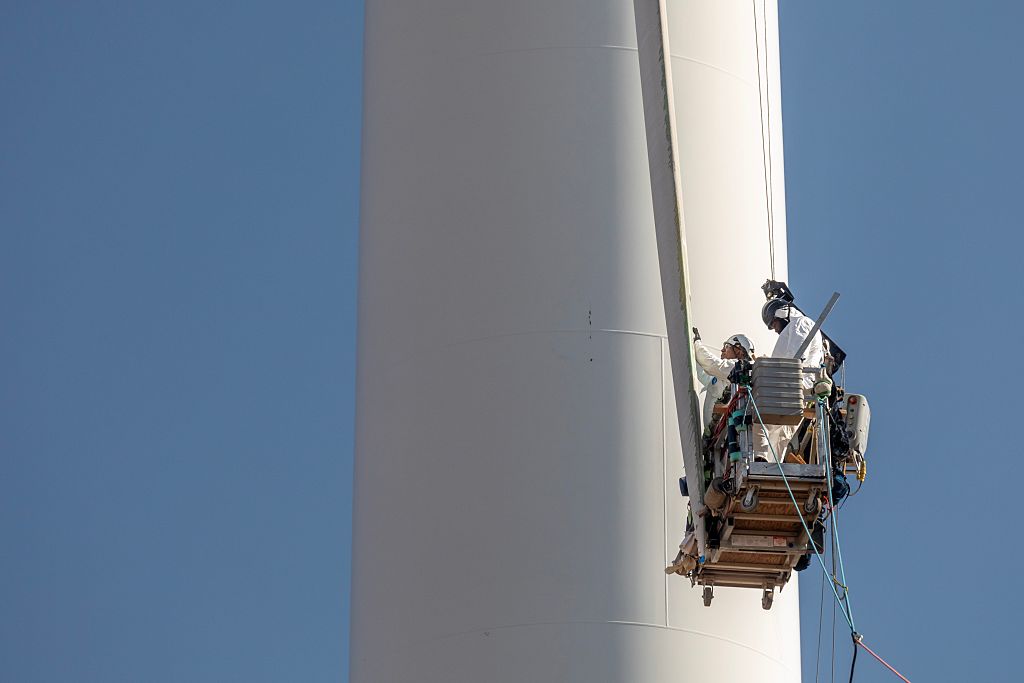
While the Trump administration has gone on the attack against offshore wind, building trades unions have been rallying behind the industry and have already experienced substantial job growth from it. (Jim West / UCG / Universal Images Group via Getty Images)

Donald Trump’s obsessive hatred of wind energy has reared its ugly head again. On Monday, December 22, Interior Secretary Doug Burgum announced that all construction on offshore wind projects would be halted due to “national security concerns.” This will affect five offshore wind projects on the East Coast, some of which are already mostly completed. In an X post, Burgum called these projects “expensive, unreliable, heavily subsidized offshore wind farms.”

The move rests on supposed classified claims from the Department of War that these projects interfere with radar systems, but no solid evidence has been presented publicly. Just three days before this announcement, the Army Corps of Engineers had approved continued construction on Vineyard Wind, one of the projects that will now be paused. A few months ago, the Trump administration’s attempt to derail the Revolution Wind project in the name of national security was defeated in the courts. A coalition of anti-offshore-wind groups has been coordinating this offensive and supplying the administration with a slew of draft executive orders to use.

While Trump has gone on the attack, building trades unions have been rallying behind offshore wind development and have already experienced substantial job growth from it. This latest salvo has added to growing tensions between the administration and construction unions.

A statement from North America’s Building Trades Unions (NABTU) said this move “kills thousands of good-paying jobs on projects that were legally permitted, fully vetted, fully funded, and already underway. These aren’t hypothetical jobs. They are real paychecks and billions in investment.”

The International Brotherhood of Electrical Workers (IBEW) also spoke out and called the order “a direct attack on American workers. . . . Offshore wind projects represent thousands of good, union jobs for IBEW members who have spent years training to build and maintain this infrastructure.”

The Laborers’ International Union of North America (LIUNA) highlighted the disruptive nature of these stop-work orders, saying, “LIUNA members plan their life around this work. Pulling the plug now — during the holidays and after years of negotiations and extensive reviews — is reckless and unfair to the men and women who build this country.” They demanded that the administration “let us work — and stop playing politics with our jobs.”

The Potential of Offshore Wind

All five of the paused projects are on the East Coast, an ideal location for offshore wind development. The North Atlantic Coast in particular has the best conditions for the industry in the entire country. The National Renewable Energy Laboratory estimates that there is capacity to build 264 gigawatts (GW) of offshore wind that could produce up to 27 percent of the United States’ annual electricity consumption by 2030.

This is why the building trades in New England have been especially proactive and supportive of the industry. Back in October 2023, these unions pushed a unique multistate procurement agreement for offshore wind that was signed by Rhode Island, Connecticut, and Massachusetts. This procurement was meant to help coordinate its development across the region and reduce costs in implementation. Unions worked with the Climate Jobs National Resource Center to craft a vision for building out the entire domestic supply chain including components, specialized ships, and transmission networks.

In October, Rhode Island AFL-CIO president Patrick Crowley announced that building trades unions in Rhode Island and Massachusetts signed a labor peace agreement with SouthCoast Wind to ensure union work on a massive 2.4 GW offshore wind project they have planned.

States throughout southern New England have already begun making substantial investments in port infrastructure directly tied to offshore wind development. New Bedford Marine Commerce Terminal, the first offshore wind port in the country, and the heavy-lift deepwater port New London State Pier are signs that offshore wind is becoming a key driver of industrial development. Rhode Island’s Block Island Wind Farm has increased the demand for skilled workers at the Port of Providence and Quonset. This represents some of the few real examples of successful reindustrialization in the last decade.

More recently, building trades unions on the East Coast participated in a national “Yes to Wind” week of action. In Baltimore, IBEW Local 24 hosted a press conference at their union hall. The local’s political director, Rico Albacarys, says, “Offshore wind is a big deal for us locally.” Earlier this year, the local had the largest class for its training facility on record, and they see offshore wind as a prime growth sector for the future. Energy developer US Wind had plans to build a huge offshore wind hub off Maryland’s Eastern Shore that could power about 700,000 homes.

United Steelworkers union (USW) members would also get work retrofitting the Bethlehem Steel plant, once the largest steel production facility in the world. Jim Strong, a USW “offshore wind sector assistant,” spoke of the symbolic meaning of having workers back at the plant: “We had history and now we have a future with the return of steel workers here. So, this is a big deal for our union.”

But in August, the Trump administration pulled the $47 million federal grant for the US Wind project and is trying to revoke the federal permits. Now it lies in limbo as the dispute works its way through the courts.

In Maine, Iron Workers Local 7 member Chad Ward stressed the potential for local job creation:

A job in the offshore wind industry in Maine would mean I could see my kids grow up, and my kids could have the option of going into an industry that keeps them employed in Maine while also helping to do something good for the environment.

Trump’s attacks on offshore wind and other unionized clean energy projects have opened up political cleavages that building trades unions could creatively leverage beyond statements of opposition and press conferences. The administration would likely have a difficult time dealing with rowdy demonstrations from sympathetic construction workers and media appearances that give them an opportunity to present a compelling case for why these projects must stay. This is a time to emphasize the contradiction between the president’s pro-blue-collar rhetoric and his policies.

We should listen to the building trades: offshore wind is both a critical energy source and job creator for the future. Trump’s repeated attempts to block it are just another front in his war on workers.