Canada’s “Diversification” Trade Deal Is a Gift to Autocrats

Canadian prime minister Mark Carney is touting a trade deal with the UAE. Behind the talk of investment and partnership lies a trade agenda that weakens rights protections, boosts natural gas, and reinforces one of the world’s most repressive states.
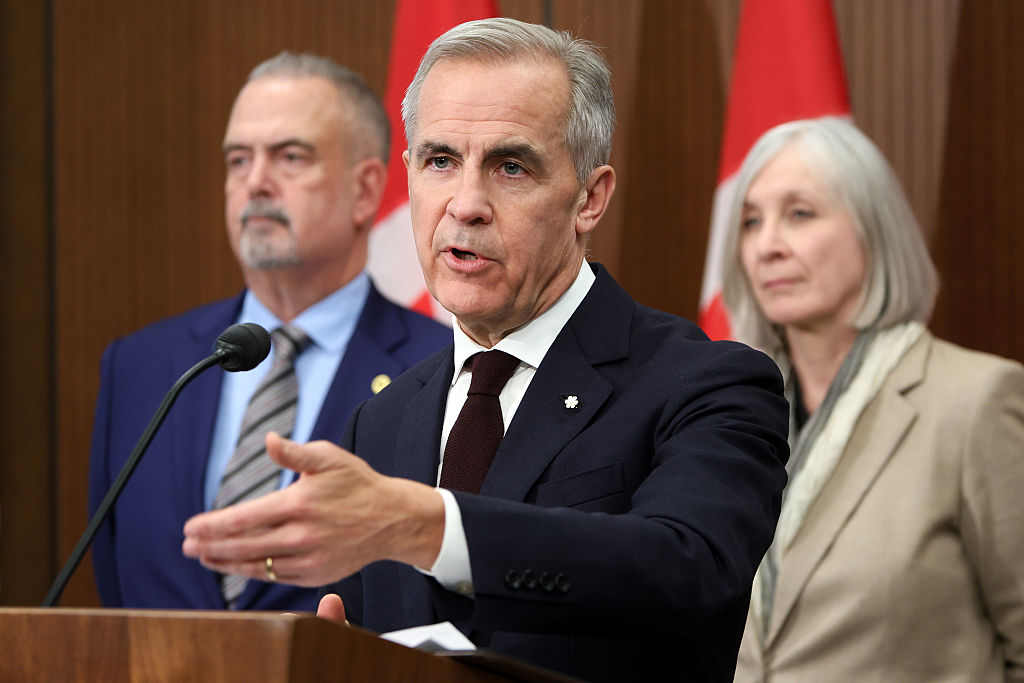
Mark Carney’s Liberal government is selling its new partnership with the UAE as prudent statecraft. But the trade push will lock Ottawa into fossil fuel expansion, lax rights protections in its trade agreements, and closer ties to a petrostate autocracy. (David Kawai / Bloomberg via Getty Images)

The announcement of a Foreign Investment Protection Agreement (FIPA) and huge investments between Canada and the United Arab Emirates (UAE) is being hailed as a milestone. Prime Minister Mark Carney is using this development to show that his government is serious about diversifying Canada’s trade relationships. Negotiations for a free-trade agreement (FTA) between Canada and the UAE are expected to follow.

Scratch below the surface, and the hype falls apart. Carney declared that the deal’s importance was based on building new relationships for Canada in a “more divided and dangerous world.” But indulging Abu Dhabi with trade deals and investment opportunities is not going to make for a safer and more united world. Even if Canada is forced to diversify its trade relationships away from the United States, these early signs from Carney are hardly a sign of a progressive alternative.

The UAE is facing increasing scrutiny for its increasingly imperial foreign policy. It participated in the Saudi-led military intervention in Yemen and backs a separatist movement in the former South Yemen.

More controversial is its alleged support for the Rapid Support Forces (RSF) that are battling the Sudanese military. The RSF’s campaign for control of Sudan has reached genocidal proportions, with nearly 30,000 killed in the city of El Fasher in only a few days, according to Minni Minnawi, the governor of Darfur region, where El Fasher is located.

Conflict Gold, Gas, and Labor Abuses

The UAE has become the fourth-largest investor in Africa after the United States, China, and the European Union. While the government touts its investments in African green energy and tourism projects, the UAE’s involvement in conflict gold is drawing increased attention. Unprocessed gold illicitly taken from Sudan and the Democratic Republic of Congo is routed through non-gold-producing countries like Libya and Uganda before winding up in the UAE. This has allowed Dubai to become one of the world’s three largest gold processing and trading hubs, alongside London and Zurich.

These developments have allowed the UAE to become one of the most powerful subimperial states of our time. And like its other autocratic neighbors in the Gulf, the UAE is known for its poor treatment of many migrant workers who make up 88 percent of its population. Its use of the kafala system opens the doors to widespread abuses, including restrictions on movement, debt bondage, and forced labor.

For Canada to announce that it is seeking closer ties to the UAE at this moment looks ignorant at best and callous at worst. There are also serious questions as to what benefits this will bring Canada. While the UAE does invest in green energy projects around the world, the Canadian government is signaling that liquefied natural gas (LNG) is to be part of this new relationship. Ottawa is signaling that LNG will feature in this new relationship, a strange move if Canada is serious about its decarbonization commitments.

The idea of natural gas as a “bridging fuel” between dirtier fossil fuels like coal and renewables is largely a mirage. Recent research on China — the world’s biggest coal consumer and LNG importer — finds that rising LNG imports have not reduced or slowed the country’s coal usage and still plays only a marginal role in its power mix. Instead, it is wind and solar that are squeezing coal out, and these renewables are now cheaper than gas-fired power.

Canada and the UAE both have large natural gas sectors, and both are expanding LNG capacity. The PM’s announcement simply notes that “opportunities in LNG” will be put before UAE investors — which most likely means Canadian LNG projects seeking foreign capital. But regardless of which country stands to profit, expanding LNG risks locking Canada into new fossil fuel infrastructure at exactly the moment when a transition to renewables is most viable.

Artificial intelligence is another sector in which Canada hopes to gain UAE investment. The UAE is becoming a major player in AI, but much of its development there is based on using AI for surveillance purposes. Not only could Canadian companies help the UAE develop AI surveillance technologies to spy on Emirati citizens and migrant workers, but such technologies, when developed, could also be used against Canadians.

Investor Rights, Not Human Rights

While Justin Trudeau’s promise of “inclusive trade,” like many of his progressive promises, was more style than substance, the Carney government does not bother to put on socially conscious facade. Carney apparently has dropped the previous Liberal government’s plans to introduce a “feminist foreign policy,” which would presumably have made signing trade deals with the UAE problematic, given that country’s record of gender-based discrimination and prolific use of forced labor. The recently announced Canada-Indonesia FTA, which backtracked on trade-based human rights, labor rights, and environmental protections, would also have been difficult under a truly feminist foreign policy. Then there is the Canada-Ecuador FTA, which has drawn significant criticism for trampling on the rights of indigenous communities in the South American country.

Any trade agreement with the UAE will also sit within a long-standing Canadian pattern: Ottawa’s near-automatic insistence on including Investor-State Dispute Settlements (ISDS). ISDS allows foreign investors to sue governments over potential economic losses. These cases are most often used to challenge environmental laws. Except for the United States–Mexico–Canada Agreement (USMCA), where the first Trump administration sought to remove ISDS, Canada has been happy to sign FTAs and FIPAs with ISDS provisions. And notoriously, Canadian companies — especially in fossil fuels and mining — launch a large number of ISDS cases against foreign governments.

Immediately after his visit to the UAE, Carney headed to Johannesburg for the G20. The statement coming out of the meeting, the first G20 on African soil, emphasized peace, fighting climate change, and helping countries in the Global South to develop and escape from debt. Canada’s growing relationship with the UAE does nothing to advance those worthy goals or build a truly fair global trade system — and could become a liability for the country in the future.