When the Market Came for the Dying

In the early years of the AIDS crisis, the US government left people with HIV to fend for themselves. Desperate, they turned to a new and little-understood financial instrument: selling their life insurance policies to investors for quick cash.
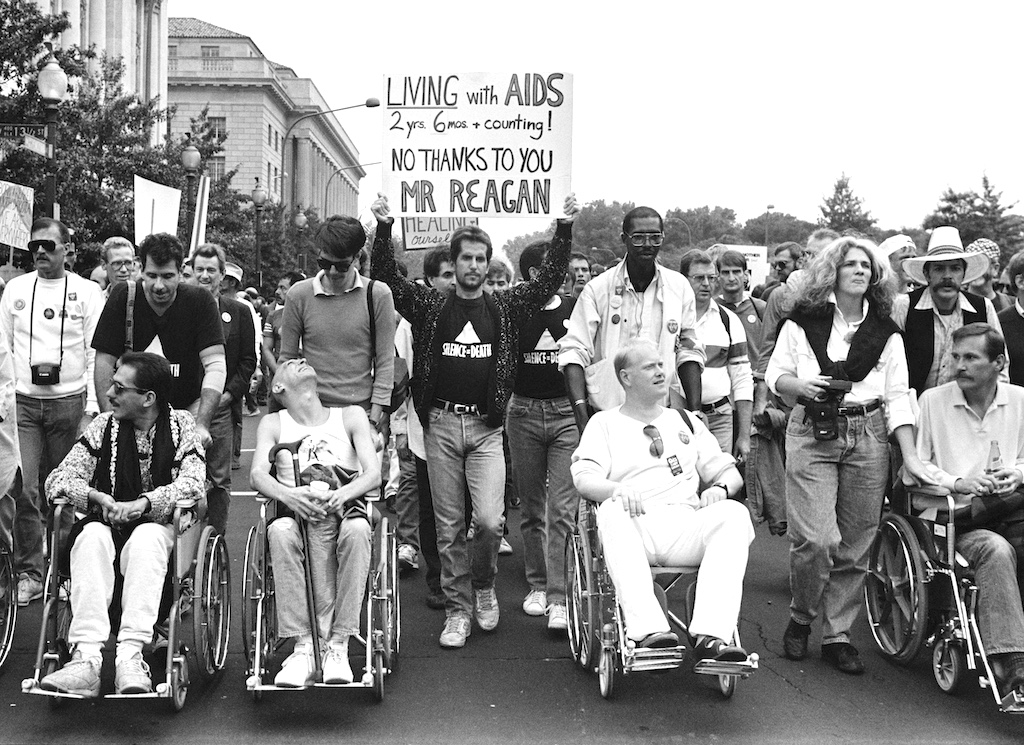
The political lesson that AIDS activists fought to teach us was simple: the market cannot and will not keep people alive, housed, and cared for. (Jean-Louis Atlan / Contributor / Getty Images)

December 1 is World AIDS Day. Every year, people around the world remember the epidemic as a medical and moral tragedy, a time of heroic patients and long-awaited medical breakthroughs. But the economic story — the one about abandonment, profit, and the marketization of survival — is largely absent. That missing story matters, especially because its logic is resurfacing now.

In the early years of the AIDS crisis, when thousands of people were losing their jobs, housing, and health insurance, the American government didn’t step in to support them. Instead, a new, little-understood financial instrument emerged: people with AIDS began selling their life-insurance policies to investors for quick cash, often just to afford rent, medication, or a measure of comfort in their final months. An investor would pay a patient a portion of their life-insurance “death benefit” — maybe 80 percent, maybe 30, depending on how soon the patient was expected to die. After the patient’s death, the investor would collect the full insurance payout.

These transactions, called viatical settlements, were often portrayed as a macabre curiosity of the epidemic — a clash between “bankrupt” sellers and “morally bankrupt” buyers. Gawking anchors on corporate news shows found a new favorite word: ghoulish. But the viatical market wasn’t an aberration. It was a predictable outcome of austerity and abandonment, a textbook example of what happens when the social safety net is deliberately dismantled and private capital rushes in.

I recently directed a documentary about this industry, Cashing Out, which also explores my own unexpected connection to it: my father was one of the early investors who bought life-insurance policies from people with AIDS. He profited when they died; unbeknownst to me, those profits helped fund my adolescent years — when, incidentally, I was figuring out I was gay.

People tend to fixate on the personal drama of this story, but that reaction obscures what viaticals actually reveal: investors didn’t behave cruelly; the state did. It created conditions in which people with AIDS had to make bets on their own deaths in order to survive, and in which ordinary people could be easily recruited into profiting from that precarity.

What made viatical settlements possible was the deliberate retreat of public infrastructure under Ronald Reagan and, later, Bill Clinton: the hollowing out of Medicaid eligibility, public housing, community health budgets, and pathways to disability benefits; the privatization of health care; and the cultural decision to relegate queer people and drug users to destitution and death. The epidemic created new needs at precisely the moment the state was withdrawing from meeting them. Markets could only fill the void because the state had left it wide open.

While I was interviewing survivors for my film, I met DeeDee Chamblee, a black trans activist in Atlanta who, while surviving as a sex worker, didn’t have a life-insurance policy to sell. She told me she didn’t view viaticals as vulture capitalism so much as the logical endpoint of the system that had defined her life: one that abandons people and then shames them for surviving however they can. What struck DeeDee about my father’s involvement, she said, was less its grotesquerie than its banality — a reminder that inequality reproduces itself not through exceptional villains but through routine transactions that feel apolitical or even benevolent. DeeDee illuminated what capitalism had worked to keep hidden from me as a white gay man from a well-off family: the American project has privatized survival and naturalized extraction.

Over the last two decades, the political lessons of the epidemic have been softened and repackaged. Pharmaceutical companies sponsor World AIDS Day commemorations. Corporations wrap themselves in red ribbons. A once-militant care network and expansive political movement — born of mutual aid, tenant organizing, abolitionism, and anti-racist struggle — has been professionalized into a philanthropic–nonprofit industrial complex. ACT UP’s core insight — that AIDS was a political crisis created by austerity, racism, and homophobia — has been replaced by narratives of individual resilience, medical heroism, or depoliticized “awareness.”

The problem is that this sanitized remembrance makes it harder to recognize echoes of AIDS history when we hear them in the present. HIV/AIDS programs now face deep cuts under a second Trump administration. Affordable Care Act (ACA) tax credits are set to expire, threatening the only affordable coverage millions have. The unwinding of Medicaid has thrown millions off the rolls. People with long COVID are being denied disability benefits at staggering rates. Medical-debt start-ups, private equity–backed emergency rooms, and for-profit hospice chains repeat the viatical logic in updated form: when the state abandons people, the market monetizes the fallout.

As public infrastructure is gutted once again, new markets will continue to form around the needs the state refuses to meet. Our most pressing question isn’t whether individuals will behave well within those markets. It’s why we’ve allowed our politics to make markets the arbiters of who gets to live with dignity — and who gets to live at all.

This World AIDS Day, we must resist a sentimental remembering of the epidemic. As we sink into another period of austerity, another effort to dismantle the minimal protections won through decades of struggle, we must remember accurately. The political lesson that AIDS activists fought to teach us was simple: the market cannot and will not keep people alive, housed, and cared for. That is a collective responsibility — and a political choice. To honor the millions lost in the epidemic’s early days, we must confront the conditions that made the logic of viaticals possible, then and now.