At a Time of Emergency, ACT UP Refused to Be Bystanders
Sarah Schulman’s Let the Record Show tells the story of one of the most compelling and successful social movements of the past century, ACT UP. We talked to Schulman about the "New York Crimes," the messy joy of political commitment, and how ACT UP changed history.
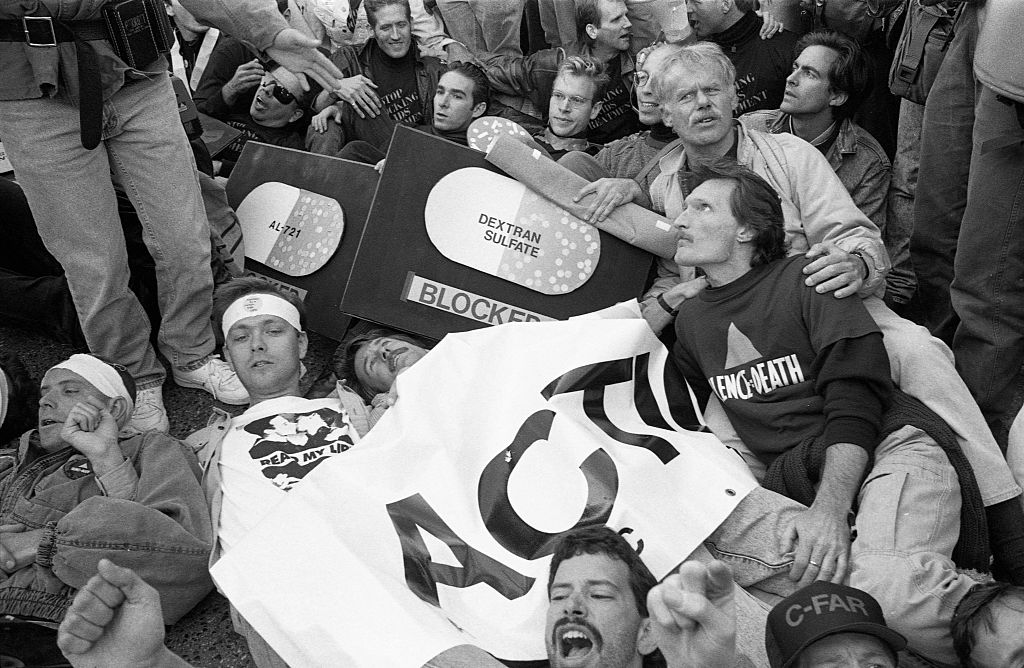
An ACT UP protest at the headquarters of the Food and Drug Administration (FDA) on October 11, 1988 in Rockville, Maryland. (Catherine McGann / Getty Images)
On July 3, 1981, the New York Times ran an article headlined “Rare Cancer Seen in 41 Homosexuals.” For many people, this was the first they’d heard of what we now know as acquired immunodeficiency syndrome (AIDS). With startling rapidity, the illness would decimate entire communities, the gay community foremost among them. To wit: my dad lived in the New York area at the time. He read that article out loud to his two roommates, both of whom were gay. It was the first that either had heard of the illness. Within months, both had passed away from it.
In 1987, New Yorkers formed the AIDS Coalition to Unleash Power, better known by its acronym, ACT UP. After years of triage and loss caused by a plague that the government, helmed by Ronald Reagan, was utterly uninterested in combating, ACT UP members resolved to fight back, forcing changes that no one had been willing to offer them. Recall that, at the time, “gay-bashing” was a frequent occurrence, and the state — police in particular — was part of the problem. Sodomy laws were still on the books, and there were no protections against being fired or denied housing because of one’s sexual orientation.
Enter ACT UP. The group’s unifying principle? Direct action to end the AIDS crisis.