Western NGOs: Saving Lives, or Just Regulating Death?
For decades, the Western aid industry became ever more powerful in Sudan, even as it grew quieter about the reasons for underdevelopment. Rather than combat the root causes of poverty, NGOs served only to alleviate the number of deaths.
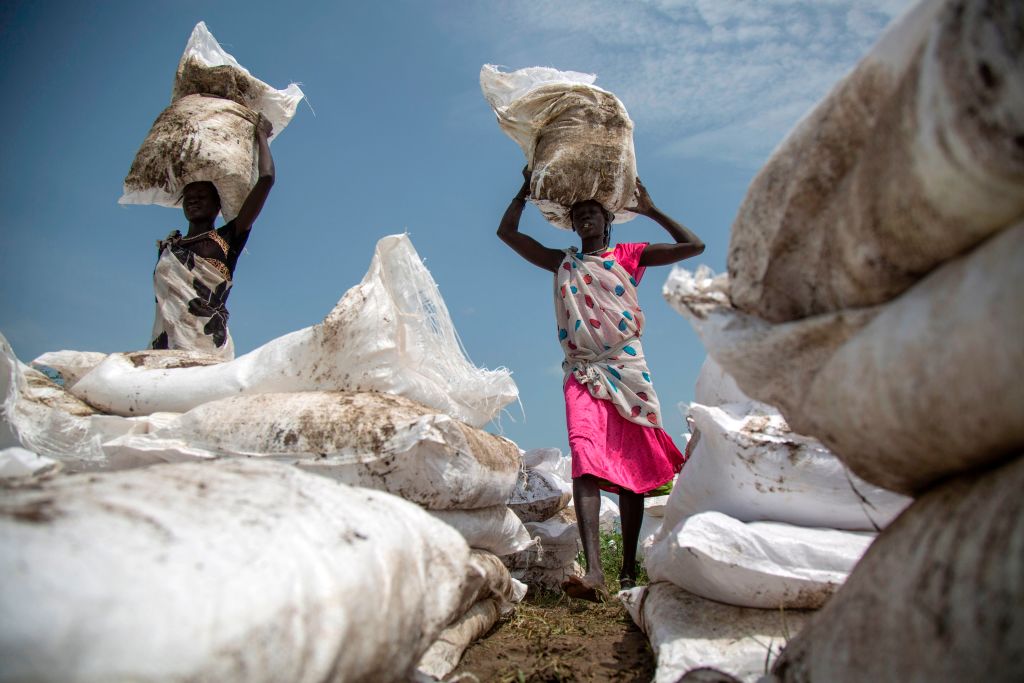
Women carry sacks of food, airdropped by the World Food Programme and distributed by the NGO Oxfam in Padding, near Lankien, Jonglei, South Sudan, on July 3, 2017. (Albert Gonzalez Farran / AFP via Getty Images)
During the second half of the 1980s, Oxfam ran an extensive food aid program among Beja nomads in Sudan’s arid Red Sea Hills. The Beja had lost around half of their cattle and sheep during the severe drought of 1984. Based on extensive household and nutritional surveillance, Oxfam operated what was claimed to be a humanitarian “food for recovery” program. Using targeted food assistance, it promised, future stress sales of livestock could be prevented, thus helping the Beja to recover their herds.
Sometime in 1987, as Oxfam’s country representative for Sudan, I was in the wrap-up session of a periodic visit to its Port Sudan office. The humid sea air did nothing to reduce the oppressive afternoon heat. Having gone through day-to-day organizational issues with the team, the closing conversation took an unscripted turn.
Doubtless informed by growing knowledge of conditions in the Red Sea Hills and the regional government’s attitude, the question of what Oxfam was “actually doing” speculatively bubbled to the surface. While the “food for recovery” idea made a strong public case for donor support, there was a suspicion that there was more to it than that.