Poland, a Case Study in Class Dealignment
On Sunday, Poland votes in the first round of presidential elections. The contest is dominated by various right-wingers, while small progressive forces speak mainly to the highly educated, professionals, and the downwardly mobile middle classes.
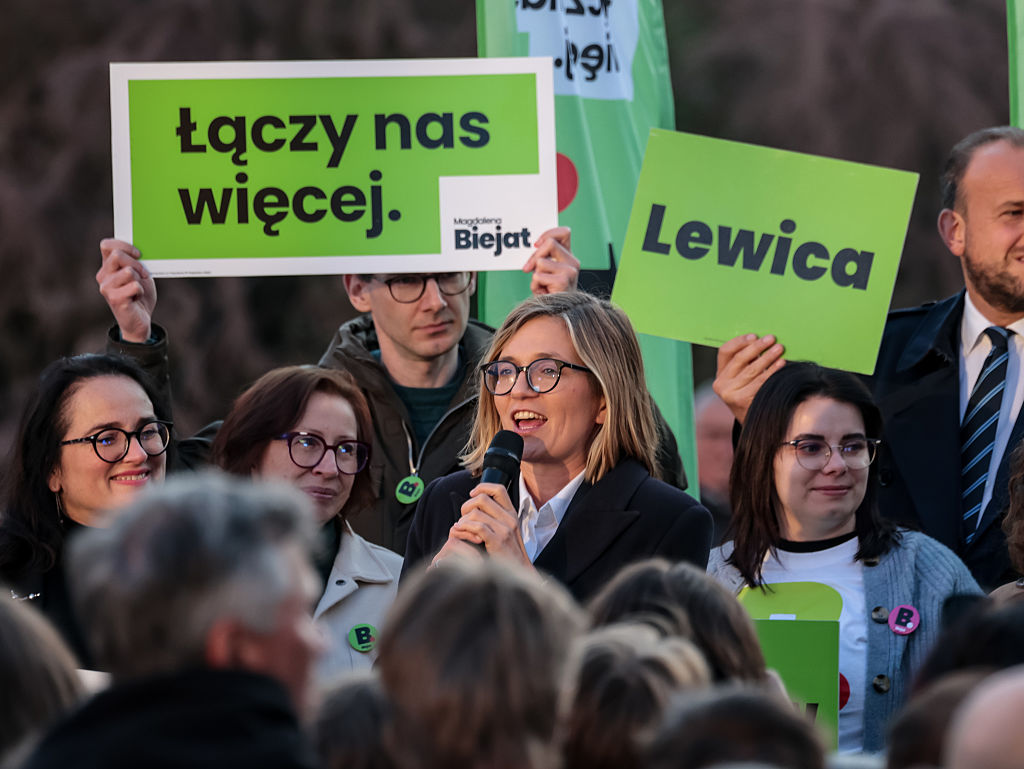
Magdalena Biejat, a deputy speaker in the Polish Senate and a candidate for president from the Lewica party, speaks to the public during an election rally in Krakow on May 13, 2025. (Dominika Zarzycka / SOPA Images / LightRocket via Getty Images)
On Sunday, Poland holds its presidential election, largely offering a choice between candidates from the broad right wing of the political spectrum. In the government camp is Rafał Trzaskowski, representing prime minister Donald Tusk’s neoliberal Civic Platform. Then there is Karol Nawrocki, backed by Jarosław Kaczyński’s far-right Law and Justice (PiS), which ruled the country from 2015 to 2023. Even more radical is Sławomir Mentzen of the authoritarian Confederation.
While there are also left-wing candidates — polling in single digits and not expected to reach the second round — the race has already become a dispute within the Polish right. Certainly, the president’s formal powers are limited in Poland’s parliamentary system, and yet their veto powers and symbolic role remain significant. For the ruling coalition, led by former European Council president Tusk, controlling the presidency is essential to ensure smooth legislative work.
The Left, then, will likely have little impact on the outcome. Yet even for its forces, the vote is truly existential.