Why Donald Trump Has Turned on Europe
For decades, European leaders fostered a willing dependence on the United States that has made the continent acutely vulnerable to the superpower’s whims. Donald Trump has sensed this weakness and is using it to advance his own narrow interests.
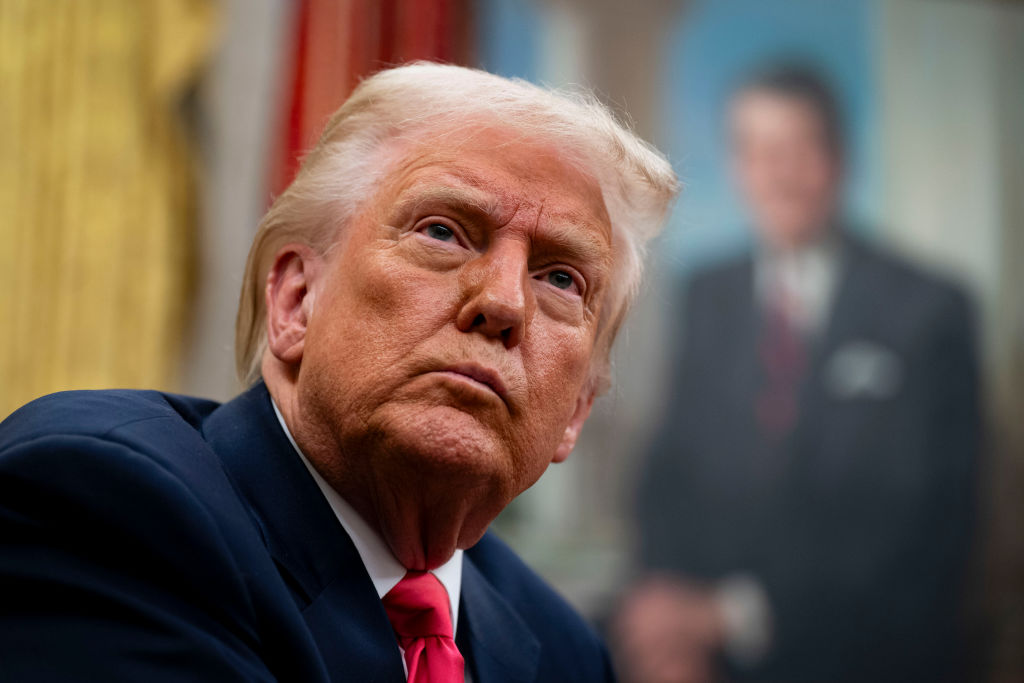
President Donald Trump in the Oval Office of the White House in Washington, DC, on March 6, 2025. (Al Drago / Bloomberg via Getty Images)
Less than a fortnight after Secretary of Defense Pete Hegseth and Vice President J. D. Vance read Europe the riot act at the Munich Security Conference in mid-February, Donald Trump followed up with a performance that would not have been out of place on an episode of The Apprentice. In front of cameras, America’s president berated his counterpart Volodymyr Zelensky — who has held a deeply fractured nation together through three years of war against a more powerful adversary — for ungratefulness, reaffirming the might-is-right worldview that has been consistent throughout his presidencies.
These two episodes, which have perhaps done more than any others in recent years to disgrace the idea of statesmanship, did succeed in bringing to the fore one point: Europe’s geostrategic position is dangerously precarious. For decades, the continent’s leaders have fostered a relation of willing dependence on the United States, which has in exchange exercised an only limited influence over Europe’s domestic and international politics. This led many to assume, wrongly, that geopolitics could not, in a post-historical world, get in the way of trade. But over the past decade, Europe’s economic ties to China, which is both a market for and a source of advanced manufactured goods, and Russia, whose cheap energy aided the competitiveness of German heavy industry, have butted against America’s commitment to hegemony.
The continent, despite the desires of leaders like Emmanuel Macron, has not become an independent “third pole” on the global stage. Instead, it is now, in its Franco-German core, increasingly reliant on America for the underwriting of its energy and defense capabilities. On the Western periphery, the UK and Ireland have been pursuing a fire sale of their assets to US private equity while also becoming heavily dependent on California’s FAANG companies (Facebook, Amazon, Apple, Netflix, and Google) for foreign direct investment (FDI). Just last year, Amazon committed to investing $10 billion over the next five years in British data centers, and Google pledged $1 billion for the same purpose.