A Museum Worthy of Spain’s Democratic Transition
In the late 1970s, nationalist vigilantes tried to destroy Pablo Picasso’s Guernica. Today the painting itself is safe — but the museum in which it is housed has again become the focus of right-wing polemics.
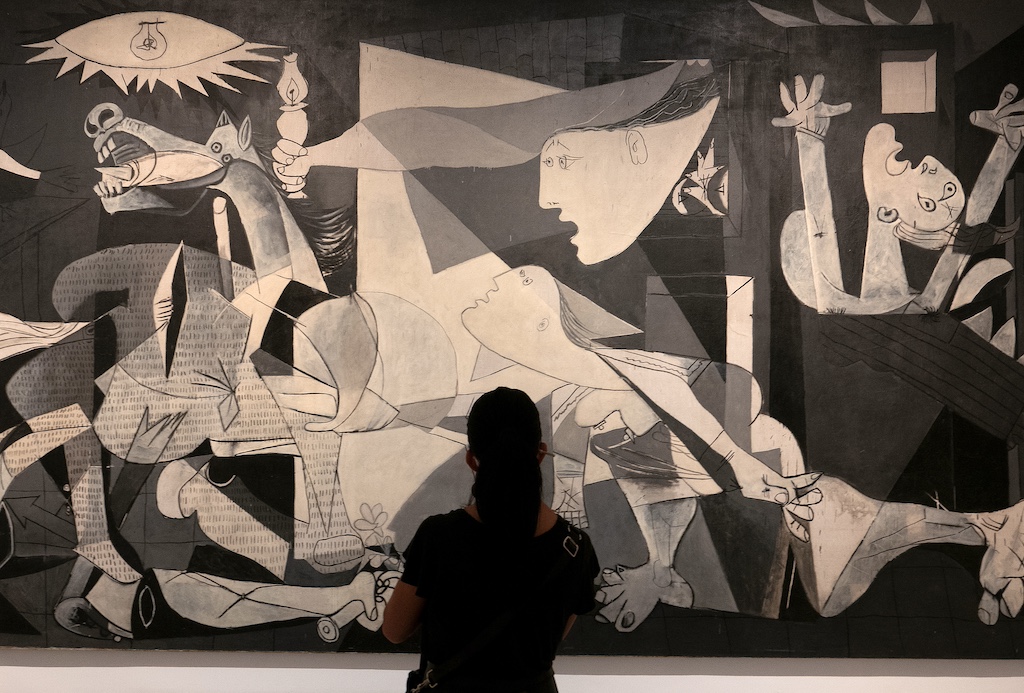
A woman views Pablo Picasso’s Guernica painting at the Reina Sofia museum on September 10, 2021, in Madrid, Spain. (Denis Doyle / Getty Images)
Twentieth-century Spain could boast of world-leading artists from Salvador Dalí to Joan Miró and Pablo Picasso. Yet paradoxically, the country often lagged behind its neighbors with regard to the exhibition and appreciation of modern art. The most obvious culprit for this is Francisco Franco’s long dictatorship from 1939 to 1975, though some responsibility also lies with the politicization of cultural appointments well into the democratic period.
Nowhere is this more evident than at Madrid’s Reina Sofia Museum, an institution established as a symbol of democratic normalization as Spain gained entry to the European Economic Community in 1986 and, crucially, as a permanent home for Guernica following its return from MoMA in New York. If Picasso’s masterpiece was painted as a propagandistic indictment of fascist violence during the Spanish Civil War, its voyage home was a message from Spaniards — to themselves, and to the outside world — that consensus marked the way forward. The permanent collection of the Reina Sofia Center, which was baptized as a museum in 1992 — the year that Madrid was the European City of Culture — runs from 1881 (when Picasso was born) up to the present day.
The idea of consensus during Spain’s Transition to parliamentary democracy was long mythologized in a way that often underplayed the violence and conflict that marked this historical moment. In fact, museum spaces with works by Picasso were targeted in the late 1970s by right-wing vigilante groups, while Guernica appeared behind protective glass and guarded by armed policemen when first put on display in Madrid in 1981. That said, the last decade has undoubtedly seen a break with the so-called consensus politics of the Transition, with a polarization of politics and society hitherto unknown since the death of Franco.