Guernica Was a Dress Rehearsal for the Nazi War That Followed
The bombing of Guernica on this day in 1937 wasn’t just part of the Spanish Civil War but a show of Nazi Germany’s military might. When antifascist journalist George Steer uncovered Germany’s responsibility, it prepared the world for the terror that followed.
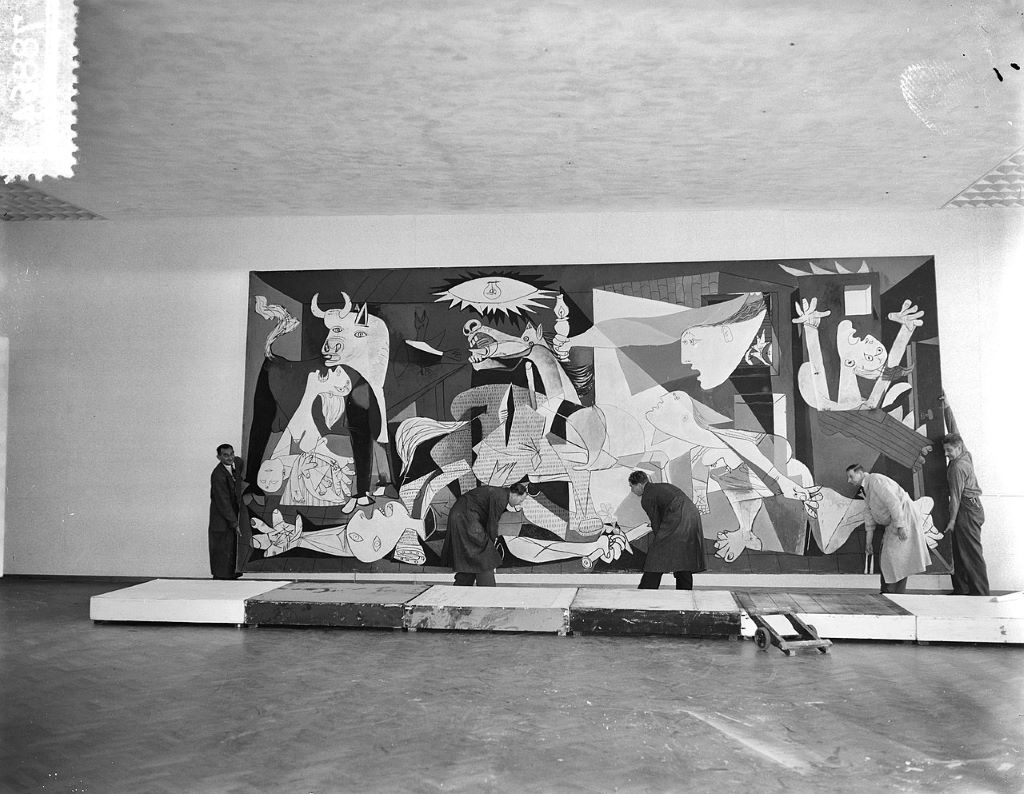
Guernica by Pablo Picasso being placed at the Stedelijk Museum in Amsterdam, July 11, 1956. (Herbert Behrens / Anefo)
Twenty-seven-year-old George Lowther Steer was in Toledo, Spain, covering the civil war for London’s Times in fall 1936 when he was abruptly expelled from the city. The Nationalist military staff had discovered Steer’s recently published Caesar in Abyssinia, a book attacking its Italian fascist supporters. Steer explained how, among other sadistic measures, Benito Mussolini’s forces had used poison gas against Ethiopians, at most armed with antique weapons from past resistance against Italian invasion in 1896.
Following his stint in Ethiopia, at the time known as Abyssinia, Steer had a sojourn in London, signing on as a freelancer with the Times to complete his book. He remained in that position in Spain, where he headed after the war broke out in July 1936. Before he even reached Toledo, General Francisco Franco completed a savage, bloodstained attack. It was so devastating that his fellow generals named Franco the caudillo, unquestioned head of the rebel armed forces and their state.
Expelled from the city, Steer took a British Royal Navy destroyer to the Basque port city of Bilbao in January 1937. A few months later, on April 28, he published a bombshell story that horrified Europeans and Americans alike. Steer and a small group of foreign journalists had rushed to nearby Guernica after hearing that the historic town had been decimated on the afternoon of April 26 — a market day.