The Relationship Between Art and Politics Is Shifting
Issues of inequality, class, and exploitation have come to the forefront within the art world in recent years. Marxist art critic Ben Davis believes that the politics of culture are changing as a result.
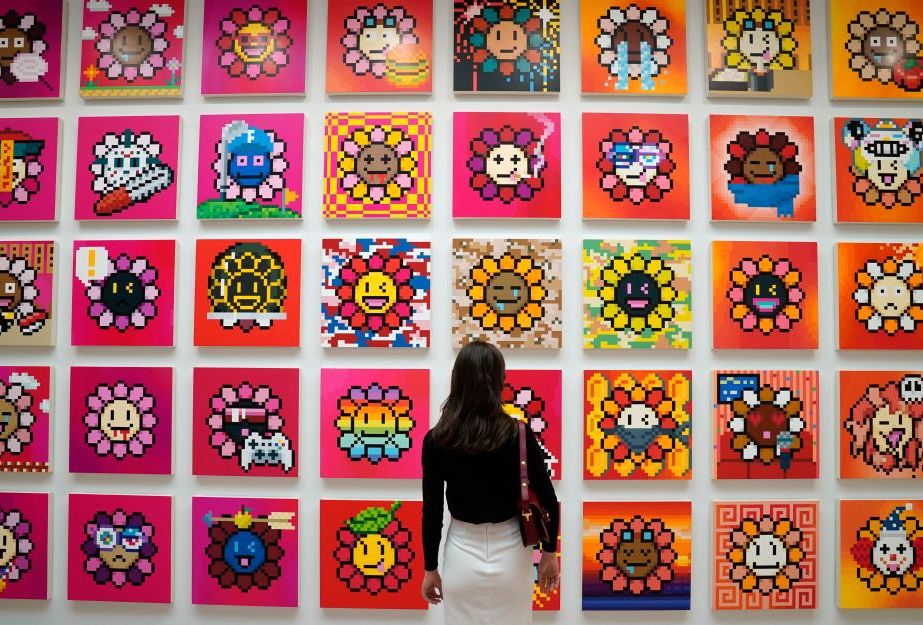
Gallery goer looks at Takashi Murakami’s NFT project called Murakami Flowers at Gagosian gallery in New York, May 2022. (Timothy A. Clary / AFP via Getty Images)
Visual art produced during the neoliberal period has become increasingly alien to working-class and middle-class people, while its role as an investment opportunity and social club for the elite has ballooned. At the same time, a current of critical and explicitly political art has emerged and grown within and alongside the commercial art market. In the past decade, this politically charged current has become a central tendency of contemporary art, raising new questions regarding how to think about the relationship between art and politics.
In 2010, Marxist art critic Ben Davis wrote a pamphlet entitled “9.5 Theses on Art and Class” as part of an exhibition called #Class, organized in response to the vapid and money-saturated state of the art world. His book of the same title, expanding on the pamphlet’s ideas, was published a few years later, provoking a renewed discussion around the role of class in the world of contemporary art.
Since then, Davis has continued to develop his ideas about art and its political significance, writing in publications like the New York Times, New York magazine, the Baffler, Jacobin, Slate, Salvage, e-flux journal, and Frieze. Davis has been the national art critic for Artnet News since 2016. In 2019, Nieman Journalism Lab reported that he was one of the five most influential art critics in the United States.