Liberal Delusions Won’t Save Ukraine
For some liberals, Donald Trump’s decision to humiliate Volodymyr Zelensky showed that he’s a Russian stooge. But Trump’s crudeness is just a more striking illustration that Ukraine’s future is subject to US realpolitik.
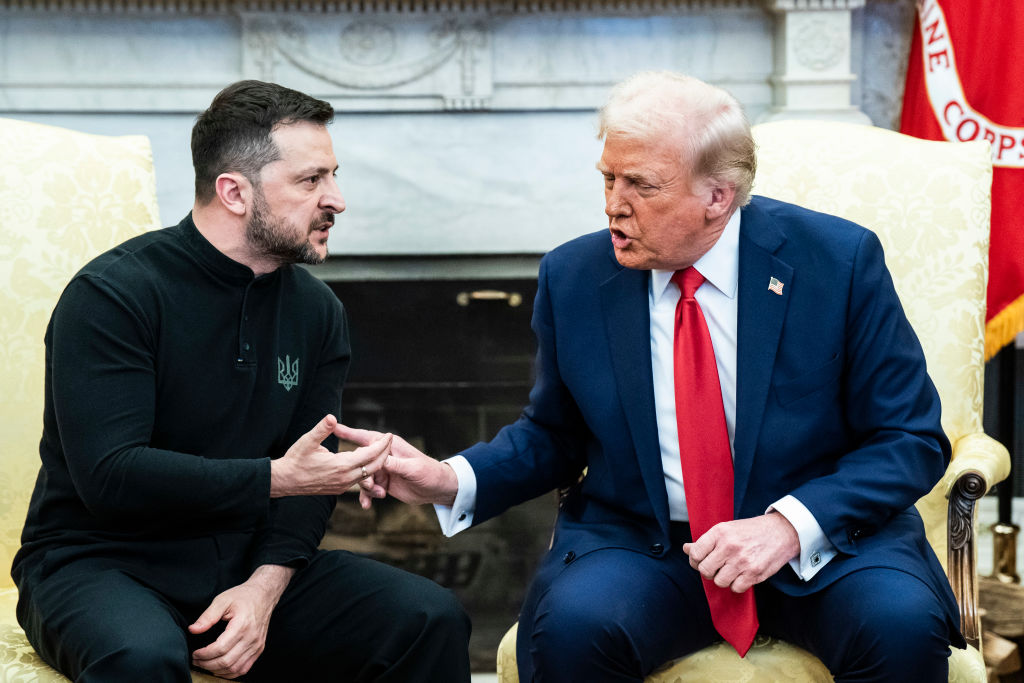
President Donald Trump meets with Ukrainian president Volodymyr Zelensky in the Oval Office at the White House on February 28, 2025, in Washington, DC. (Jabin Botsford / the Washington Post via Getty Images)
The horrific war in Ukraine is, in several senses, a lesson in imperialisms: classic versus new, formal versus informal, dumb versus smart. But it is also a general lesson in epistemologies, in the keys that we use to read the world, and their usefulness or otherwise. As such, they reveal intellectual, political, and moral bankruptcies.
The Follies of Discourse Theory in Practice
Once Russia invaded Ukraine, many seemed determined to deduce Russia’s war aims from its sentimental-ultranationalist folklore oriented toward the home front (and pleasing it) rather than examine Russia’s recent history, political economy, its position in the international arena of geopolitics and empire, and its concrete military-strategic approach to Ukraine. This choice, including by many on the Left, meant rejecting solid materialist analysis in favor of cheap discourse analysis, which happened to be in line with Western liberal state propaganda.
Those professionals who would rather look at what is being said instead of what is being done observed that Russian president Vladimir Putin had called the collapse of the Soviet Union the greatest tragedy of the twentieth century and had questioned Ukraine’s status as an independent nation-state. They concluded that Russia was obviously not only about to swallow up all of Ukraine but is eventually going to attack the rest of the post-Soviet world, including non-NATO states like Georgia, Moldova, and Kazakhstan, and even NATO ones like the Baltic states and their Russian minorities.